Hezbollah Opens Fire on Aoun, Threatens: Restricting Weapons North of Litani Means Civil War
Hezbollah threatens civil war after issuing threats against Aoun regarding the restriction of weapons north of the Litani River.
Translated by Alqyas from Al-Rai — Original source
As the region and the world “held their breath” in response to what appeared to be a countdown to igniting a fuse whose start time and location were known, but whose end time and place remained uncertain, Beirut caught its breath partially as the roar of aircraft and threats of an Israeli escalation in the region subsided in recent hours, and as the guarantor countries succeeded in securing a date and venue for a conference to support the army, scheduled for March 5 in Paris.
The reduction in the frequency of Israeli attacks was considered a “transitional” development, necessitating a focus on the highly volatile situation in the region, the potential for which could slide into a multi-front confrontation. Amid the belief that Sunday’s “fire storm” served as a “deterrent message” to “Hezbollah” against repeating the “support war” experience, the announcement of the date for the Lebanese army and internal security forces support conference gained particular significance in both form and substance:
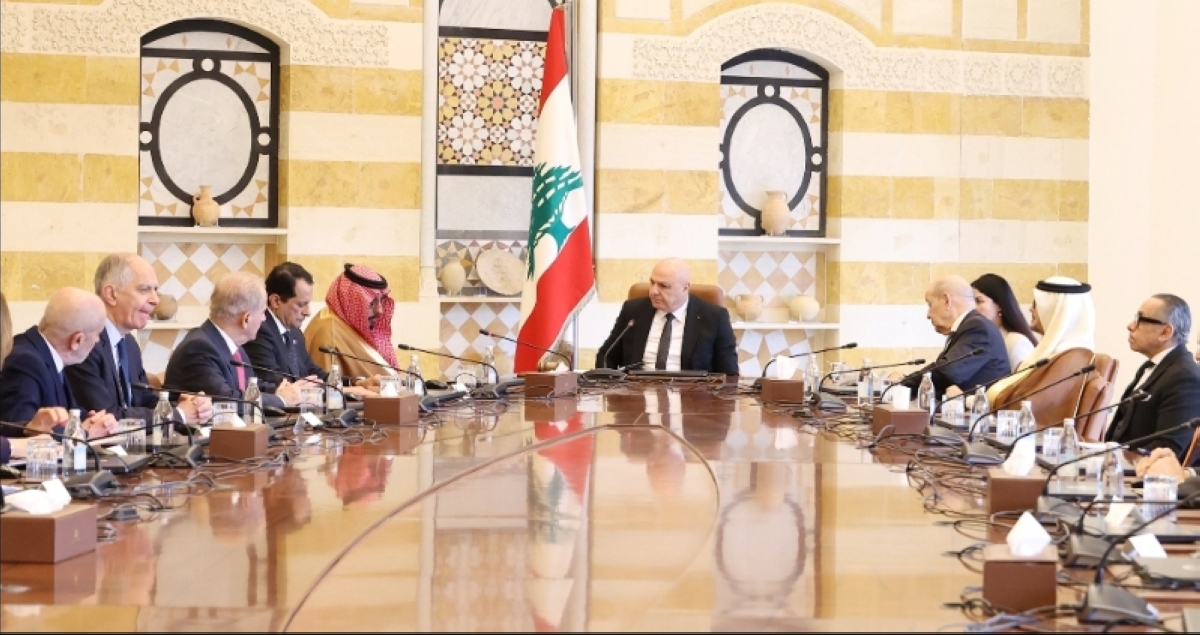
- In terms of form, this development was “announced” following a meeting chaired by President Joseph Aoun, attended by representatives of the “Group of Five” countries in Lebanon, which is accustomed to convening at the ambassadorial level. However, this time, the level of participation was enhanced to include Prince Youssef bin Farhan, the Lebanese file official at the Saudi Foreign Ministry and advisor to Minister Faisal bin Farhan (alongside Ambassador Walid Bukhari), and the French Presidential Envoy Jean-Yves Le Drian (alongside Ambassador Hervé Maurey).
Alongside them, US Ambassador to Beirut Michael Issa, who has effectively become an “extraordinary ambassador,” Qatar’s Assistant Minister of State for Foreign Affairs Mohammed bin Abdulaziz Al Thani (alongside Ambassador Saud bin Abdulrahman Al Thani), and Egyptian Ambassador Alaa Moussa also participated.
The attendees discussed, as stated in a statement issued by the Lebanese Presidency, “the ongoing preparations for the convening of a conference to support the Lebanese Army and Internal Security Forces,” with the decision made to hold this conference in Paris on March 5 next year, to be inaugurated by French President Emmanuel Macron. The attendees agreed to conduct the necessary communications to ensure the widest possible participation in the conference.
- As for the substance, setting the date for the army support conference through the diplomatic-political “Quintet” (established more than three years ago) was considered a boost for it with valuable points, making it a parallel “driving force” to the military and diplomatic-civilian “Quintet” responsible for overseeing the implementation of the ceasefire agreement (November 27, 2024) and envisioning “the day after” with its security and broader foundations. This latter group includes generals from the United States, France, Lebanon, Israel, and the United Nations, as well as two civilian representatives from Beirut and Tel Aviv.
Furthermore, the choice of the conference timing appeared to political circles as a “success, but” for Lebanon, which has taken the “ticket” for convening to keep the effectiveness of the support demonstration for the army and security forces contingent on the response of the guarantor countries, as well as those who will agree to participate after preparatory contacts in the coming weeks. This depends on what the Lebanese Army’s plan will include, which will be presented to the government in early February regarding the first phase of weapon containment north of the Litani River (between the Litani and the Awali River), and whether it will be governed by a clear time frame desired by the international community.
Some consider that behind elevating the “Declaration of Intentions” to support the army from the framework of verbal promises to specifying a date is a simulation of one of the most prominent points used by official Lebanon and the military institution as elements facilitating the “excuse” for moving north of the Litani under the title of “providing capabilities,” despite the firm rejection by “Hezbollah,” which on Wednesday considered insistence on this matter as “cutting the rope” of national peace.
The expanded “Quintet” did not limit itself on Wednesday to meeting with President Joseph Aoun; reports also indicated that a subsequent meeting was held at the Baabda Palace with its ambassadors, followed by another in the afternoon with Army Commander Major General Rodolphe Haykal, attended by Saudi Foreign Minister Prince Faisal bin Farhan and French Foreign Minister Stéphane Séjourné. Consultations took place in the morning between the envoys and the ambassadors, focusing on the possibility of holding the meeting at the Presidential Palace in a quintet format (Washington, Paris, Riyadh) instead of a trilateral one, which ultimately occurred.
Other reports stated that Ambassador Bakri hosted an iftar dinner for Prince Faisal bin Farhan, Stéphane Séjourné, and Wissam al-Hassan, during which a meeting was held to coordinate joint efforts regarding support for the army and internal security forces. It was agreed that a preparatory meeting would take place in Doha in mid-February, paving the way for the Paris conference.
Meanwhile, as Prince Faisal bin Farhan visited Prime Minister Najib Mikati on Tuesday evening upon his arrival in Beirut and met with several members of parliament, Stéphane Séjourné held two meetings with both the head of government and Parliament Speaker Nabih Berri. Berri praised “French efforts and the efforts of all countries supporting Lebanon and its army, which has fulfilled its obligations,” reiterating that “Lebanon has committed and remains committed to UN Security Council Resolution 1701 and the November agreement, and it is unacceptable for Israel to continue its aggression against Lebanon and its occupation of parts of Lebanese territory in the south.”
In parallel, Al Jazeera quoted a senior Lebanese military source as saying that “the army is assessing the situation between the Awali and Litani rivers from a logistical standpoint,” and that “based on this assessment, it will formulate a vision for the second phase of arms containment.” The source emphasized that “the military effort in the second phase must coincide with political, social, and economic efforts,” adding that “Israeli attacks and the lack of cooperation from Hezbollah’s environment could hinder the implementation of the second phase.”
It was not coincidental that Hezbollah launched its most intense attack against Aoun following the president’s televised interview on Sunday evening, in which he declared that Hezbollah’s weapons “have completed their mission and no longer serve a deterrent role, becoming a burden on its environment and on Lebanon as a whole,” urging him to “exercise reason and realism, and to correctly read the regional and international circumstances surrounding us.”
In response, Mahmoud Qammati, deputy head of the Political Council, stated via Russia Today that “statements by the President of the Republic and the Prime Minister regarding arms containment north of the Litani mean that the government is heading toward chaos, instability, and an internal situation that no one will accept.” He declared that “some insist on implementing external dictates and making concessions to Israel for free and without compensation,” calling for a “return to reason, wisdom, and Lebanese dialogue.”
Qammati stressed that “there can be no talk or dialogue about any situation north of the Litani before Israel withdraws from all Lebanese territories, liberates the south and prisoners, and stops the plundering of Lebanon. The only solution to maintaining Lebanon’s stability is reaching a defensive strategy. The greatest crime the state can commit is making a decision regarding weapons north of the Litani River, as it consolidates and accepts occupation, and moves toward arming the resistance (...) We will not accept that the army becomes an executive tool in the hands of the Israelis through the Mechanism Committee; the army will not accept that.”
