Turkish Ambassador: Turkish projects in Kuwait worth $10 billion, totaling 54 projects
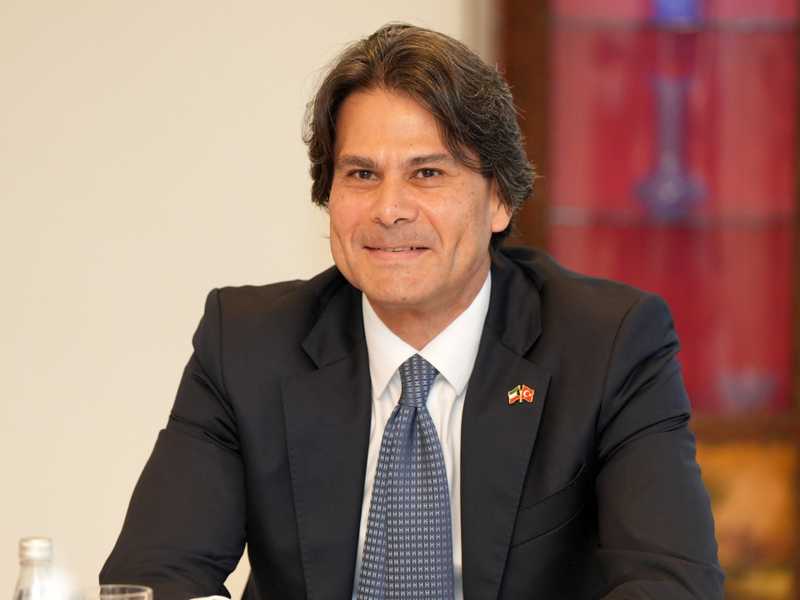
Turkish Ambassador Jan Oghuz affirmed Turkey's support for Kuwait's security and economy, pointing to 54 projects worth $10 billion and increasing defense cooperation.
Translated by Alqyas from Al-Qabas — Original source
May Al-Sukari: The Turkish Ambassador to Kuwait, Jan Oğuz, affirmed that Kuwait’s security, sovereignty, territorial integrity, stability, and prosperity are of paramount importance to Turkey. He stressed that Turkey has demonstrated its steadfast support for Kuwait during the recent regional crisis through practical and tangible steps, rather than mere political statements and positions, within the framework of the deep-rooted strategic relations between the two countries.
Speaking at a press conference with representatives of local media on the occasion of officially commencing his diplomatic duties in Kuwait, Oğuz noted that defense cooperation has become the most prominent sector in bilateral relations, amid regional developments and security challenges facing the region. He emphasized that Ankara is keen on developing its defense partnership with Kuwait and leveraging the advanced capabilities of the Turkish defense industry.
He clarified that Kuwait-Turkey relations are built on solid historical, institutional, and popular foundations, anchored in solidarity, brotherhood, and mutual understanding between the two leaderships and peoples. He pointed out that Turkey views these relations from a long-term strategic perspective and seeks to expand cooperation to include defense, economy, trade, tourism, education, health, and culture.
He added that the relationship between the two countries can be summarized in three key concepts: “commitments, capabilities, and partnerships.” He affirmed that what has been achieved so far represents a strong foundation for further development, and that the available potential requires more joint efforts to transform it into tangible projects and achievements.
In response to a question regarding Turkey’s stance on the attacks Kuwait suffered during the recent regional crisis, the Turkish Ambassador confirmed that President Recep Tayyip Erdoğan initiated contact with the Emir of Kuwait within the first 24 hours of the attacks, expressing Turkey’s full solidarity with Kuwait and its firm rejection of the attacks targeting Kuwait, as well as those targeting sister Gulf states.
He explained that communications continued at the level of the foreign and defense ministries of both countries, resulting in tangible Turkish support that has proven effective and remains ongoing. He noted that the visit of Kuwait’s Minister of Defense, Sheikh Abdullah Al-Yahya Al-Sabah, to Turkey to participate in the defense industry exhibition “SAHA EXPO” provided an additional opportunity to explore ways to enhance cooperation and develop support mechanisms.
He stressed that Turkey will continue to stand by Kuwait, based on its conviction that Kuwait’s security and stability are an integral part of regional security, and that the partnership between the two countries has proven its ability to move from political understandings to practical cooperation during crises.
Regarding the future of military cooperation, the Turkish Ambassador stated that Kuwait’s purchase of the Turkish “Bayraktar” system in 2023 marked a new beginning for a robust partnership in the defense industry sector. He pointed out that the visit of Kuwait’s Emir, Sheikh Meshal Al-Ahmad Al-Jaber Al-Sabah, to Ankara two years ago saw the signing of a government agreement on cooperation in the defense industry, which serves as the basic framework for guiding partnerships between relevant institutions and companies in both countries.
In response to a question about the possibility of signing new defense agreements similar to the arrangements Turkey is pursuing with some Gulf states, he clarified that his country is open to studying various models that could enhance security and defense cooperation, affirming that there are opportunities to be explored jointly with the Kuwaiti side. He added that the current priority is to implement existing agreements and translate them into practical programs, while remaining prepared to update previous documents or sign additional agreements if necessary.
Turkish projects. On the economic front, he revealed that the volume of Kuwaiti investments in Turkey exceeds $2 billion, while Turkish investments in Kuwait amount to approximately $70 million, with a continuous growth in the interest of Turkish companies in the Kuwaiti market. He clarified that Turkish companies have completed around 54 projects in Kuwait since 2013, with a total value of $10 billion, noting that these figures reflect the strength of Turkey’s presence in the contracting and infrastructure sectors, as well as the Kuwaiti market’s confidence in Turkish expertise. He added that major Turkish construction companies are present in Kuwait and are participating in the implementation of important projects, pointing out that the Kuwait International Airport project, implemented by Limak, represents one of the most prominent models of economic cooperation between the two countries. He expressed his hope that the project would be completed and opened soon, considering it a significant milestone that embodies the vast potential of Kuwaiti-Turkish commercial and investment partnerships. He noted that the volume of trade between the two countries has surpassed $1 billion, but this level does not reflect the true potential of the two economies, emphasizing both sides’ aspiration to raise trade volume to $5 billion in the coming period. Regarding complaints from Kuwaiti investors and concerns related to certain incidents, he stressed that Turkish authorities deal seriously with any incident that could affect Kuwaitis’ confidence in the Turkish economy. He stated that individual incidents are possible in various countries around the world, but the most important aspect lies in the swift response to complaints and the remediation of damages, affirming that Turkey does not allow individual actions to affect the strong economic relations between the two countries.
