New book by Faiq Al-Sheikh Ali: Sectarian rule in Iraq
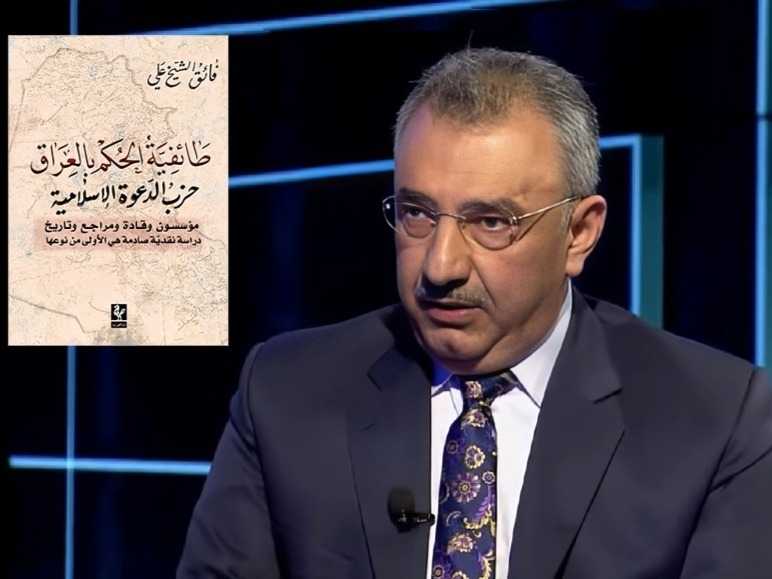
Faiq Al-Sheikh Ali's book analyzes Mehdi Al-Hakim's memoirs and discusses narratives of founding the Da'wa Party and relations with the British royal system
Translated by Alqyas from Al-Qabas — Original source
The fourth episode opens this series with the book “The Sectarian Rule in Iraq: The Islamic Da’wa Party… Founders, Leaders, Maraji’, and History,” by writer Faiq al-Sheikh Ali. This new book is based on a reading of the history of the Islamic Da’wa Party through the memoirs of its founders, their testimonies, and texts written or relayed by Iraqi Islamic movement figures at various stages. The book focuses particularly on the founding period and the disagreements that accompanied it regarding individuals, dates, and ideas, attempting to present the founders’ narratives and compare them with later accounts. The author relies substantially on the testimonies of Talib al-Rifai and Mahdi al-Hakim, considering them among the earliest founders, while also pausing at Muhammad Baqir al-Sadr as the third founder, according to the narrative the book adopts. From the first pages, the author declares that the book does not seek to be a hagiographic biography of the Da’wa Party nor a traditional academic study, but rather a critical reading of the texts themselves, allowing their authors to speak about their experiences, followed by an analysis of their testimonies, contradictions, and differences. Thus, the book’s importance, in the author’s view, lies in its attempt to place multiple narratives before the reader, leaving facts and details to reveal the differences among them. We in Al-Qabas have chosen to publish excerpts from the book, which certainly do not replace reading it in full...
Mahdi al-Hakim’s Memoirs on the Table of Dissection: Tehran vs. Baghdad: Which Enemy Is More Dangerous?
Not all memoirs are innocent memories. Some are deferred trials written by their authors for themselves, their opponents, and for a history that cannot respond. From this perspective, Iraqi writer Faiq al-Sheikh reads the memoirs of Sayyid Mahdi al-Hakim, son of the late Marja’ Mohsen al-Hakim and the second founder of the Islamic Da’wa Party, in his book. He grasps the text by its threads and asks: Where is the documentation? Where are the details? Why does the narrative contradict itself? In this episode and the next, we present a summary of what was contained in the material, along with its author’s arguments. These are sharp opinions that retain their author’s responsibility.
The Islamic March
The author begins by comparing Mahdi al-Hakim’s decade in the two countries. In Iraq, al-Hakim says, the Islamic march faced an “ideology” that was present: socialist leftism. In Iran, however, the situation was different, because the Shah did not have a defined project, and the coming danger was from an enemy possessing a creed greater than the danger from an enemy without a creed.
Faiq al-Sheikh believes the picture is completely inverted. In his reading, the Shah ruled with a liberal program based on market openness, personal freedoms, solid universities, industry, agriculture, and construction, leaving behind a stable state with a sound economy, a strong army, and robust security. His creed was to preserve Iran as a unified country, as he inherited it from his father. In contrast, no genuine ideology governed Iraq between 1958 and 1968, neither under Abdul Karim Qasim nor under the Aref brothers. The Ba’ath Party, which came to power in 1968, had just assumed authority and had not yet spread among the masses. The author cites Joudat al-Qazwini’s description of the Aref period as politically calm, but the clamor of the Islamic movement and al-Hakim’s marja’iyya left no room for participation in power, as the opposition was at its strongest, with the call to overthrow the regime as its paramount obsession.
He then highlights contradictions he sees as glaring: a marja’iyya that supports a coup against the national regime in the country where it resides, while fearing a coup in another country out of concern for its division, even though Iraq had not been divided after the 1958 coup.
Demands Without Titles
The memoirs relate that it was customary for the Marja’ to receive the King of Iraq in the courtyard of Imam Ali. Al-Hakim went out to receive the young King Faisal II, his uncle Regent ‘Abd al-Ilah, and Nuri al-Said in 1946, and presented in that meeting “general requests concerning the people.”
After three years, he was refused entry despite the intervention of officials, and he claimed the issue was not serious because the demands had not been implemented. The writer asks: What are these demands? Neither the Marja’, nor its representatives, nor his sons, nor the authorities have informed us of them. If they were popular demands, they would have become a story passed down through generations, repeated from pulpits, and recorded in books and newspapers. All that is mentioned in the memoirs is that the court began sending doctors to treat the Marjas when they fell ill, and Al-Hakim considers this an advancement in the movement of the Marji’iyya! As for published books, including Hani Al-Fakiaki’s “Nests of Defeat,” the writer states that they are filled with Al-Hakim’s personal demands rather than general ones. The writer cites an example from the memoirs themselves regarding the closed mosque. During the June 1967 war, Abdul Rahman Arif sent a letter to Al-Hakim requesting a statement urging Muslims to shoulder their responsibilities. The reply came accompanied by a question: Why is the Ismail al-Sadr Mosque in Kadhimiya still closed? This is the mosque that was forcibly shut down following a clash between al-Sadr’s group and Sheikh Mehdi Al-Khalisi’s group during the era of Abdul Salam Arif. Another example: When Ahmed Hassan al-Bakr, Hardan al-Tikriti, and Fadhil Hussein contacted Mehdi Al-Hakim before 1968 and asked what they wanted, he replied that they wanted nothing but a government that Iraqis feel is their own and would defend. The writer argues that what Al-Hakim calls “demands” were mostly matters concerning his group, not the people. He continues with a contemporary example: When ISIS occupied half of Iraq in 2014, many waited for a fatwa on defensive jihad from the Supreme Marja’, Ali al-Sistani, before rising up, even though custom, honor, and patriotism dictate fighting the invader without waiting for a cleric’s opinion.
What lies behind July 14? Mehdi Al-Hakim claims that the background of the 1958 coup was “100% British,” citing Britain’s occupation of Jordan to prevent it from moving as evidence. He wonders why the National Government did not describe the clients linked to the dominant state, which was Britain, not America. Faqih al-Sheikh responds with a series of questions: How could Britain sacrifice its clients, the ruling family and Nuri al-Said, and leave them to be dragged through the streets after four decades of service? How could the coup be British when Iraq had left the Sterling Area, negotiated with oil companies, imprisoned men of the monarchy, and tried them publicly in the Al-Mahdawi court, with many fleeing abroad, dismantled the feudal system, and distributed its lands? How could Iran’s Shah, a British ally, oppose Qasim with all his might, while the British themselves worked with the 1963 Ba’athists to overthrow Qasim? As for Jordan, it believes its government requested urgent British military support out of fear that the coup would spread to it, and that the Jordanian Army was led by the British General Glubb Pasha from 1939 to 1956; so whose occupation is this? He calculates that Al-Hakim’s questioning about liquidating clients is either based on factual errors or an attempt to confuse people’s memory and history, noting that Iraq exited the British sphere after the coup and joined the Eastern, not Western, bloc.
The Tale of Unveiling in Najaf: According to the memoirs, the first public mass movement against the post-July 14 conditions originated from Al-Hakim’s house, due to a “secret call” to abolish the hijab. He recounts schoolgirls wearing abayas and displaying vanity, and a gathering of 150 to 200 people after censorship prevented Sheikh Muhammad Amin Zain al-Din from speaking on chastity. The writer is a Najaf native for generations and states that he knows of no such call in Najaf’s memory, and that the city did not witness a single instance of vanity, even under the most secular regimes. Meanwhile, Iraq experienced unveiling and mixing since the 1920s, as evidenced by archival photos from the 1930s, 1940s, and 1950s, and poets fought these battles early on, with Al-Zahawi at the forefront. He asks: Where was the protest throughout all those decades? And why did it suddenly erupt against Qasim’s government?
In his view, the story is an excuse to justify the hostility of the Marja’iyya (religious authority) toward the Communists. Mehdi al-Hakim cites Saif to justify the fatwa declaring “Communism is disbelief and atheism.” He argues that Communist leaders include elements linked to Britain, citing Saif’s memoirs, which were published during the era of Nuri al-Said, after which Fahd and Hussein al-Shabibi were executed. The author, known as “the man,” is Saif’s owner, born in al-Amara in 1917, a teacher who joined the party in 1941. Hanna Batatu claims he betrayed the party. Al-Qazwini adds, along with testimonies from members of the Mandaean community, that he ended up working as an informant for successive security agencies. How, then, can he be considered a credible witness against others? Returning to his book “For History, the Tongue,” the author clarifies that Saif’s confessions concerned the party’s stance on the decision to partition Palestine and its endorsement by the Soviet Union—a stance Saif himself called a deviation. If this was collaboration, it was with Moscow, not London.
**Taxes and Markets**
Mehdi al-Hakim admits, albeit belatedly, that Abdul Karim Qasim lacked sectarian, and even religious, sensitivity; he was simply “Iraqi,” neither Shia nor Sunni. The author asks: So why all this hostility? He answers by referring to the memoirs themselves. Qasim abolished feudalism, cutting off the Marja’iyya’s income from religious dues and taxes (khums) that tribal sheikhs had previously paid in large sums. Then came Abdul Salam Arif’s socialism, which Hakim describes on page 85 as a blow to the “Shia market” after the tribal dimension had been dismantled, thereby dealing a further blow to the religious authority. Thus, the author concludes that the story is primarily about money, not religion, rituals, or sacred values.
**A President Who Never Visited the Marja’**
Under the heading “Mr. Hakim Refuses to Allow Abdul Salam to Visit Him,” Mehdi al-Hakim recounts events that, according to the author, contradict the title. The Marja’iyya attempted, through its followers, to arrange a presidential visit, pleading with several officers and Shia officials close to Arif, but the president refused. The author narrates something Iraqi listeners had never heard before, citing Sheikh Ali Kashif al-Ghita, Arif’s friend: an angry response that questioned the Marja’iyya’s sincerity. Arif had visited Najaf in 1964 but did not visit Hakim or inquire about him, and he supported Kashif al-Ghita’s Marja’iyya in opposition to Hakim’s.
**The Weakest Rule… and the Best Period**
Mehdi al-Hakim describes Abdul Rahman Arif’s reign as the weakest period in Iraq’s history, yet “the best period” for the Islamic movement, as the barrier of fear disappeared and opportunities improved in Baghdad. Hakim had reproached the people themselves: “Half a million Shias followed the Marja’iyya and expressed their displeasure with the authorities. Where were they when the confrontation intensified?” The author then asks: With a weak ruler, a strong party, field leadership, and a Marja’iyya followed by half a million people, why did the call not seize power? Does it wait for the regime’s strongest moments? He answers with several points: There was no intense confrontation between the Marja’iyya and the authorities, only protests, incitement to riot, messages, and threats. Crowds do not signify absolute loyalty, and the Marja’iyya itself is not adept at politics.
**The Oil Minister and Sectarian Eyes**
Hakim recounts telling President Abdul Rahman Arif that Iraq’s oil was being bartered, and that the person negotiating it was “either an Ismaili or an Alawite,” questioning by what right he spoke and sold. He did not name the minister, but the author suspects it was Abdul Starr al-Hussein, who held the oil ministry post from May 1967 to July 1968. He pauses at the irony: “You complain about the authorities’ sectarianism against you, yet how can you speak of others with such contempt? Whether Ismaili or Alawite, the minister was Shia like you, and Prime Minister Naji Talib was also Shia.” He then wonders: What business does a cleric residing in Najaf have with oil policies and government decisions? Here, he sees hostility toward patriotic Shias who reached power through their own efforts and qualifications.
**University of Kufa…**
On page 106, Mehdi al-Hakim recounts that he protested to Abdul Salam Arif against the closure of the University of Kufa, which had been ordered by his father. He notes that none of the university’s staff were willing to accompany him out of fear, so he was accompanied only by Salman al-Tamimi and Sheikh Musa al-Ya’qubi. The president replied that Hardan had carried out the decision. The same encounter is recounted again on page 126, but this time the official mentioned is Saleh Mahdi Amash. The author considers this contradiction confusing and damaging to the credibility of the other accounts, and sees the fear among the elite who had contributed to building the university, as evidenced by the president’s question, as an indicator of everyone’s terror of the authorities. He adds that the new nationalist regime sought to unify education under state supervision, and that although he criticizes the coercion involved, he believes the closure was in the interest of Iraqis compared to the current lack of regulation in education.
Students of the Hawza and soldiers: In a second meeting with Arif, al-Hakim protested against the conscription law because it did not exempt students of religious sciences. The author explains that Shia maraji’ had been accustomed, since the Ottoman era, to submitting annual lists of Iraqi Arab students’ names to secure their exemption. The authorities would agree, either to buy loyalty or out of respect for the marja’s status; they might delay or extort, and the marja might include names unrelated to Hawza studies out of courtesy to close associates or donors. He observes that among the thousands of exempted individuals, no prominent marja or respected author emerged, and that the Shia soldier fighting in the war would wonder about the benefit of exempted individuals who enjoyed living in underground bunkers with air conditioning and heating, while their country was fighting Iran.
