Minister Al-Amer: Culture is a fundamental pillar for building the modern state
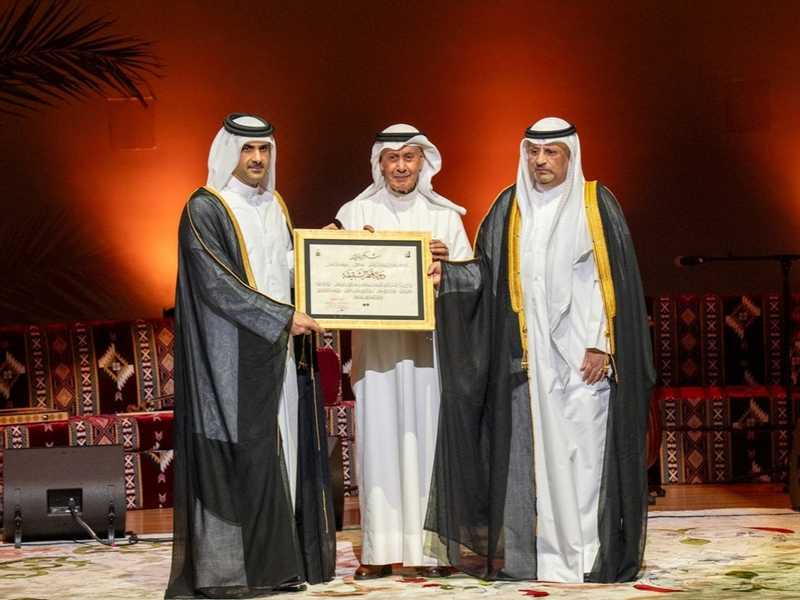
Minister of State for Communications and Information Technology Affairs Omar Al-Amer emphasized that culture is a fundamental pillar for building the modern state and not a luxury, during the opening of the 49th Kuwait International Book Fair, praising the leadership's patronage and supporting cultural cooperation with
Translated by Alqyas from Al-Qabas — Original source
The Minister of State for Communications and Information Technology, the Acting Minister of Information and Culture, and the Chairman of the National Council for Culture, Arts and Letters, Omar Al-Omar, affirmed on Thursday that culture is a fundamental pillar in building a modern state, not an intellectual luxury. He highlighted the importance of books in providing younger generations with a deeper understanding of their history, language, and values, as well as greater capacity to shape the future.
This statement was made in a speech delivered by Al-Omar, representing His Highness the Prime Minister, Sheikh Ahmad Abdullah Al-Ahmad Al-Sabah, during the official opening ceremony of the 49th edition of the Kuwait International Book Fair, held on Thursday evening at the Sheikh Jaber Al-Ahmad Cultural Centre.
Minister Al-Omar stated that the high patronage of culture by His Highness the Amir of Kuwait, Sheikh Meshal Al-Ahmad Al-Jaber Al-Sabah, and His Highness the Crown Prince, Sheikh Sabah Al-Khaled Al-Hamad Al-Sabah, reflects the nation’s commitment to nurturing and supporting cultural development.
He welcomed the fair’s guests, including Qatar’s Minister of Culture, Sheikh Abdulrahman bin Hamad Al Thani, and described Qatar as a sister country and the guest of honor for this edition. He emphasized that its presence symbolizes a meeting of people bound by close ties and a shared memory forged by life at sea, pearl diving, and trade, and solidified through milestones of cooperation.
He pointed out that among the most prominent of these milestones are the 1978 Agreement on Economic, Educational, and Media Cooperation, the 2016 Agreement on Cultural and Artistic Cooperation, and the collaboration between the National Council for Culture, Arts and Letters and the Public Establishment for the Cultural Quarter (Katara), under the gracious patronage of the leadership of both brotherly countries.
Al-Omar added that the fair’s slogan, “We Read and We Rise,” reaffirms the belief that culture is not an intellectual luxury but a foundational pillar in building a modern state, and that books empower generations with a deeper knowledge of their heritage, language, and values, enhancing their ability to shape the future.
In this context, Al-Omar noted the honoring of writer and poet Dr. Khalifa Al-Waqian, who was selected as the fair’s personality of the year in recognition of his career, which has enriched Kuwait’s literary and intellectual landscape since the 1960s. He highlighted that Al-Waqian is one of the founders of the National Council for Culture, Arts and Letters, formerly served as Secretary-General of the Writers’ Association, authored the book “Culture in Kuwait,” and has received the State Appreciation Award and the Jerusalem Literary Award.
He expressed gratitude to the National Council for Culture, Arts and Letters and the organizers of the fair, praising their role in supporting cultural activities and nurturing national talents. He also welcomed Kuwait’s guests and participating publishing houses from 34 countries.
For his part, writer and poet Dr. Khalifa Al-Waqian affirmed that culture has contributed to documenting Kuwait’s history and civilizational presence, enhancing its status through the scientific, literary, and cultural contributions of its sons, both domestically and internationally. He expressed his gratitude to those who conceived and implemented the idea of honoring those engaged in the cultural field, considering culture one of the tools of soft power.
Al-Waqian stated that Kuwaitis have given culture special attention wherever they reside, and in return, culture has endowed them with its enchanting and penetrating strength, which transcends borders and carries their legacy and characteristics based on openness and enlightenment.
He added that culture has played a key role in documenting Kuwait’s history and cultural presence since the 17th century, citing several scholars whose manuscripts and works have survived, including Sheikh Musaed bin Ahmad bin Muaid, who copied the Muwatta of Imam Malik in 1682 and added some annotations; Sheikh Abdullah bin Ali bin Bahar, who copied the legal treatise on Maliki jurisprudence in 1726; and Uthman bin Sand, born in Failaka Island in 1766, whose works amounted to approximately 50 books and treatises on language, jurisprudence, history, and poetry.
He clarified that these evidences confirm that cultural history has documented the presence of Kuwait and the efforts of its scholars before such presence was documented by political sources and facts. He pointed out that the founding fathers bequeathed to subsequent generations a solid cultural foundation through the establishment of cultural civil society institutions and forums, including associations, clubs, public libraries, newspapers, and printing presses within Kuwait and in countries where they resided for commercial, scientific, or da’wah purposes, such as India, Aden, Indonesia, Basra, Cairo, and Damascus. Al-Waqian also touched upon the contributions of Kuwaitis to the establishment of journalism abroad, highlighting the role of the first generation of Kuwaiti journalists and scholars in Basra’s press. Among them was Mr. Abdulwahab Al-Tabatabai, who founded the newspaper “Al-Dustour” in 1912, followed by “Sadiq Al-Dustour,” and Mr. Hashim Al-Rifai, who issued “Al-Basra Al-Yawmiya” in February 1943. He also noted Jasim Hamad Al-Saqer’s contribution to establishing a publishing and printing house that issued the newspaper “Al-Nas.” Furthermore, he highlighted Sheikh Abdulaziz Al-Rasheed’s role in publishing two magazines in Indonesia in the 1930s, as well as “Al-Kuwait” magazine, which he issued in 1928. Additionally, Mr. Abdulaziz Hussein oversaw the publication of “Al-Ba’atha” magazine in Cairo in 1946, and Mr. Abdullah Al-Hatim published “Al-Fakahah” magazine in Damascus in 1954.
He explained that interest in culture continued through the 1960s, 1970s, and 1980s, and the decades that followed, through two main pillars: the first being civil society efforts, represented by private cultural institutions such as the Abdulaziz Saud Al-Babtain Foundation for Culture and Arts, Suad Al-Sabah House for Culture and Creativity, and public benefit associations; and the second being official efforts, represented by the Ministry of Information and later the National Council for Culture, Arts and Letters.
Speaking about the Kuwait International Book Fair, Al-Waqian described its launch nearly half a century ago as an important achievement and a beautiful endeavor. He noted that the initiative initially faced fears of potential failure and difficulty in attracting well-known Arab publishing houses without assurance of public interest. He clarified that the success of the first edition exceeded expectations, attributing this largely to the fair’s director at the time, Mr. Yahya Al-Rabian, for his efforts in convincing Arab publishers to participate, as well as his effective management of the event. He also praised the role of the National Council’s leadership at the time, Mr. Abdulaziz Hussein and Mr. Ahmad Al-Adwani, in encouraging and supporting the initiative. He added that the fair’s administration was subsequently transferred to a group of young people who believed in the importance of books as the primary vessel of knowledge. The success of the initiative encouraged many public benefit associations to organize similar exhibitions.
Al-Waqian emphasized the importance of preserving soft power, embodied by culture, and not compromising the cultural heritage left by the founding fathers, in appreciation of their efforts in building the cultural movement and consolidating its presence in society.
The opening ceremony featured the honoring of Minister Al-Omar, representing Qatar as the guest of honor, alongside the figure of the current edition of the fair, Dr. Khalifa Al-Waqian. This was followed by a Kuwaiti-Qatari traditional music session titled “A Voice That Unites Us,” featuring Qatari artist Mansour Al-Mahendy and Kuwaiti artist Salman Al-Amari, in celebration of Qatar as the guest of honor at the 49th Kuwait International Book Fair.
