Tension Index Escalates in the Region
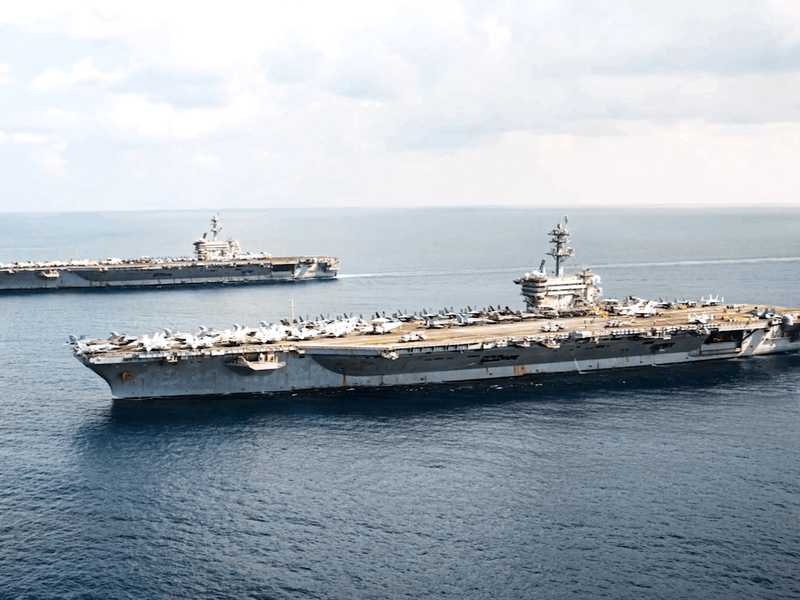
Tensions escalate in the Gulf with Iranian attacks on US targets in Bahrain and intelligence plans to threaten US officials.
Translated by Alqyas from Al-Qabas — Original source
Tensions are escalating in the region amid continued military and political escalation between Washington and Tehran, as negotiations stall, maritime attacks intensify, and Iran renews its aggression against Bahrain. This comes alongside a U.S. deployment of three aircraft carriers and intelligence reports suggesting potential Iranian plans to target officials in the Trump administration. Meanwhile, Qatar announced on Tuesday that it held a meeting with Iranian officials to discuss proposed measures and bridge differences. Qatar called on “all parties” to avoid further escalation after Iran’s Revolutionary Guard declared, for the third time in less than a week, that it had targeted a U.S. radar system in Bahrain.
Majed Al-Ansari, spokesperson for Qatar’s Ministry of Foreign Affairs, said at a press conference in Doha: “We call on all parties to exercise restraint during this period and avoid any escalation that could undermine negotiation efforts,” warning of an “extremely serious” threat to efforts aimed at ending the war.
U.S. President Donald Trump has kept his intentions toward Iran ambiguous, repeatedly insisting that the war has been won and that he no longer considers it necessary to reach an agreement with the Islamic Republic, while also leaving open the possibility of renewed attacks. In an interview with Fox News on Tuesday, U.S. Vice President J.D. Vance affirmed that the U.S. administration would not allow the war on Iran to become a two-year commitment, but he reiterated the White House’s justification for the war, insisting that Iran’s nuclear program remains a threat to the United States and emphasizing the need to dismantle it. Vance stressed that there is “no difference” between him, President Trump, or any other senior administration member regarding the war on Iran, adding that Trump is considering increasing military and diplomatic pressure on Iran and is currently reviewing this option, alongside other possibilities, including declaring an end to military operations.
Aggression against Bahrain
In a field escalation, Iran is attempting to strike U.S. interests and infrastructure in the Gulf region, claiming it hit a U.S. radar system in Bahrain in response to what it described as “repeated violations of Iranian airspace by U.S. drones.” Bahraini authorities had warned residents to seek shelter, and the General Command of the Bahrain Defense Force announced that its air defense systems intercepted and destroyed several Iranian aerial attacks targeting the kingdom before they reached their objectives, confirming the readiness of its forces to counter any aggression. Officials stated that two other Iranian attacks launched since Friday were also intercepted.
For its part, U.S. Central Command announced that air defense systems thwarted the third attack claimed by Iran, which targeted a U.S. radar facility in Bahrain. CENTCOM stated in a press release: “The Revolutionary Guard claimed that its drones struck a U.S. military radar system at a base in Bahrain early yesterday. This is incorrect.” It acknowledged that Iran launched the attack on Tuesday, stating: “Several Iranian attack drones launched by the Revolutionary Guard toward Bahrain were intercepted, causing no damage to U.S. equipment or injury to U.S. personnel.”
Strikes on Qeshm
In response, Fars News Agency reported hearing explosions and seeing smoke rising over the sky of Qeshm Island in southern Iran on Tuesday afternoon. Iranian media stated that the explosion resulted from a U.S. airstrike targeting the Nariman air defense site on Qeshm Island, which holds strategic importance due to its location in the Strait of Hormuz opposite Iran’s southern coast, near the city of Bandar Abbas, on the northern side of the strait.
Iran’s state news agency, ISNA, quoted the Iranian military as claiming that air defenses had destroyed an American Lockheed drone. Iran also alleged that a third oil tanker caught fire near the strait after colliding with a naval mine. The Iranian regime’s daily claims about ships striking mines have not been confirmed.
These Iranian provocations in the region add to intelligence warnings that Tehran is seeking to carry out attacks in the United States and Europe against American figures and interests, as well as those of the “occupation entity.” In this context, CNN cited seven U.S. officials who said intelligence indicates Iran is considering using dirty bombs or chemical weapons to target senior officials in President Trump’s administration in Washington, D.C. The officials stated that U.S. intelligence agencies had observed what they described as potential Iranian plans to carry out attacks in Washington. They reported that intelligence-monitored communications suggest Iran has stockpiled materials within the United States that could be used to manufacture bombs. Acknowledging disagreements over the reliability of the information, they clarified that the plans “do not currently indicate an imminent attack, but rather reflect Iran’s efforts to study and explore potential options for carrying out attacks.” The officials added that Washington is monitoring other intelligence suggesting, in their view, the possibility that Iran might use chemical weapons against U.S. forces deployed in the Middle East.
When asked about whether Washington faces any imminent threat from Iran, President Trump, who arrived in the Philippines yesterday and is scheduled to visit China on Thursday, responded: “Well, if there is, they will pay a price that no country has ever paid before.” Trump said, “I hope it’s not the case... We are taking it very seriously because they (the Iranians) are crazy.” The president added, “That is precisely why they cannot possess a nuclear weapon...”
The term “dirty bomb” refers to a weapon that disperses radioactive material in the vicinity of an explosion, potentially contaminating the surrounding area. Iran rejected CNN’s report, describing it as baseless. Ismail Baghaei, spokesperson for the Iranian Foreign Ministry, posted on X: “Those who have initiated aggression against Iran are now seeking to pave the media ground for their malicious plots by fabricating and spreading baseless claims, including the recent allegations published by The New York Times and the fabricated media narrative surrounding the alleged ‘dirty bomb’ promoted by CNN.” A spokesperson for Iran’s Permanent Mission to the United Nations also denied these allegations, stating in a press release that the accusations are baseless and emphasizing that Iran considers the use of chemical weapons “illegal under all circumstances.”
