3 US aircraft carriers in the region
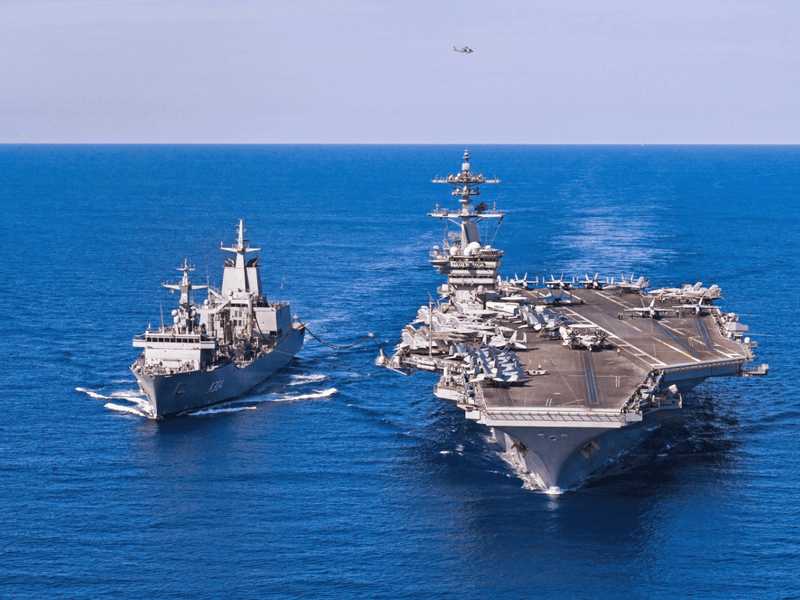
Arrival of a new US aircraft carrier with preparations for the Trump and Xi Jinping summit
Translated by Alqyas from Al-Qabas — Original source
As attention turns to China, which will host an unprecedented summit bringing together Presidents Xi Jinping, Donald Trump, and Vladimir Putin to discuss global peace, tensions in the Middle East persist as the United States continues to bolster its military buildup near Iran. The arrival of the aircraft carrier USS Roosevelt on Monday marks its third deployment in the region, amid reports that it is carrying a Marine amphibious group and thousands of troops. This marks a notable shift from reliance on air strikes toward acquiring capabilities for land and sea operations, raising questions about whether Washington is preparing for a broad military escalation or seeking to force Tehran into making concessions.
The Roosevelt and its strike group have joined the strike groups of the aircraft carriers USS George Washington and USS George H.W. Bush. According to a previous Axios report, the Makin Island amphibious group and approximately 9,000 military personnel, including 2,000 U.S. Marines, are accompanying the USS Theodore Roosevelt. This brings the number of U.S. sailors and Marines in the region to more than 20,000, while total U.S. forces approach 60,000, supported by three aircraft carriers, two amphibious groups, and hundreds of aircraft, in what is described as the largest naval buildup since the 2003 invasion of Iraq.
Axios reported that these reinforcements give Washington the ability to conduct landings and operations to control strategically important Iranian islands, notably Kish Island, through which about 90% of Iranian oil passes, and Larak Island, which holds a pivotal position in navigation through the Strait of Hormuz. Experts believe this deployment may reflect Washington’s readiness to resume large-scale strikes against Iran, after recent confrontations over the past weeks in the sea and along Iran’s southern coast focused on the Strait of Hormuz.
In parallel with ongoing diplomatic efforts to reach an agreement that would prevent a wider military escalation in the region, observers note that U.S. President Donald Trump may use the coming weeks, which precede the convening of the new Congress in January, to employ military force as leverage to push Iran toward signing a nuclear deal and ensuring the reopening of the Strait of Hormuz to navigation. However, any attack is ruled out before the unprecedented trilateral summit in China.
Chinese Foreign Ministry spokesperson Mao Ning stated that the three presidents, scheduled to meet on Thursday in Shenzhen on the sidelines of the Asia-Pacific Economic Cooperation (APEC) Leaders’ Summit, will hold “an in-depth dialogue on safeguarding global peace and enhancing strategic stability in relations among major powers,” considering the meeting to be of “historical significance.”
Trump intends to raise the issue of war with Iran alongside the war in Ukraine, and to hold historic trilateral nuclear talks with Russia and China aimed at reducing nuclear arsenals. In this context, the U.S. President said yesterday before departing for Manila, the first stop on his Asian tour, that he might meet North Korean leader Kim Jong Un. He told reporters: “We’re going on a big tour... We’re heading to the Philippines to hold meetings on economic issues and many other matters... Then we’re heading to China where we’ll meet President Xi and President Putin, and perhaps I’ll meet Kim Jong Un,” adding, “We have an opportunity to accomplish a lot.”
On the Iranian issue, Trump said: “Our position regarding Iran is very good, but we will discuss this file a little... We will also touch on my two favorite topics: Ukraine.”
Trump had posted on his Truth Social platform, stating that Iran had launched between 8,000 and 9,000 suicide drones and approximately 2,000 ballistic missiles since the beginning of the “Epic Fury” operation, but only three missiles and two drones managed to breach defense systems, resulting in the deaths of American soldiers. Trump affirmed: “In other words, 99.99% of Iran’s missiles and drones were shot down, or they did not result in the deaths of American soldiers, even if they managed to breach defense systems.” Trump also described the performance of the U.S. Central Command (CENTCOM) defense system as historic in terms of effectiveness, claiming that no other country in the world has the capability to achieve similar performance.
Meanwhile, Tehran is maneuvering with its conditions, particularly regarding the nuclear file, and continuing its provocations in the Strait of Hormuz and the Persian Gulf. At a time when Iranian Foreign Minister Abbas Araghchi accused the United States of choosing a path far from diplomacy, considering that it preferred aggression, threats, assassinations, economic pressure, and sanctions over peaceful settlement, he claimed that a regional bloc comprising 10 countries endorsed Tehran’s proposed plan to reopen the Strait of Hormuz under an initial ceasefire with the United States.
For his part, Iranian Deputy Foreign Minister Kazem Gharibabadi said that Tehran would not allow UN inspectors to visit its damaged nuclear facilities until the war ends permanently and the United States meets its conditions. Gharibabadi claimed that the Atomic Agency’s request to inspect damaged facilities “likely aims to assess the effectiveness of American weapons.” He added that the United States may wish to exploit diplomacy to buy time and launch a new attack, and that “America cannot be trusted at the negotiating table.”
Meanwhile, the Islamic Revolutionary Guard Corps continued targeting ships in the Strait of Hormuz, warning yesterday that the southern passage of the strait is mined, threatening that ships complying with American instructions “will burn.” The IRGC claimed explosions occurred on two oil tankers due to collisions with mines while they were transiting south of the Strait of Hormuz, under the protection of American fighter jets. It also claimed, for the third consecutive day, the downing of an American MQ-170 drone through electronic warfare and its takeover in Qeshm Island.
In Tel Aviv, the smaller ministerial security cabinet (the Cabinet), which convened under Netanyahu’s chairmanship for more than five hours on Sunday night, heard from Mossad head Romen Gofman, who had just returned from a visit to the United States during which he held talks with CIA Director John Ratcliffe and Presidential Envoy Steve Witkoff, focusing on Iran. Gofman also held a separate meeting with Netanyahu after the “Cabinet” session, providing him with a comprehensive briefing on his meetings in Washington and the results he reached.
