Gold Outside the Law: Who Are the 'Dehaba' in Egypt?
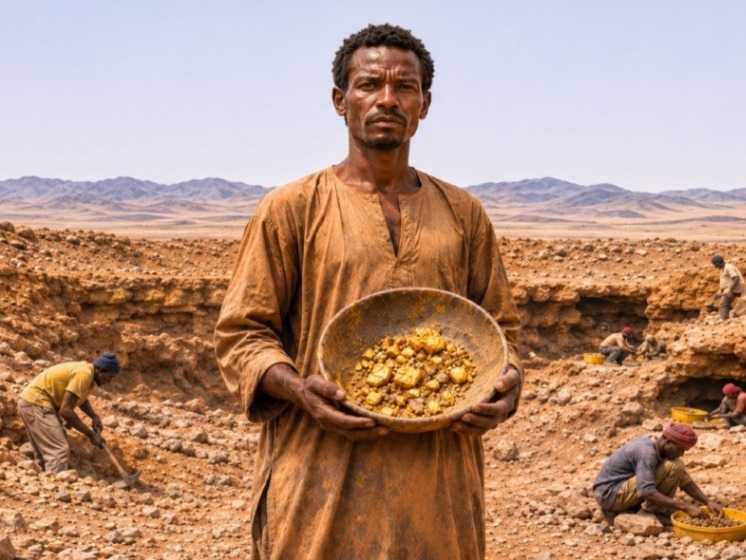
Egypt pursues illegal mining and regulates it through the South Shield initiative.
Translated by Alqyas from Al-Qabas — Original source
In the heart of Egypt’s southern desert, near the border with Sudan, hundreds known as “Al-Dahaba” are undertaking a perilous quest for gold. These individuals, who hold Egyptian, Sudanese, and some other African nationalities, operate outside legal frameworks and without licenses, navigating rugged terrain using metal detectors, rock-breaking tools, and crushers.
The search for gold has become an activity attracting those seeking livelihoods, particularly as the continuous rise in the price of the precious metal has made finding even small quantities a tempting opportunity for financial gain. Some “Al-Dahaba” rely on electronic devices to detect metals and identify areas likely to contain gold, while others resort to crushing ore-bearing rocks, grinding them, and processing the material to extract the valuable metal particles.
Conducting this activity without licenses places prospectors at legal risk. One of the most significant challenges is that the extracted gold bypasses official channels. Selling and trading it outside the purview of relevant authorities makes it difficult to trace its source and determine actual production volumes, while also facilitating cross-border smuggling. Investigations have documented accounts of extracted gold, as well as ore-bearing rocks, being transported out of Egypt before processing and metal extraction, thereby depriving the state of a portion of its mineral wealth.
The repercussions of this phenomenon extend beyond smuggling. Some illegal mining sites are linked to cross-border networks, and the impact has spread to mining companies operating under official licenses for exploration and extraction, threatening their investments and raising questions about the sector’s ability to function in an environment lacking clear legal rules.
In response to these activities, Egyptian authorities launched the “Southern Shield” operation, aimed at tracking illegal mining operations, combating gold smuggling, and securing the southern borders. The response to the phenomenon was not limited to security measures; it also included efforts to regulate the activity and establish a legal pathway to integrate artisanal prospectors, especially since mining has become a source of income and employment opportunity for many in areas with limited economic prospects.
In this context, meetings were held in Aswan, Halayib, Shalateen, and Marsa Alam, bringing together tribal elders, representatives of tribes and families, officials and relevant authorities, and prospectors’ representatives. These talks resulted in an understanding regarding the regulation of gold search operations and the integration of workers in the sector into the formal economy.
These moves reflect an attempt to balance border security concerns and the protection of mineral resources from depletion and smuggling, with preserving income sources for communities dependent on artisanal mining. Regulating these activities would enable the state to monitor production and trade, while granting prospectors the opportunity to work free from prosecution and the risks associated with the informal market.
