Egyptian Ambassador: Our Relationship with Kuwait is Historical and Firm
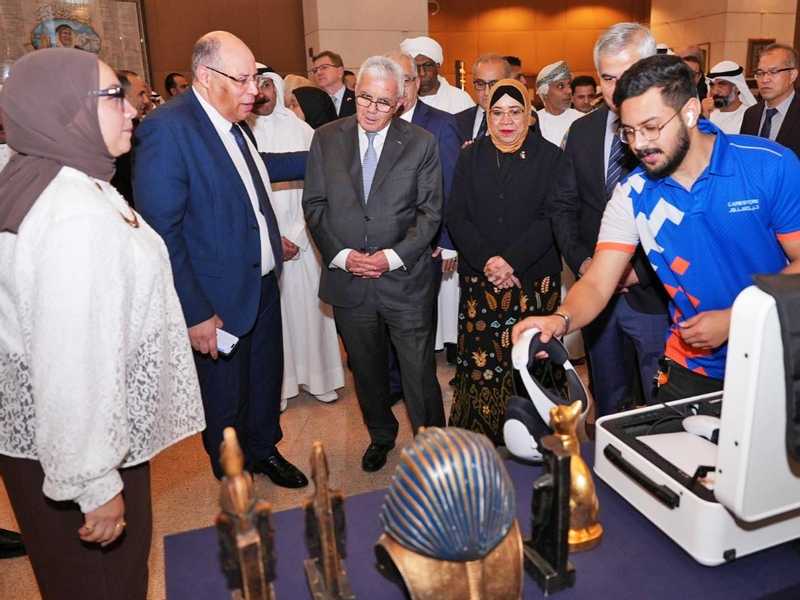
The Egyptian Ambassador to Kuwait affirmed that cultural ties are solid, during an event on the Grand Egyptian Museum in cooperation with the National Council for Culture, Arts and Letters.
Translated by Alqyas from Al-Qabas — Original source
May Al-Sukkar - Egyptian Ambassador to Kuwait, Mohamed Aboulwafa, affirmed that the historical ties between the two countries are firmly rooted, noting that science, culture, and the arts are among the most prominent pillars of this relationship. This statement was made during an event organized by the Cultural Office of the Embassy of the Arab Republic of Egypt in cooperation with the National Council for Culture, Arts and Letters yesterday, titled “The Grand Egyptian Museum: A Civilization That Narrates and a Future That Reveals,” marking the first anniversary of the museum’s opening in the capital, Cairo, in early November last year.
Aboulwafa emphasized that the museum, located near the area of the Ramses Square and the three pyramids, is “a unique cultural edifice that embodies Egypt’s renewed message to humanity and the message of a civilization that has spanned thousands of years and remains capable of inspiring and contributing.” He added, “The Grand Egyptian Museum, spanning an area of 490,000 square meters, is an exceptional cultural and humanitarian project through which Egypt has combined the grandeur of the past with the aspirations of the future, presenting the world with a model of how to utilize modern science, technology, and arts to preserve and rediscover human heritage.”
He clarified that the museum, which displays approximately 57,000 archaeological artifacts, including unique and distinctive pieces, is one of the largest archaeological museums in the world dedicated to a single civilization. It houses unique archaeological treasures, offering visitors an extraordinary journey through the history of ancient Egyptian civilization.
For her part, Aisha Al-Mahmoud, Assistant Secretary-General for Cultural Affairs at the National Council for Culture, Arts and Letters, stated in a similar address: “This event underscores that museums are not merely spaces that collect antiquities, but living cultural and knowledge institutions that contribute to preserving human memory and enhancing awareness of cultural identity.” She added that “the Grand Egyptian Museum is a cultural edifice that embodies the antiquity of Egyptian history and reflects the vast human and cultural heritage of Egyptian civilization, whose influence has extended through the ages.”
In his turn, Dr. Sayed Mahfouz, Professor of Ancient History and Archaeology at the Faculty of Arts, Kuwait University, presented an overview of the most important artifacts housed in the museum, including the Hanging Obelisk (the obelisk of King Ramses II, made of pink granite and weighing 110 tons, divided into sections that were restored and reassembled), the colossal statue of Ramses II (who ruled Egypt for 66 years, from 1279 to 1212 BC, and was the third pharaoh of the 19th Dynasty), as well as 10 statues of King Senusret I and the Grand Staircase in the museum, which includes 59 statues of kings and other exhibited treasures.
