Gulf Railway: Economic returns exceed ticket sales and transport revenues
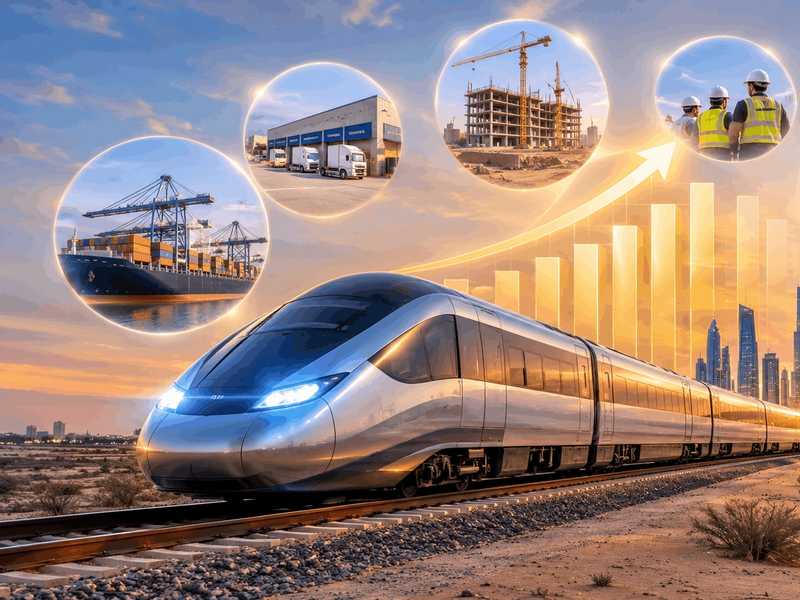
The GCC railway project aims to link economies and reduce transport costs, with full operation targeted by 2030.
Translated by Qiyas from القبس — Original source
• Kuwait as the Northern Gateway to the Rail Network.. Anticipated Gains for Trade and Logistics • Opportunity to Enhance Its Role as a Hub for Storage, Distribution, and Re-export to GCC Countries • Linking Ports, Industrial Zones, and Warehouses Opens New Markets and Reduces Transportation Costs • Project Boosts Intra-GCC Trade and Increases the Resilience of Gulf Economies Against Shipping Disruptions • Promising Investments in Construction, Operation, Maintenance, and Real Estate Surrounding Stations • Target of 271 Million Tons to Be Transported Annually by 2045.. Opportunities Extending Beyond the Transport Sector • Estimated Initial Cost of $16 Billion for the Network.. Full Operation by 2030 Ibrahim Muhammad – The signing of the general agreement for the GCC Railway project in Doha is not merely a new step in the path of establishing a long-awaited regional transport network; it reflects an economic shift toward reshaping trade, logistics, and mobility flows among Gulf countries, thereby enhancing economic integration, reducing the cost of moving goods and people, and opening the door to new investment activities that extend beyond the transport sector itself. The agreement gains particular importance as it establishes a unified framework for coordination among the six member states, defining commitments, implementation and operational mechanisms, technical specifications, safety requirements, and interoperability between national networks, thus paving the way to transform the project from a collection of separate national lines into an integrated regional network. The project aims for full operation by December 2030, while GCC Secretary-General Jassem Al-Budaiwi announced that the completion rate has reached 55.9%, with the possibility of operating parts of the network between neighboring countries as soon as their requirements are met, without waiting for the completion of the entire project.
2,117 Kilometers Connecting the Gulf
The planned route extends approximately 2,117 kilometers, starting from Kuwait, passing through Saudi Arabia, Bahrain, Qatar, and the UAE, and reaching the Sultanate of Oman, linking economic, industrial, port, and logistics centers in GCC countries. According to adopted standards, passenger train speeds will reach approximately 200 kilometers per hour, while freight train speeds will range between 80 and 120 kilometers per hour. Estimates indicate that the basic cost of the project ranges between $15.4 and $16 billion, figures subject to revision in light of rising construction material, service, and civil works costs, as well as inflation. It is important to note that this cost is an estimate for infrastructure and does not represent a final, updated budget following the signing of the agreement.
The significance of this network extends beyond reducing travel time; establishing an integrated land corridor among GCC countries can enhance supply chain efficiency, reduce certain transportation and storage costs, and provide companies with additional options for moving goods between Gulf markets, particularly for products requiring regular supply and rapid delivery to their destinations.
Kuwait.. Gains Extending Beyond Railways
For Kuwait, the project’s importance stems from its position as the northern gateway to the Gulf network and as a starting point for the corridor linking it to Saudi markets and then to the rest of the GCC. The Kuwaiti segment of the Gulf integration project is approximately 111 kilometers long, extending from the Al-Shadadiya area, near Kuwait University, to the Nuwaisib border crossing with Saudi Arabia, thereby connecting the country to the regional network. Economically, this linkage can enhance Kuwait’s position on the transport and logistics map, particularly if effective connections are developed between railways, ports, industrial zones, warehouses, and commercial centers.
Instead of goods movement remaining primarily reliant on maritime transport and trucks, companies will have an additional means to transport products to Gulf markets, thereby supporting the competitiveness of storage, distribution, trade, and industrial sectors. The project also offers potential momentum for economic and industrial zones, particularly those near the railway route, by increasing demand for land, warehouses, and logistics service centers, and encouraging ancillary activities such as customs clearance, multimodal transport, maintenance, and operations. New investment opportunities in commercial and real estate services may emerge around stations and cargo centers, extending the project’s economic impact beyond train operating revenues.
The greatest impact on Kuwait may not lie in the direct jobs created by the railway line itself, but in the jobs and investments that could arise around it, if the country succeeds in transforming it into a logistics hub connected to ports, industrial zones, and warehouses, especially the Mega Port of Mishref and its associated economic zones. This becomes even more significant given Kuwait’s efforts to diversify income sources and enhance the contribution of non-oil sectors to GDP. The modern transport network not only facilitates passenger and goods movement but also helps reduce the cost of doing business, improves the investment climate, enables local companies to access broader markets, and enhances the country’s attractiveness as a distribution and re-export hub.
Kuwait’s gains are not limited to its share of the project; the true value multiplies as the network expands its connectivity with Saudi Arabia, the UAE, Oman, and other GCC countries. Hence, the importance of integration between the GCC Railway project and national railway projects, including bilateral links, is crucial to ensure the network does not become fragmented into separate routes that fail to maximize economic benefits.
Trade and supply chains at the GCC level: The railway offers an opportunity to enhance intra-GCC trade and facilitate the movement of goods between Gulf markets by linking production and consumption areas, ports, and industrial centers. This can open avenues for companies to expand their operations and benefit from a more integrated Gulf market, supporting joint investments and strengthening value chain integration in industrial, trade, and service sectors. This role gains additional importance amid disruptions to maritime shipping routes, which have highlighted the risks of relying on specific corridors for trade and supply movements. The railway will not replace maritime transport, which remains the primary mode for international trade and bulk cargo, but it will serve as a complementary route, providing additional options for intra-regional freight transport and enhancing the resilience of Gulf economies to supply chain disruptions.
Projections indicate the potential to transport approximately 6 million passengers and 200 million tons of cargo by 2030, with passenger numbers rising to over 8 million and cargo volume reaching around 271 million tons by 2045. These figures indicate the potential scale of economic activity the network could generate, although actual benefits will depend on infrastructure readiness, competitive freight rates, efficiency of border and customs procedures, and companies’ ability to integrate the railway into their logistics operations.
Financing and the private sector: Among the key economic factors that will determine the project’s returns are financing, implementation, and operations.
According to statements accompanying the signing of the agreement, each country will finance and implement the portion of the project located within its territory, while member states will jointly determine the costs of the shared components that link the networks. The involvement of the private sector remains an option for certain components, based on the results of economic and financial feasibility studies, without a unified public-private partnership model for the entire network. This presents an opportunity for Kuwaiti and Gulf companies to participate in construction, supply, operation, and maintenance works, as well as to invest in warehouses, shipping centers, and services related to the stations. However, realizing these opportunities requires clear contracting models, risk allocation, and guarantees of sustainable operational returns, in addition to providing a regulatory environment that enables service integration across countries. Conversely, the investment cost, which approaches $16 billion, should not be viewed merely as an expenditure burden, but rather as a long-term investment in regional infrastructure. The return on this investment is not measured solely by ticket revenues and shipping fees, but also by the time and costs saved by the project, the investments it attracts, and the jobs and supporting economic activities it generates. Nevertheless, accurately estimating its contribution to GDP or the volume of savings it will achieve is still premature and requires detailed studies based on routes, types of cargo, and origin and destination hubs.
The Gulf Railway project dates back to 2009, with the Gulf Railway Authority established in 2021 to coordinate implementation and interconnect national networks, setting December 2030 as the target date for full operation. The signing of the general agreement yesterday marks the project’s transition to a more advanced stage of institutional and operational coordination, following years of delays and varying levels of progress among member states. However, the next challenge extends beyond completing the lines on schedule; it lies in ensuring their operation under a unified and efficient system, facilitating cargo and passenger transit procedures, connecting stations with ports and economic zones, and offering competitive prices that make the railway a practical choice for businesses and individuals.
Specifically for Kuwait, the project’s success will be measured by its ability to transform its position as the network’s starting point into a tangible economic advantage, by attracting storage, distribution, manufacturing, and logistics activities, rather than merely serving as a transit route for trains. Regionally, the network represents an investment in economic integration, diversification of trade routes, and enhancement of supply chain resilience, making its strategic and economic value greater than that of a mere transport project. It provides the Gulf Cooperation Council (GCC) countries with shared infrastructure that will support their competitiveness in the coming decades.
