35th Anniversary of Extinguishing Kuwait's Last Oil Well After the Invasion: An Eternal National Epic
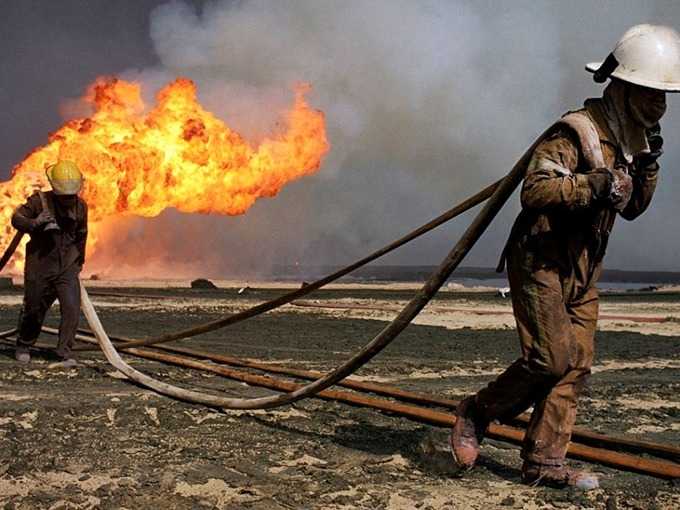
The 35th anniversary of extinguishing the last oil well in Kuwait.
Translated by Qiyas from القبس — Original source
KUNA – As the 35th anniversary of the extinguishing of the last burning oil well in Kuwait approaches, coinciding with November 6, 1991, this occasion stands as an eternal historical milestone in the national memory and a symbol embodying the firm Kuwaiti will and its ability to overcome hardships and challenges, no matter how great. Following the brutal Iraqi invasion, Kuwait faced one of the largest environmental and economic disasters in modern history, when the hand of thwarted criminality set fire to hundreds of oil wells in Kuwait, causing widespread devastation and severe damage to the environment, the economy, and daily life.
On this day in 1991, Kuwait celebrated the extinguishing of the last burning oil well in the Burgan field in the Ahmadi region, under the patronage and presence of the late Emir Sheikh Jaber Al-Ahmad Al-Jaber Al-Sabah, may God have mercy on him. This marked the culmination of tremendous efforts made by specialized Kuwaiti teams and other friendly countries over several months to extinguish these wells and mitigate the repercussions of one of the worst environmental disasters the world has witnessed.
The tragedy of burning wells began on February 21, 1991, as the invading Iraqi forces retreated, taking various forms in key areas of Kuwait’s oil fields, including Ahmadi, Burgan, Magwa, Manaqish, and Warah. These areas also witnessed what became known as oil lakes, which had extremely dangerous effects on the environment and human life. The ignition of the wells was accompanied by widespread smoke and fire spreading in all directions, and the explosion of oil gathering centers connecting the wells to export terminals, further intensifying the area’s flames and destruction.
Large quantities of fire debris (soot) fell on Kuwait, covering plants and buildings, leaving serious impacts on living organisms, including plants and animals, while turning day into pitch darkness. The drop in temperatures by approximately four degrees Celsius caused the death of a large number of marine creatures. The invading Iraqi forces blew up 737 Kuwaiti oil wells before their withdrawal. Kuwait’s loss amounted to between 4 and 6 million barrels of crude oil per day, with daily losses estimated at around $120 million, excluding environmental and health damages.
The negative effects of these fires on oil facilities across various regions of the country were numerous, requiring a long period to rehabilitate them. The material losses resulting from the fires affected the global economy for seven months. The destructive impacts of burning the wells did not stop at Kuwait’s borders but extended to several countries. Smoke from the wells reached Bahrain, Saudi Arabia, Qatar, Iran, the Sultanate of Oman, and other countries in Central Asia, along with black rain carrying oil and gas falling on them.
The Kuwaiti firefighting team, which undertook the task of extinguishing the wells, earned the appreciation of specialized foreign teams and the world for its challenge, determination, and heroic role. Despite being a relatively inexperienced team in this field, it contributed to extinguishing 41 wells. More than 10,000 people, distributed among 27 teams from various countries, participated in extinguishing the wells.
Following the liberation of Kuwait, efforts by various relevant authorities began to rebuild the oil sector by establishing specialized committees to study the extent of damage to the sector’s facilities and to find appropriate solutions to address them and tackle other resulting challenges, as well as to meet global market needs for Kuwaiti oil.
A large number of scientists and specialized environmental experts flocked to Kuwait to study the repercussions of these fires. Seminars, conferences, and discussion panels were held in several countries to discuss ways to save the environment and understand the future impacts of this catastrophe.
The initial plans for rebuilding the oil sector and its diverse facilities were based on two primary objectives: extinguishing the oil wells as quickly as possible and preparing some wells for a rapid return to production, along with repairing certain surface facilities. The efforts to extinguish the wells involved contacting approximately 30 international companies specializing in the reconstruction of oil facilities damaged by fires and other factors, with many companies possessing distinctive expertise in this field selected. The number of equipment pieces and vehicles involved in extinguishing the burning oil wells reached about 5,800 units, representing the second-largest non-military equipment fleet in the world and the largest fleet assembled in a single location. Extinguishing the last oil well was not merely the end of an environmental disaster, but a declaration of victory for willpower and determination, and the beginning of a new phase of reconstruction and recovery. This epic endeavor embodied the convergence of national and international efforts, along with a spirit of sacrifice and persistence in restoring the country’s economic lifeline. The commemoration of this national anniversary serves to recall one of the most prominent chapters of Kuwaiti resilience and to highlight the extraordinary efforts made to extinguish the fires, emphasizing the lessons of solidarity, challenge, and achievement that this period carried, keeping the memory of extinguishing the last oil well as a testament to Kuwait’s ability to rise from the heart of destruction and create hope anew.
