Is Andorra's goalkeeper facing charges of involuntary manslaughter?
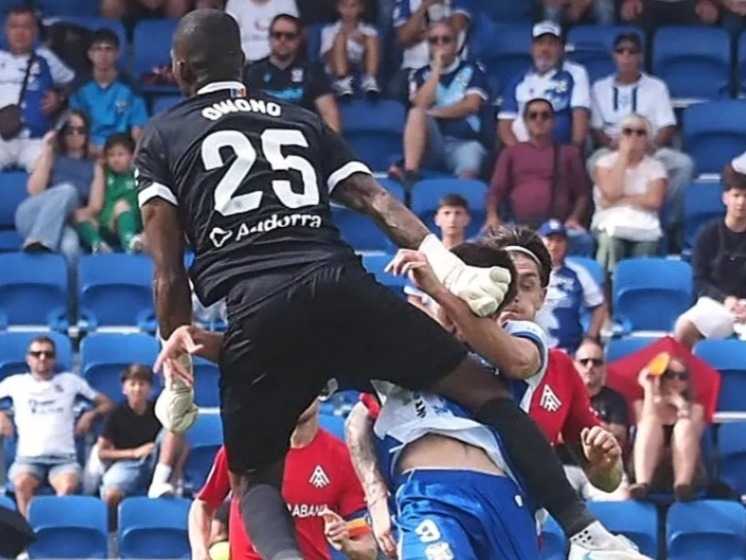
Criminal and disciplinary investigation launched into the death of a Tenerife striker following a collision with Andorra's goalkeeper.
Translated by Qiyas from القبس — Original source
A confrontation in Spain’s Segunda División turned into a human tragedy that shook the sports world following the death of Jesús de Miguel, a forward for Tenerife, who succumbed to injuries sustained in a violent collision with Andorra’s goalkeeper, Jesús Ovono. The incident has raised questions regarding the goalkeeper’s civil and criminal liability.
While the deceased player’s family and teammates are plunged into deep grief, Ovono is facing severe psychological and legal repercussions. The incident, which occurred during Monday’s match, resulted in the player’s death on Tuesday, with reports indicating that Ovono fell into a state of severe shock.
According to the Spanish newspaper *Sport*, the goalkeeper had intended to contact De Miguel’s family to offer his apologies, but the player’s death has made the situation more sensitive and complex. This is compounded by the escalating attacks against him on social media platforms, where he was subjected to a barrage of insults and labeled a “killer” by some fans, prompting him to disable comments on his accounts.
The repercussions of the accident extend beyond the humanitarian aspect. The police have opened an investigation into the circumstances of the incident, placing the matter under legal scrutiny alongside questions about potential sporting sanctions against the Andorra and Equatorial Guinea national team goalkeeper.
On the sporting front, Ovono may face disciplinary action under the regulations of the Royal Spanish Football Federation (RFEF), which include penalties for violent conduct toward opponents during play, particularly if it results in injuries or serious harm. Article 102 of the Federation’s disciplinary code allows for suspensions ranging from four to twelve matches in cases of violence against an opponent during play that result in injuries or serious damage.
This article may be referenced when evaluating the incident; however, its application is not automatic. The relevant disciplinary bodies must study the details and circumstances of the collision to determine whether the goalkeeper’s behavior falls under the violations covered by the article. Furthermore, the regulations do not stipulate an automatic specific penalty solely for a player’s death resulting from contact during a match. Consequently, determining the sanction depends on the nature of the conduct, the extent to which it violates disciplinary rules, and the circumstances surrounding the incident.
Alongside sporting accountability, a more sensitive legal issue emerges: Can a goalkeeper be held criminally liable for a player’s death during a football match? According to the Spanish newspaper *Marca*, the fact that the accident occurred within a sporting competition does not necessarily preclude the intervention of criminal courts. However, proving the link between the collision and the death is not sufficient on its own to convict the goalkeeper. It requires demonstrating that his behavior involved negligence reaching a level criminalized by law.
The Spanish Penal Code, in Article 142, defines two types of unintentional homicide resulting from negligence: gross negligence, punishable by one to four years in prison, and lesser negligence, punishable by three to eighteen months in prison. However, these penalties represent the general legal framework and do not mean that Ovono has been formally charged or will necessarily face a prison sentence. This depends on the results of investigations and evidence that judicial procedures may reveal.
To establish criminal liability, the nature of the goalkeeper’s conduct must be examined, along with his adherence to the duty of care required during competition, whether the tragic outcome could have been objectively foreseen and avoided, and whether a causal and legal link exists between his behavior and the player’s death.
Spanish regulations distinguish between disciplinary accountability within the sporting arena and criminal liability before the courts, meaning that a goalkeeper’s submission to disciplinary measures or the imposition of a sporting sanction does not automatically establish that he committed a crime. Conversely, cases containing indicators of a criminal act can be referred to the Spanish Public Prosecutor’s Office, allowing the competent judicial authorities to determine whether criminal liability exists that warrants prosecution. Between the legal investigations and the disciplinary assessment, the fate of the Andorra goalkeeper remains tied to what the evidence reveals about the circumstances of the collision and the nature of the conduct that preceded De Miguel’s death, in a case that transcends the boundaries of sporting competition and raises difficult questions about legal responsibility for fatal incidents on football pitches.
