Chinese Ambassador Yang Xin: Regional tensions delay Mubarak Port operations
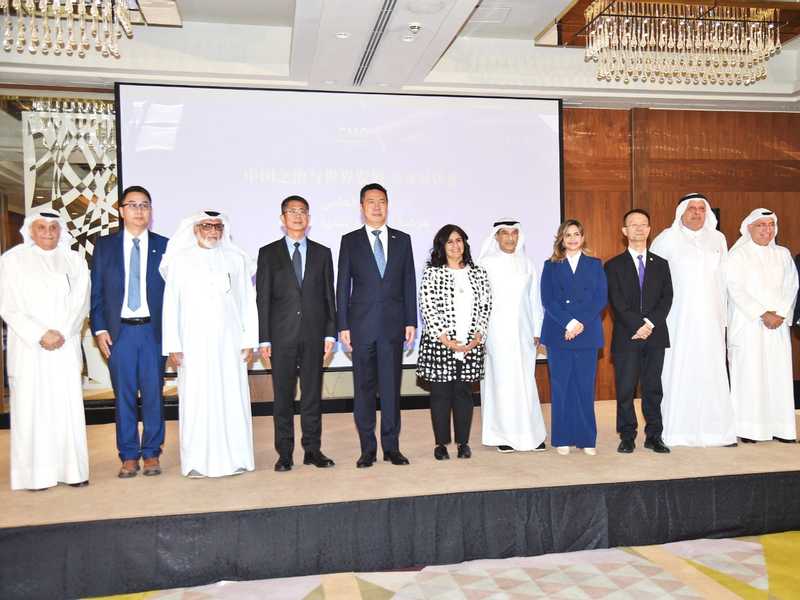
Chinese Ambassador Yang Xin confirmed progress on Mubarak Port and Silk City projects with Kuwait, noting the impact of regional tensions on schedules, while Sheikhah Aouda Al-Sabah reaffirmed China as Kuwait's largest trading partner.
Translated by Qiyas from القبس — Original source
Mai Al-Sukari: Yang Xin, the Ambassador of the People’s Republic of China to Kuwait, confirmed that all strategic cooperation projects between his country and Kuwait are progressing well, as they implement strategic decisions taken by the leaderships of both nations. The two governments, relevant authorities, and companies on both sides are making every effort to execute these initiatives.
Speaking at the Global Dialogue event held yesterday morning under the theme “China’s Governance and Global Development,” Yang Xin noted that the construction phase of the Port of Mishref has begun, while a formal opening ceremony was recently held for the wastewater treatment project. He added that both sides are working to launch the third and fourth projects in the near future.
Regarding the timeline for project completion, he explained that both sides aim to finish them as quickly as possible, although construction activities have been affected by regional circumstances and developments. He pointed out that the Port of Mishref project faces challenges related to the waiting of construction materials and some construction vessels outside the Strait of Hormuz, which necessitated adjustments to construction plans, while ensuring the project is completed according to the established schedule.
He emphasized the continuation of meetings and communication between the Kuwaiti side and the Chinese teams involved in the projects, noting that coordination between the two sides remains regular to monitor progress.
On regional developments, Yang Xin stated that the entire international community is concerned about the current situation in the region. He affirmed that China has been doing its utmost since the escalation of tensions on February 28 to de-escalate the situation and help end the conflict as soon as possible. He added that his country continues to use diplomatic channels to address developments, noting that Chinese President Xi Jinping held bilateral talks with the Sultan of Oman, discussing bilateral relations and regional issues, during which China’s position and proposals regarding security and stability in the region were reiterated.
He noted that Chinese Foreign Minister Wang Yi held meetings on the same day with delegations from Saudi Arabia and Iran, as part of diplomatic efforts to contain tensions and de-escalate the situation. He pointed out that the Chinese Ministry of Foreign Affairs also announced the dispatch of three envoys and special representatives of the Chinese government to the Middle East and North Africa region, a step aimed at contributing to de-escalation and addressing developments related to the Strait of Hormuz and the Red Sea.
He stressed that China is closely monitoring the possibility of renewed escalation in the region, emphasizing that his country will continue to work to achieve peace and stability for as long as possible, preferring diplomatic means over military options.
Regarding security and military cooperation with Kuwait, Yang Xin affirmed that it continues across various fields, primarily political and diplomatic areas, which he described as the most important in strengthening bilateral relations. He added that military relations between Kuwait and China are at a good level, characterized by continuous cooperation and regular exchanges of visits between the two armies, emphasizing both countries’ commitment to further developing cooperation and enhancing partnerships in various fields.
He noted that China’s new development plan focuses on innovation, technological modernization, and high-quality development, pointing out that the convergence of China’s development priorities with Kuwait’s Vision 2035 opens broad horizons for enhancing bilateral cooperation, particularly in smart cities, infrastructure, renewable energy, digital transformation, trade, and investment.
He stated that the Fifth Plenary Session of the 20th Central Committee of the Communist Party of China, held in Beijing from October 26 to 29 last year, laid the foundations for the next phase by preparing to implement the 15th Five-Year Plan (2026–2030), aimed at enhancing scientific and technological capabilities, developing smart infrastructure, and expanding international partnerships, in line with global economic shifts and geopolitical challenges.
A historic partnership. Yang Shen added that this year marks the 55th anniversary of the establishment of Kuwait-China diplomatic relations, emphasizing the importance of building on this historic partnership and expanding cooperation areas to serve mutual interests. He identified four main pathways for future cooperation: smart cities and infrastructure, renewable energy and sustainability, technology and digital transformation, and trade and investment. He clarified that major projects, such as the Silk City and the Port of Mishref, align with Chinese expertise in developing smart cities, economic zones, transportation networks, and logistics services.
He highlighted the importance of cooperation in solar and wind energy, artificial intelligence, fifth-generation (5G) networks, and cloud computing, as well as cybersecurity and the protection of critical infrastructure, ports, and oil facilities, and smart monitoring and early warning systems, thereby enhancing Kuwait’s technological capabilities and national security. He stressed that the partnership between the two countries is not limited to political and economic aspects, but also includes cultural and humanitarian cooperation, which strengthens people-to-people ties and supports development and stability in the region.
For her part, Sheikh Dr. Anoud Al-Sabah emphasized that Kuwait-China relations have witnessed significant development over more than five decades, with China becoming Kuwait’s largest trading partner for 11 consecutive years. Cooperation has expanded in energy, oil, petrochemicals, investment, and infrastructure, notably the Port of Mishref project, alongside promising opportunities in the digital economy, advanced industries, and green development.
For his part, Dr. Anwar Al-Sharaian, an economics professor at Kuwait University, stated that Kuwait needs to develop its own economic model, suited to the nature of its political and social system and its economic foundations, while drawing on successful international experiences, foremost among them the Chinese model, which combines a strong state role with the use of market mechanisms. Al-Sharaian stressed the importance of investing in national human capital and developing education to meet future labor market needs, as well as enhancing domestic consumption and social welfare, drawing on the Chinese experience in leveraging government planning and market mechanisms to support economic growth. He concluded that the goal is not to replicate the Chinese experience, but to benefit from its success factors in a manner consistent with Kuwait’s specificities, noting that clear vision, strong leadership, and the ability to review plans and correct course are fundamental pillars for achieving sustainable development and enhancing economic stability.
