Minister of Public Works Calls for Building an Integrated Arab Transport and Logistics System
Press coverage 1 newspapers covered this event: Al-Qabas →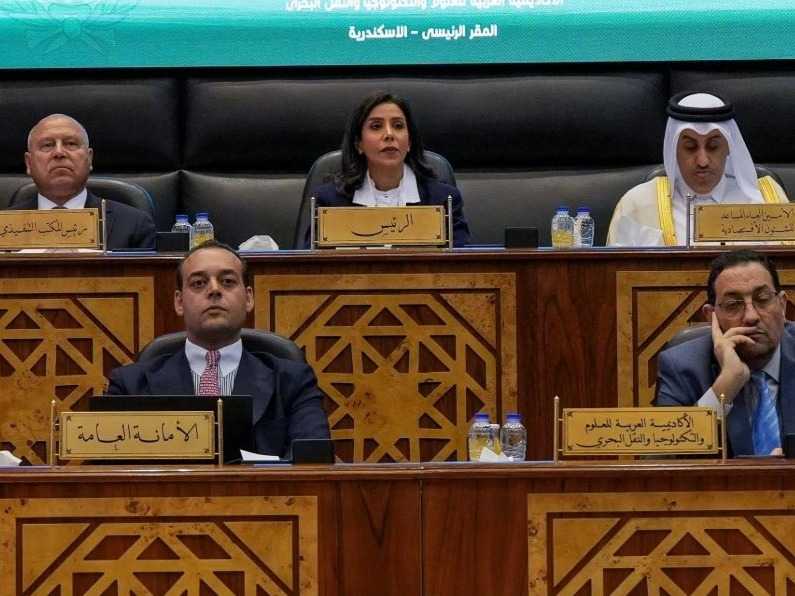
Noura Al-Mashaan called for the establishment of an integrated Arab transport and logistics system to enhance Arab economic integration and security during the opening of the 39th session of the Arab Ministers of Transport Council.
Translated by Qiyas from القبس — Original source
Minister of Public Works Dr. Noura Al-Mashaan called for the establishment of an integrated Arab transport and logistics system based on strengthening links between Arab countries, exchanging information and expertise, developing mechanisms for joint coordination, and raising readiness and emergency response levels, thereby ensuring the continuity of supply chains and enhancing Arab economic security. This was stated in a speech by Minister Al-Mashaan today, Tuesday, at the opening of the 39th session of the Council of Arab Ministers of Transport, held at the headquarters of the Arab Academy for Science, Technology and Maritime Transport in Alexandria.
Minister Al-Mashaan said, “I am pleased to meet you today at this important Arab forum, which embodies the depth of fraternal ties among our countries and underscores our shared commitment to elevating the transport sector as a key driver of economic development and a cornerstone of integration and interconnection among Arab states.”
She expressed her sincere gratitude and appreciation to the Arab Academy for Science, Technology and Maritime Transport for its excellent hospitality and warm reception, commending the commendable efforts of the Academy’s President, Dr. Ismail Abdel Ghaffar, in supporting joint Arab work and developing the transport and logistics system. She also expressed her thanks and appreciation to the General Secretariat of the League of Arab States for its continuous efforts in preparing and organizing the Council’s work and following up on the implementation of its decisions and recommendations, thereby enhancing the trajectory of cooperation and coordination among Arab countries.
She emphasized the importance of holding the meeting in light of the rapid developments and growing challenges facing the region, including Iranian aggression targeting the Gulf Cooperation Council countries and Jordan, which constitutes a blatant violation of state sovereignty, principles of good neighborliness, and international law, given that such actions pose a direct threat to the security and stability of the region.
In this regard, she pointed to the ongoing terrorist attacks carried out by the Houthi militia against the Kingdom of Saudi Arabia, which demonstrate to all the severity of such threats to the Kingdom’s security and the safety of its territory, “a matter that necessitates a unified and responsible Arab stance to confront anything that undermines the security of our countries and regional stability.”
Minister Al-Mashaan stressed that these challenges “have directly impacted the transport sector and supply chains at both the regional and international levels, placing upon us a doubled responsibility to develop the transport system, enhance its capacity to adapt and respond to changes, and ensure the continuity of services and trade flows under all circumstances.”
She clarified that transport is no longer merely a means of moving people and goods; it has become a fundamental element in achieving economic security, enhancing the competitiveness of countries, and ensuring the delivery of goods and basic necessities to societies.
She added, “From this perspective, the topics on our Council’s agenda acquire special importance, as they include efforts to develop land, maritime, and multimodal transport; strengthen links between Arab transport networks; update regulatory and legislative frameworks; raise safety and efficiency standards; and support digital transformation and sustainability in this vital sector.”
Minister Al-Mashaan expressed hope that the meeting’s discussions would contribute to formulating practical decisions and recommendations that enhance integration among transport systems in Arab countries, support the smooth flow of trade and cross-border transport, and elevate joint coordination to address future challenges.
She stated that the developments and exceptional circumstances the region has witnessed have proven that supply chain resilience is no longer an option but has become a strategic necessity requiring advance preparedness, effective coordination, and rapid response.
In this context, she confirmed that the State of Kuwait, in cooperation with the Gulf Cooperation Council countries and relevant national authorities, has taken a series of exceptional measures to ensure the continuity of transport operations and enhance supply chain resilience. She noted that these measures reflected the importance of integration among national entities and coordination with Arab countries, emphasizing the need to strengthen the readiness and resilience of transport systems to ensure the continuity of supply chains in the face of exceptional circumstances.
With the conclusion of the State of Kuwait’s presidency of the Council, Minister Al-Mushaan extended her sincere thanks and appreciation to the Arab ministers, the General Secretariat of the League of Arab States, the Arab Academy for Science, Technology and Maritime Transport, and all relevant entities for their cooperation and commendable efforts in supporting the work of the 38th session of the Arab Transport Ministers Council and advancing the process of joint Arab action.
On this occasion, she announced the handover of the presidency of the 39th session of the Arab Transport Ministers Council to Egypt’s Minister of Transport, Major General Engineer Kamal al-Wazir, wishing him success and prosperity in leading the Council’s work, and expressing hope that the session’s outcomes would yield constructive decisions that contribute to the development, integration, and sustainability of the Arab transport system.
Minister of Public Works Dr. Noura Al-Mushaan chaired the State of Kuwait’s delegation to the session, which included Kuwait’s Permanent Representative to the League of Arab States, Ambassador Talal Al-Mutairi.
