Fahad Al-Othman Revives the History of the Al-Muzayen Family and Sheds Light on Old Kuwait
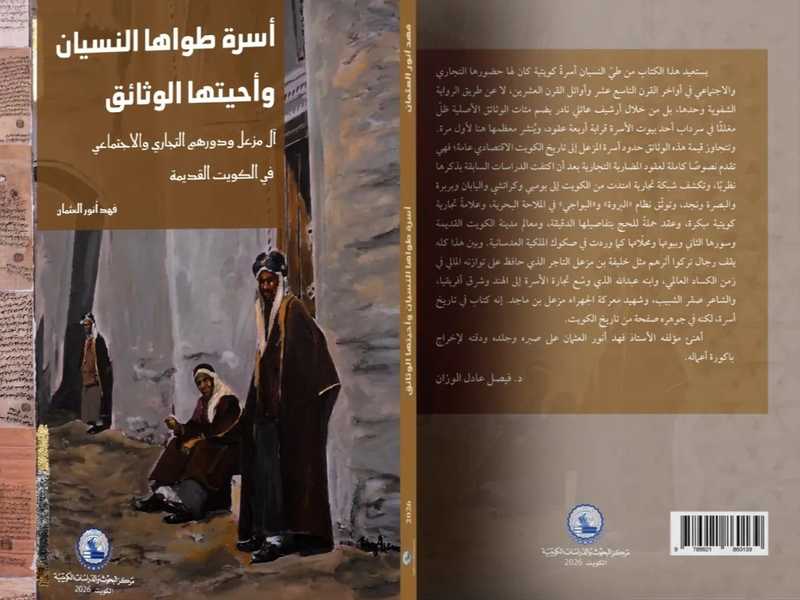
Researcher Fahad Anwar Al-Othman publishes a book on the Al-Muzayen family and their commercial role in old Kuwait, based on rare documents.
Translated by Qiyas from القبس — Original source
There are books that restore to us names that have faded from memory, and others that open windows onto bygone eras, allowing us to rediscover through them the contours of a society whose identity was forged through work, trade, and human ties. Among these books is the work by researcher Fahd Anwar Al-Othaim, “A Family Swallowed by Oblivion and Revived by Documents: Al-Muzayea and Their Commercial and Social Role in Old Kuwait,” published this year by the Kuwait Center for Research and Studies in Kuwait. The book offers a qualitative addition to Kuwait’s historical library, relying on rare family documents that reconstruct the biography of a family that played a prominent role in commercial and social life during the late nineteenth and early twentieth centuries.
The book derives its significance from its ability to combine fidelity to family memory with rigorous historical research. The author begins with stories told by his grandmother, Aisha bint Abdul-Karim Al-Muzayea, and what he heard from her in his childhood about her family and its notable figures. He then embarks on a research journey that transcends the boundaries of oral narrative, drawing on documents and manuscripts that had remained preserved and out of circulation. This transforms memories into historical material amenable to examination, study, and utilization in reading Kuwait’s past. This humanistic beginning gains its significance from the nature of the project itself; the desire to write stems from a personal connection to history, and matures through research into origins and documents, comparing evidence, and uncovering the information they contain. Here, Fahd Al-Othaim succeeds in transferring the family’s memory from its private sphere to the space of national memory, presenting a model of a researcher who understands that the history of homelands is composed of the history of their institutions and major transformations, as well as the biographies of families and individuals who contributed to building their economic and social life.
As a witness to life, the document reveals the book’s most prominent value in its reliance on a rare family archive comprising hundreds of original documents, which, according to the book’s introduction, remained preserved in the cellar of one of the family’s homes for nearly four decades. This archive enabled the author to present material that goes beyond recalling names and lineages to revealing details of daily life, commercial practices, investment patterns, relationships among merchants, and communication networks that linked Kuwait to multiple commercial centers within the region and beyond. Historical documents grant depth and practicality to history; they record what actually occurred in real life, reveal the nature of interpersonal relationships, and place the researcher before the language, terminology, and business organization methods of their era. Through this material, the book offers a picture closer to the details of the old Kuwaiti economy, moving beyond mere general narration of events or abstract references to the prosperity of maritime and land trade.
In the book’s foreword, Professor Dr. Abdullah Yusuf Al-Ghanim, President of the Kuwait Center for Research and Studies, highlights the importance of private documents in tracing Kuwait’s history and the economic, social, and educational aspects they reveal, many of which have not received adequate documentation. This assessment confirms that studying the Al-Muzayea family archive falls within a broader endeavor aimed at completing the picture of national history through its original sources.
From Kuwait to India and East Africa, the author devotes significant space to the commercial activities of the Al-Muzayea family, tracing their maritime and land extensions, the partnerships established by its members, and their connections with external markets. The documents reveal a commercial network that reached India, Japan, Singapore, and Barawa in Somalia, as well as Basra and Najd, underscoring the breadth of the Kuwaiti merchant’s horizon and his ability to navigate diverse economic environments.
This commercial geography gains significance when read in its historical context; old Kuwait was not an isolated society detached from its surroundings, but rather an integral part of a vast network of ports, markets, and caravan routes. Kuwait’s maritime location, the accumulated expertise of its merchants, and their ability to forge partnerships all contributed to strengthening Kuwait’s commercial presence and establishing economic ties that extended to distant regions. The book allows readers to approach this activity through tangible documents that reveal the names of partners, the nature of transactions, the routes of goods, and methods of settling accounts. Thus, an image of the economy emerges from within its records, with details that help elucidate the mechanisms of commercial operations, as well as the sources of strength and the risks faced by merchants during that period. Notably, the author pays attention to documenting Kuwaitis’ investments in the marshes of the Shatt al-Arab, maritime activities, and the associated terminology and procedures. These topics expand the scope of research into the history of Kuwaiti trade and offer readers an opportunity to explore aspects that are less prominent in the prevailing historical narrative.
Commercial Partnership and Money Management
The chapter dedicated to commercial partnership constitutes one of the book’s key themes, given that it includes documents providing practical examples of this type of transaction. The importance of this aspect stems from the fact that economic terms acquire their full meaning when observed in practice, within contracts that define rights and obligations and clarify the nature of the relationship between parties to commercial dealings. Through documents from the Al-Muzayen family, the author approaches methods of money management, profit distribution, and account settlement, revealing a dimension of the economic culture that evolved in Kuwaiti society through practice and experience. This material aids in understanding how merchants organized their business, managed their investments, and interacted with their partners amid changing economic conditions. The value of these documents increases when placed in the context of crises that markets experienced, including the repercussions of the global depression. In the biography of Khalifa Al-Muzayen, as presented in the book, we see the features of a merchant who managed to maintain financial stability during a difficult period, while his son, Abdullah, expanded the family’s commercial activities toward India and East Africa. Thus, the book enables a reading of a family’s economic experience from two complementary perspectives: managing resources and maintaining stability on one hand, and expanding commercial relations and capitalizing on opportunities on the other.
Houses, Relationships, and Social Features
The book does not limit itself to markets, contracts, and accounts; it also turns its attention to the social fabric in which this commercial experience emerged. In its early chapters, it addresses the family’s lineage, its migration from Ha’il to Kuwait, its houses in the old city, its marriages, and its relationships, relying on notarial documents that record aspects of ownership, urban development, and the distribution of houses and shops. This material holds particular significance in documenting the features of old Kuwait, as property deeds help reconstruct some of its spatial and social details, providing researchers with evidence that can be utilized in studying the history of neighborhoods, houses, and the relationships that connected their inhabitants. The documents also reveal the presence of kinship, marriage ties, and friendship in building relationships among Kuwaiti families. These bonds contributed to shaping the social trust that commerce required and enhanced cooperation among individuals and families. In this sense, the book presents the economy as a human activity connected to society, governed by interests and customs, and influenced by personal relationships and family ties.
The author adds to this picture social and religious documents, including one related to a Kuwaiti Hajj campaign organized by Saif Al-Dawila, which details the journey, the number of camels, boys, and food. These small details reveal the value of private documents in recording aspects of life that official records may not necessarily address, offering us a chance to understand the conditions of travel, pilgrimage, and social organization of that era. Names reassert their presence: the book’s scope expands to include figures and names connected to the history of the Kuwaiti family and society, among them the poet Saqr Al-Shaib Al-Muzna, whose roots are referenced by the author, adding a new dimension to the study of his biography. Muzna bin Majid, the martyr of the Battle of Jahra, is also mentioned in the context of reviving figures linked to the family’s history. These references give the book a dimension that transcends commercial history, linking economic activity with literary and national life, and affirming that family histories cannot be reduced to a single aspect of their roles. The family archive may hold, alongside accounts and contracts, keys to understanding the personalities, connections, and events that contributed to shaping collective memory. In this context, the Al-Muzna family appears as a model for several Kuwaiti families that left their mark on society, and the book examines their fading presence in the prevailing narrative over time. It reopens the file on this family, relying on written evidence that provides a historical foundation for future studies.
This scholarly effort deserves praise. Fahd Anwar Al-Othman is commended for choosing a subject that requires patience and precision, and for his attempt to present family documents within a methodological framework that connects archival material with historical context. The book’s structure, spanning lineage, migration, commercial activity, speculation, ledgers, and collections, reflects an effort to build a comprehensive picture of the family’s experience, while allowing the reader to move from partial facts to their broader implications. Furthermore, the book’s publication by the Kuwait Center for Research and Studies grants it an important position among efforts to preserve national memory and enrich its sources. As Dr. Abdullah Al-Ghanim explains, the Center has done well in supporting this type of work, which opens private archives to scientific research and gives documents a new lease on life after years of being out of circulation. This also highlights the importance of families’ awareness of the value of the documents, photographs, letters, and ledgers they preserve. These materials may seem to have limited family significance, yet they contain valuable information about society, the economy, urban development, and human relationships. The more such materials are cataloged, studied, and published, the greater the potential for writing a more detailed and rich history.
Ultimately, the book “A Family Hidden by Oblivion, Revived by Documents” offers a research experience that engages with the past, benefits the present, and remains open to future questions. Its value lies in reviving the biography of the Al-Muzna family, while simultaneously revealing features of old Kuwaiti economy, the vitality of its commercial relations, the depth of its social fabric, and the diversity of its memory sources. Through this work, Fahd Anwar Al-Othman has brought to light names worth knowing, documents worth reading, and details that give Kuwaiti history greater clarity and depth. When documents speak after a long silence, they offer the past a new chance to become a living part of the present, reminding us that national memory still requires those who will delve into its archives, listen to its evidence, and present it to future generations in the language of research and the integrity of documentation.
