Rare Dinosaur Skeleton Sold for $47 Million
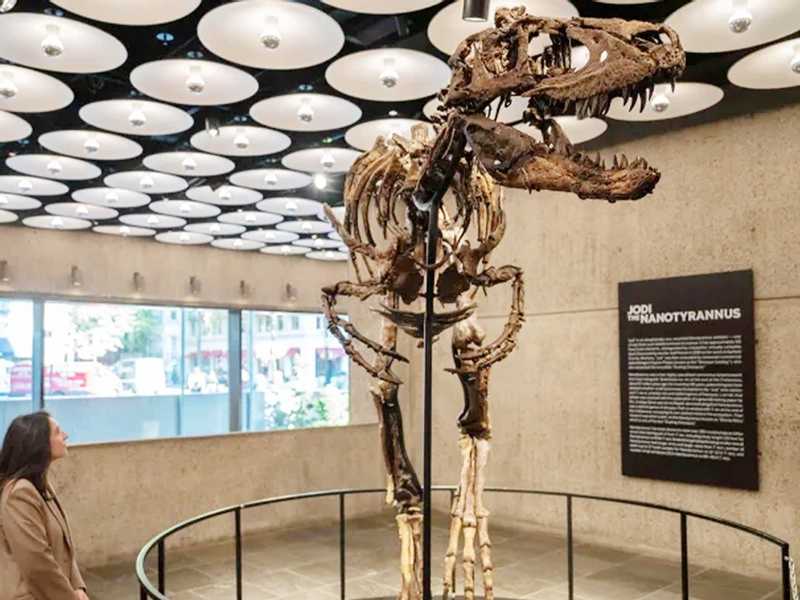
A rare dinosaur skeleton named Judy was sold for $47.3 million at a Sotheby's auction in New York, far exceeding estimates.
Translated by Qiyas from القبس — Original source
A dinosaur skeleton that lived approximately 67 million years ago sold in just 12 minutes at an auction in New York City, becoming the second most expensive dinosaur skeleton ever sold at auction. The rare fossil, known as “Judy,” fetched $47.3 million, surpassing Sotheby’s estimates of $6 million to $9 million. The story of “Judy” dates back to 2019, when the skeleton was discovered on a ranch owned by Judy Pearson in Montana, United States, within the Hell Creek geological formation, renowned for late Cretaceous fossils. The Hell Creek Formation represents the final period of the Mesozoic Era, spanning from approximately 145 to 66 million years ago, a time marked by the proliferation of dinosaurs before their extinction at the end of that period.
The skeleton belongs to a dinosaur known as Nanotyrannus, a carnivorous animal resembling the famous Tyrannosaurus rex but smaller and more slender. The displayed skeleton measures approximately 6 meters in length, is about 70% complete, and comprises around 191 fossilized bones. The fossil’s significance is further enhanced by its rarity; reports indicate it is one of only three known large skeletons of this dinosaur. It was named “Judy” in honor of the rancher who discovered the fossil on her land.
For decades, the identity of Nanotyrannus remained uncertain among scientists. Some researchers argued that fossils attributed to it belonged to juvenile Tyrannosaurus rex specimens, suggesting that differences in size and structure reflected a growth stage rather than a distinct species. Conversely, other researchers maintained that anatomical differences indicated Nanotyrannus was a separate genus that coexisted with Tyrannosaurus rex approximately 67 million years ago. In a study published in the journal Nature in 2025, researchers concluded that Nanotyrannus differs from Tyrannosaurus rex, based on anatomical comparisons, growth models, and bone characteristics. This study revived scientific interest in these fossils after years of debate over their classification. This means that “Judy” is not merely the remains of an extinct creature but a specimen that can contribute to understanding the diversity of late Cretaceous carnivorous dinosaurs.
The skeleton was displayed at Sotheby’s in New York prior to its sale on October 27, 2026. In an auction lasting approximately 12 minutes, six bidders competed before an anonymous buyer won through phone and online bids. The final price exceeded initial estimates by more than five times, making “Judy” the second most expensive dinosaur skeleton sold at auction, behind a Tyrannosaurus rex skeleton known as “Gust,” which sold for $50.1 million earlier in the same year.
No public information is available regarding the new owner’s plans to display the skeleton or make it accessible to researchers, a point of particular importance amid ongoing debates about the trade in rare fossils. The sale of “Judy” has raised concerns among paleontologists that scientifically significant specimens may move into private collections, restricting access for researchers and the public. Opponents of such auctions argue that the value of fossils extends beyond their rarity or price, encompassing the evidence they provide for studying the evolution of organisms, comparing species, and reevaluating previous scientific conclusions. Private retention of rare specimens away from research institutions could hinder examination or their use in future studies. Conversely, defenders of the fossil market point out that discovering, extracting, and preparing fossils requires specialized work and significant costs, and that sales can provide returns to discoverers and owners who contribute to bringing these specimens to light.
The fact that “Gouda” has moved to a private farm does not necessarily mean it will be hidden from scientists or the public, as the farm has not yet announced its plans.
