What If Netanyahu Loses the Majority in the Elections?
A detailed report on the possibilities of Netanyahu or Eizenkot winning and forming the government.
Translated by Qiyas from القبس — Original source
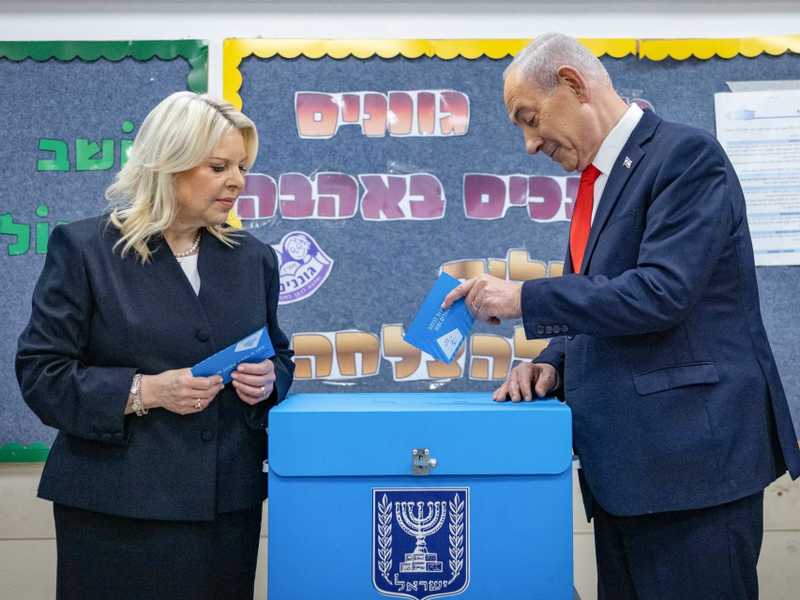
International Affairs Editor – The Zionist entity held its first general elections for the Knesset since the October 7, 2023, attack, amid anticipation regarding the political fate of Prime Minister Benjamin Netanyahu and the far-right. While most polling stations are scheduled to close at 10:00 PM today, voter turnout reached record levels; the participation rate stood at 55.7% as of this afternoon, marking the highest turnout ever recorded since 1973.
For his part, Opposition leader Gadi Eisenkot, head of the Yesh Atid party, warned that Prime Minister Benjamin Netanyahu is preparing to challenge the election results and allege attempts at fraud. While Netanyahu’s Likud party called for extending the voting period, Netanyahu claimed that Arab voters in the south were “rushing to the polls and trying to steal the election,” an attempt to revive a controversial strategy from previous elections. A shift of just one or two seats in parliament could determine whether Netanyahu remains Prime Minister, whether he is replaced by Opposition leader Gadi Eisenkot, or whether the country heads toward new elections.
It appears that a clear victory for either Netanyahu or his rival Eisenkot will be difficult to achieve, meaning the process of forming a new government will take time. However, importantly, the hardline stance toward Iran and Hezbollah will remain unchanged, as both parties belong to the right wing and are not inclined to show any leniency.
With neither political camp likely to secure a majority, Tel Aviv may face an opposition-led government, a new coalition headed by Netanyahu, a minority government, an agreement to form a unity government, or new elections. Coalition formation negotiations could last for weeks. The outcome remains highly uncertain, given no guarantees that either camp will secure a majority. Most polls indicate that Netanyahu’s right-wing and religious allies, as well as the parties seeking to replace him, will fail to win the 61 seats required for a majority in the 120-member Knesset. However, even in the absence of a clear winner, negotiations could result in the formation of a new government, a fragile minority government, or an unexpected agreement between political rivals.
Analysts warn of the possibility that Netanyahu might resort to unconventional steps or incite political and legal chaos to challenge the results or evade his ongoing legal proceedings and trial. Below are the scenarios if Netanyahu loses the majority:
1. Political Paralysis and a Caretaker Government: If neither side secures a majority of 61 seats and parties refuse to form joint alliances, the Zionist entity may face a deadlock leading to new elections. In this case, Netanyahu would remain as head of a caretaker government for several additional months without a genuine parliamentary majority, prolonging political uncertainty.
2. Opposition Government Led by Eisenkot: If parties seeking to replace Netanyahu manage to secure a majority, they could form a coalition including the centrist Yesh Atid party led by Gadi Eisenkot, the Yamina party led by former Prime Minister Naftali Bennett, the Israel Beiteinu party led by Avigdor Lieberman, and the leftist Democrats party led by Yair Golan. Opposition leaders might thus form an alternative government coalition separate from Netanyahu, potentially involving new political arrangements, a recalibration of international relations, and domestic reforms, while ending the dominance of the far-right (such as Ben-Gvir and Smotrich) over security decision-making.
3 - Netanyahu wins a new term with right-wing parties. The alternative lies in a victory for the right-wing and religious camp led by Netanyahu, who would need to secure at least 61 seats. Although opinion polls suggest this outcome is less likely than the opposition winning a clear majority, such a result would allow Netanyahu to reconfigure his current coalition, which includes the Likud party, the ultra-Orthodox Shas and United Torah Judaism parties, the far-right Otzma Yehudit party led by Itamar Ben-Gvir, and the Religious Zionism party led by Bezalel Smotrich.
4 - A minority government relying on Arab parties. If the opposition parties led by Jews win more seats than Netanyahu’s camp but fail to achieve an absolute majority, Gadi Eizenkot may attempt to form a minority government. Under the Knesset system, a new government does not necessarily require the support of 61 MKs to take power; it must win a confidence vote in parliament, which can be passed by a simple majority of those voting, even if the margin is just one vote. Eizenkot has stated that he will not negotiate with Arab or ultra-Orthodox parties, offer them political concessions, or reach agreements with them. His calculations are based on the assumption that Arab MKs will abstain from voting on confidence rather than help Netanyahu remain in power. However, even if such a government were formed, its survival might depend on parliamentary support from outside the coalition, provided by Arab parties or Ashkenazi ultra-Orthodox factions. Without this support, the government could collapse quickly.
5 - A unity government between Netanyahu and Eizenkot. Another possibility is the formation of a broad coalition uniting Netanyahu and Eizenkot, particularly if Arab parties achieve strong results that prevent either competing camp from securing a majority. Such an agreement might include a power-sharing formula under which the two leaders would alternate the position of prime minister during the government’s term. Both Netanyahu and Eizenkot have publicly rejected entering into such a partnership, making it politically difficult. Nevertheless, the Washington Post previously reported that circles within the U.S. presidential administration are exploring ways to keep Netanyahu in power, even if he loses, by proposing a unity government that includes his rival.
Impact on the Iran War. In all scenarios, the political landscape in Tel Aviv and the Middle East will undergo transformative shifts, highlighting the most prominent scenarios and their impacts on the war or escalation with Iran.
1 - The possibility of a “final strike” or preemptive escalation before the transfer of power: Analyses (including those in Western and Hebrew media reports) suggest that Netanyahu may view direct military escalation with Iran or issuing orders for a “final strike” as a means to shuffle the cards, improve his political terms, or even attempt to impose a reality that pushes toward an emergency unity government. Observers warn that Netanyahu’s sense of impending political collapse could drive him toward a “regional military adventure” before his actual departure from power.
2 - Unilateral action without full coordination with Washington: If the U.S. administration under President Donald Trump retreats, or according to calculations favoring temporary de-escalation that reject entering an immediate comprehensive war, Netanyahu may attempt to act unilaterally or try to entangle militarily with allies, especially since his previous statements indicated readiness to act independently.
3. A more cautious approach by the alternative government: If an alternative government led by former military figures such as Gadi Eisenkot were to take power, its approach toward the Iranian file would likely be more institutional and less inclined to engage in open, protracted wars for personal political ends. The new leadership would pursue a more coordinated and restrained path with its American ally, avoiding attempts to “force its hand” on Washington regarding Iran’s nuclear file or to drag the region into an uncalculated, all-out escalation.
