Intensive Efforts to Prevent War... and the Mecca Alliance in Tehran
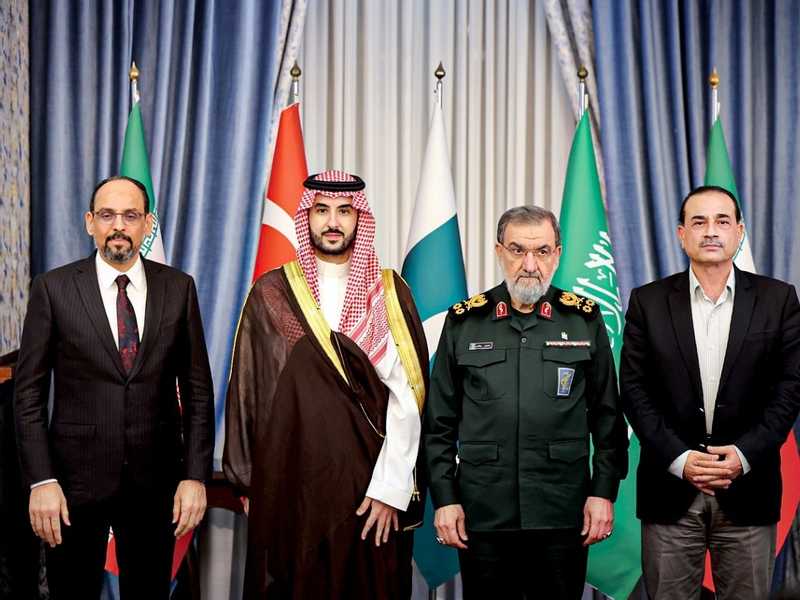
A quadrilateral meeting was held in Tehran involving Saudi Arabia, Turkey, Pakistan, and Iran to discuss de-escalation, while Washington warns of the possibility of a wide-scale military attack on Iran.
Translated by Qiyas from القبس — Original source
As the region stands on the brink of a volcano that could erupt at any moment, and amid American stances signaling a resumption of war with Iran, regional and international efforts have intensified in a final attempt to prevent a renewed confrontation that would carry grave consequences for regional security and international peace. In this context, an unexpected four-party meeting was held in Tehran today, bringing together members of the Mecca Agreement and Iranian officials as part of efforts to de-escalate tensions, establish “regional security,” and support mediation between the United States and Iran. The four-party meeting in Tehran, involving Saudi Defense Minister Prince Khalid bin Salman, Pakistani Army Chief General Asim Munir, Turkish National Intelligence Organization (MIT) Head Ibrahim Kalin, Iranian President Masoud Pezeshkian, and National Security Council Secretary Mohsen Rezaee, marked the first serious contact between the parties to the Mecca Agreement for Joint Defense and Iran at a critical juncture for the region.
The participants affirmed in a joint statement their commitment to continuing talks aimed at enhancing mutual cooperation, including in the fields of peace and security in the region. While Gulf Cooperation Council (GCC) states aligned with the Mecca Agreement seek to advise all parties on the necessity of responding to mediation efforts and making concessions to facilitate solutions, the visit to Tehran indicated that chances of reaching a settlement, though slim, still exist. Confidential diplomatic sources told Al-Qabas that recent attempts to elicit concessions from Iran have so far yielded little result, pointing to divergent views even within Iran and noting that the final say rests with the Islamic Revolutionary Guard Corps (IRGC), which does not appear ready to back down and continues to reject any discussion of the nuclear issue. The IRGC also firmly opposes removing highly enriched uranium from the country, despite the emergence of less hardline officials in recent meetings with mediators.
In its statement, the Saudi Foreign Ministry affirmed that the visit extends the Kingdom’s role in fostering dialogue and peace, and called on the parties to the crisis to engage positively and practically with the outcomes, alongside the ongoing efforts of Qatar and Pakistan, to open negotiation channels and prevent a return to military escalation, paving the way for an agreement that ends the crisis.
Parallel to the four-party meeting, a Qatari delegation has been visiting Tehran since Sunday as part of efforts to defuse the threat of war. Meanwhile, the Kremlin announced today that Russian President Vladimir Putin will meet in Moscow today with Iranian President Masoud Pezeshkian and Qatari Emir Sheikh Tamim bin Hamad Al Thani.
Diplomatic efforts are racing against the drumbeats of war in Washington and Tel Aviv. In this context, CNN cited U.S. officials as saying that launching new military operations against Iran has become a matter of time, not possibility, adding that any new military operation against Iran would be wide-ranging. The officials noted that President Donald Trump could order military operations against Iran at any time before the end of the year, but it is more likely to occur after the midterm elections.
The details follow: Developments have accelerated amid ongoing escalation between the United States and Iran, just hours before pivotal elections in the Zionist entity that will determine the fate of its Prime Minister Benjamin Netanyahu, and one week before the U.S. midterm elections.
In a diplomatic move amid escalating fears of renewed war and the expansion of the aggression launched by the Iran-backed Houthi militia against Saudi Arabia and the Bab al-Mandab region, a military meeting bringing together Iran and the states of the “Mecca Alliance” to the same table was held today (Monday). The meeting was initiated by Islamabad during last week’s visit to Tehran by the commander of the Pakistani army, General Asim Munir, who proposed holding a quadrilateral meeting. Iran agreed to the proposal, viewing it as a first step toward establishing regional security mechanisms.
Saudi Defense Minister Prince Khalid bin Salman, Pakistani Army Chief General Asim Munir, and Turkish Intelligence Agency (MIT) Head Ibrahim Kalin participated in the meeting. On the Iranian side, the meeting was hosted by Mohsen Rezaei, Secretary of the Supreme National Security Council, with the participation of President Masoud Pezeshkian and Foreign Minister Abbas Araghchi. The nature of the positions held by the participants reflected the security and military character of the discussions, which addressed regional security, the activities of the occupation entity in the region, and developments in Palestine and Lebanon.
The four participating countries (Saudi Arabia, Turkey, Pakistan, and Iran) affirmed their commitment to enhancing regional peace, as stated in a joint statement issued after the meeting. They also agreed to continue talks aimed at strengthening mutual cooperation among the four regional states, including in the fields of peace and security in the region.
Iranian President Masoud Pezeshkian emphasized, before the attendees, Tehran’s support for any understanding that leads to enhanced security in the region, and expressed readiness “to take steps toward regional cooperation and resolving differences,” denying any Iranian pursuit of nuclear weapons. He also called for “regional unity,” expressing hope that “the presence of representatives from important and influential Islamic countries in the meeting would contribute to strengthening regional unity and cohesion.”
Saudi Arabia had previously stressed the importance of a positive and practical response from the parties to the current crisis to the outcomes of the visit led by Defense Minister Prince Khalid bin Salman to Tehran, and the mediation efforts undertaken by Qatar and Pakistan, emphasizing the necessity of opening negotiation channels to prevent a return to military escalation and pave the way for an agreement that ends the crisis.
In a statement, the Saudi Ministry of Foreign Affairs said that Prince Khalid bin Salman’s visit to the Iranian capital, along with representatives of the “Mecca Alliance for Joint Defense” countries, to meet with senior Iranian officials, is an extension of the Kingdom’s role in establishing regional and international dialogue and peace, and is part of efforts aimed at de-escalating tensions among the parties to the current crisis, encouraging dialogue and diplomatic solutions. It clarified that the move also comes in support of mediation efforts by Qatar and Pakistan, expressing the Kingdom’s hope that the parties to the crisis would respond positively and practically to the outcomes of the visit and the ongoing efforts of the two countries, contributing to resolving the crisis through dialogue and diplomacy.
Meanwhile, CNN reported that U.S. forces in the Middle East are prepared to launch new, potentially large-scale attacks against Iran within 96 hours of receiving an order from President Donald Trump. According to the network’s report, based on unnamed U.S. officials, the United States has plans to carry out major attacks on Iran. The network claimed that sufficient U.S. forces are present in the region to execute potential attacks, noting that the scope of new operations could go beyond efforts to maintain the status quo. It added that some current and former U.S. officials expect Trump to order an attack at any time before the end of the year, likely after the midterm elections on November 3 next year.
Citing officials, the network reported that Trump has not yet made a decision on what he will do after the midterm elections, but he “appears inclined to issue an order to carry out a broad operation.” According to U.S. officials and a security source in the occupying entity, Israeli Prime Minister Benjamin Netanyahu is pressing for new attacks on Iran. However, U.S. officials have asked Netanyahu to delay the attacks until the Trump administration is prepared to conduct joint operations.
The network, citing the Tel Aviv security source, also reported that Netanyahu tried to persuade Trump to launch a joint attack on Iran before the Knesset elections scheduled for today (Tuesday), but the U.S. president did not give the green light. It noted that the occupying entity prepared last week for the possibility of launching an attack on Iran and sought support from U.S. officials to carry it out. According to the network, senior U.S. officials, including Trump, asked Tel Aviv to wait and signaled the possibility of the two countries launching joint attacks in the near future.
In a separate report, Fox News stated today that the occupying army conducted large-scale military exercises in preparation for a surprise attack. On Sunday, it launched wide-ranging internal military drills that continued today to counter unexpected border infiltration operations and ground raids in the north and center of the occupying entity, deploying multiple divisions and air assets amid escalating regional tensions.
The occupying army said the wide-ranging drills included the 210th Division under the Northern Command, the West Bank Division, and the 98th and 96th Divisions under the Central Command, along with the Air Force. Washington was notified in advance, and the exercise was considered a non-kinetic show of force following the postponement earlier this month of a broader package of strikes against Iran.
A Tel Aviv security expert cited the 1973 Yom Kippur War, when Egypt and Syria used drills to conceal preparations for a surprise attack, warning that rising tensions in the region could actually lead to what he described as a “serious miscalculation.”
