Qatari Move to De-escalate Regional Tensions
Qatari mediators visit Tehran to lower tensions amid Trump's threats of a comprehensive war
Translated by Qiyas from القبس — Original source
As fears grow that the United States and Iran could return to war, with the conflict entering a new phase marked by overlapping mutual threats and political calculations, a well-informed source told Reuters that Qatari mediators visited Tehran on Sunday as part of an effort to de-escalate regional tensions, in coordination with the United States. The moves come after U.S. President Donald Trump hinted at the possibility of launching a military attack on Iran while keeping the door open to reaching an agreement. Trump said he faces a decisive decision regarding Iran: “Do I make a deal with them, or do I destroy them? That is the only question,” adding in an interview with Fox News: “We now control the Strait of Hormuz... we get everything, and they get nothing.” Trump stated that the United States knows “exactly what is going on at Mount Fars,” a reference to a major Iranian nuclear site that has not been attacked, saying, “We can read the tag on someone’s shirt.” Iran’s Foreign Ministry said on Sunday that Tehran had never left the negotiating table, noting that it is exchanging messages with mediators. It added that what it described as Washington’s insistence on its “unilateral” demands had caused the negotiations to stall. Diplomats and independent experts warned that a limited incident could ignite a confrontation that gradually pushes the countries toward all-out war. A senior European official told The New York Times that if intelligence reports indicating credible Iranian plans to target U.S. ambassadors in the region and officials within the United States prove accurate, a single bullet could be enough to spark a wide-ranging confrontation, according to The New York Times. According to The New York Times, an accidental explosion near a shelter where Iranian leaders are holed up could lead to a similar escalation. U.S. officials say that Trump, in private conversations, leans toward carrying out a new round of broad strikes inside Iran. In response, a senior Iranian official announced that his country is preparing for surprise attacks on its adversaries, emphasizing that there would be no “red lines.” The details follow: Risks of the United States and Iran returning to “all-out war” are escalating, as the conflict enters a new phase where security threats and political calculations intertwine, with elections approaching in both the United States and the Israeli entity, and the possibility of using security incidents to justify a new military escalation, especially since officials in President Donald Trump’s administration fear that Iran may have reached “advanced stages” of planning attacks targeting Americans. A well-informed source told Reuters that Qatari mediators were in Tehran on Sunday (Sunday) seeking to reduce regional tensions, clarifying that Qatari mediation efforts in Tehran are being coordinated with Washington. Tasnim News Agency also quoted an Iranian Foreign Ministry spokesperson as saying that Tehran has never left negotiations and continues to exchange messages with the United States through mediators, claiming that the problem lies in Washington’s insistence on its unilateral demands. It appears that Iranians are convinced that Washington and Tel Aviv are preparing to launch their third major attack on Iran in a final attempt to force compliance with their demands. In this context, U.S. officials said that Trump, in private conversations, leans toward carrying out a new round of broad strikes inside Iran. In this regard, the U.S. President said on Sunday (Sunday) that he must choose between reaching an agreement with Tehran or taking action “to destroy them,” after he indicated that Washington “may carry out another epic military operation.”
He added in an interview with Fox News: “Right now, my question is, do I strike a deal with them, or do I finish them off completely?” He further stated that the United States is fully aware of what is happening in “Mount Fas” in Iran. Trump reiterated remarks he made on Saturday evening in Florida, saying he might be forced to complete what he started in Iran, adding: “I may have to carry this through to the end, or perhaps they will reach an agreement. I’m not sure. In any case, we will win. But there is a possibility that I will bomb Iran again.” Trump also said today that the United States now controls the Strait of Hormuz, criticizing former President Barack Obama over the 2015 nuclear deal.
Reports had circulated suggesting that Iran had submitted a proposal to the United States offering to reopen the Strait of Hormuz in exchange for lifting the naval blockade. However, an informed Iranian source, according to Tasnim News Agency, denied these reports, calling them “mere illusion” and stating that “Iran fundamentally rejects any formula linking the strait to the lifting of the blockade.” The agency also quoted the military claiming that air defense systems had shot down a U.S. “Lucas” drone over the coastal city of Bandar Abbas.
Meanwhile, Iranian Foreign Minister Abbas Araghchi asserted that any resumption of war would not change Tehran’s positions or policies, claiming that navigation routes through the Strait of Hormuz “will not return to normal.” A senior Iranian official also announced that the country is preparing for surprise attacks against its adversaries and that there would be no “red lines.” The head of the National Security Commission in the parliament, Ebrahim Azizi, threatened in a post in Hebrew addressed to settlers that “making Israel uninhabitable will take no more than an hour.”
A potentially incendiary incident: In this context, diplomats and independent experts warned that a limited incident could ignite a confrontation that gradually pushes countries toward a full-scale war. A senior European official said that if U.S. intelligence reports indicating reliable Iranian plans to target U.S. ambassadors in the region and officials within the United States are accurate, a single bullet that appears to have targeted a U.S. official could suffice to spark a wide-ranging confrontation. Similarly, an accidental explosion near a shelter where Iranian leaders are holed up could lead to a similar escalation.
The American newspaper noted that the decisive elections facing both Trump and Netanyahu further complicate the parties’ calculations, given the possibility that their outcomes could shift the balance of power in both countries. It added that even if Netanyahu loses tomorrow’s (Tuesday) election, he might decide to launch a final strike that he believes his successor would hesitate to carry out. Trump, meanwhile, may seek to demonstrate that his authority as Commander-in-Chief of the armed forces remains undisputed.
Iran is approaching a difficult financial situation, with the threat of the U.S. naval blockade wiping out its revenues from seaborne crude oil exports by mid-December. However, the economic hardship is likely to fall more heavily on ordinary Iranians than on the Revolutionary Guard. Iranian President Ebrahim Raisi had acknowledged that many people are suffering from food shortages.
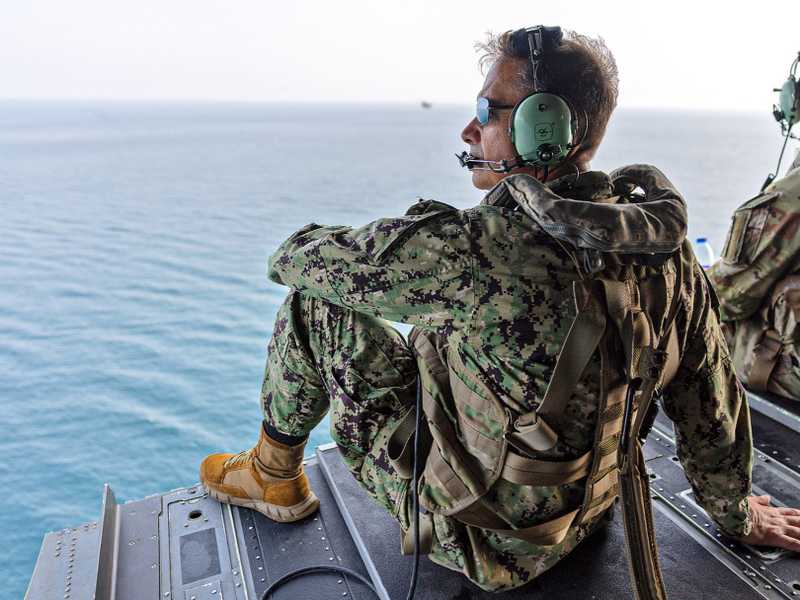
CENTCOM commander inspects “Hormuz”: Transit routes are free of mines. Admiral Brad Cooper, commander of the U.S. Central Command (CENTCOM), visited the Strait of Hormuz today (Sunday) to assess the current operational situation while flying in a U.S. Army CH-47 Chinook helicopter over the international waterway. Cooper stated: “We continue to stand shoulder to shoulder with our partners in the Gulf and the shipping sector... This visit reaffirms our strong commitment to ensuring freedom of navigation through the Strait of Hormuz.”
During the trip, Kupper met with members of the U.S. service who supported the mine clearance mission, and thanked them for their ongoing commitment and dedication. Kupper said, “Today, the main transit routes in the Strait of Hormuz remain free of Iranian naval mines thanks to the tremendous efforts made by our people. We continue to focus intensely on ensuring the continued flow of commercial navigation, in coordination with our colleagues in U.S. agencies, the Gulf Cooperation Council, and the maritime shipping sector.”
