Al-Marzouq: Let's Make the Gulf a Global 'Silicon Desert'
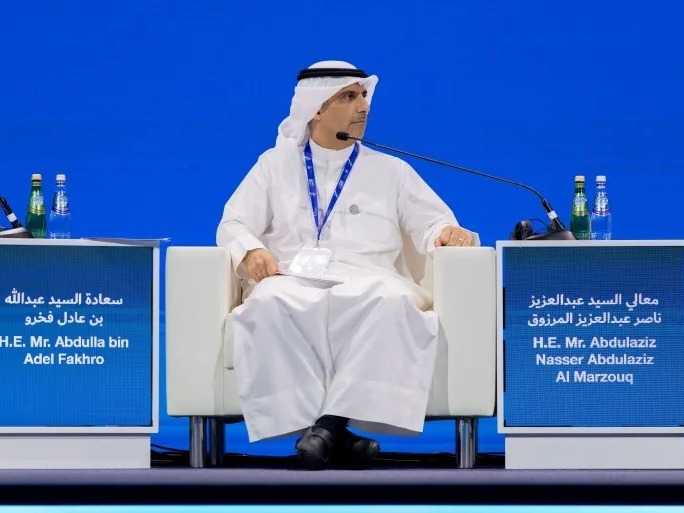
Gulf ministers and officials proposed initiatives to enhance economic and logistical integration and attract investments in technology and industry sectors during the Qatar Forum.
Translated by Qiyas from القبس — Original source
State Minister for Economic Affairs and Investment, Abdulaziz Al-Murri, called for focusing on the “quality and value” of investment, not just its size, proposing a initiative to transform the Gulf into what he termed a global “Silicon Desert.” He based this proposal on the region’s vast abundance of both clean and conventional energy sources, which are essential for operating data centers, cloud computing services, and advanced artificial intelligence projects.
During his participation in the Global Investment Forum in Qatar, the minister emphasized that Gulf Cooperation Council (GCC) countries possess all the capabilities to become the emerging economic region of the future. He noted that the region is a source of energy, has a continuously developing human capital, and benefits from sovereign wealth funds and a suitable legislative environment to attract investments.
For his part, Undersecretary of the UAE Ministry of Commerce, Fahad Al-Qarqawi, proposed launching a unified Gulf logistics corridor for exports and investment, in cooperation with the United Nations, represented by the United Nations Conference on Trade and Development (UNCTAD). The aim is to unify entry and exit points and support sectors such as the food industry. He confirmed that this corridor would strengthen supply chains in the region, allowing goods to enter through one port while exiting and being exported through another corridor within GCC countries, adding that the United Nations could support this initiative.
Meanwhile, Bahraini Minister of Industry and Commerce, Abdullah Adel Fakro, revealed his country’s experience in identifying the top 12 industrial sectors based on imports that could be replaced by local products, calling for the adoption of this model across the Gulf to avoid duplicating investments. Minister Fakro stressed the necessity for Gulf countries to expand international free trade agreements to overcome the region’s limited population size, which accounts for less than 1% of the world’s population.
On another note, Qatari State Minister for Foreign Trade, Ahmed bin Mohammed Al-Sayed, called for greater integration among Gulf countries to attract numerous investment projects, particularly those led by the private sector, including data centers and cloud service providers. He predicted that integration among GCC countries in modern technology would generate a massive new economy for the region, alongside the importance of enhancing logistical connectivity between these nations.
Finally, GCC Secretary-General Jassem Mohamed Al-Bedawi reviewed indicators positioning the Council as a unified economic bloc among the world’s top 10 economies, with a gross domestic product (GDP) of $2.4 trillion, foreign trade exceeding $1.8 trillion, sovereign assets surpassing $5 trillion, and an average per capita income of $38,000. He clarified that the balance of foreign direct investment (FDI) inflows to GCC countries exceeded $792 billion, of which more than $171 billion represents the value of intra-GCC investments. He affirmed that investing in any GCC country does not mean entering merely a “single national market,” but rather a cohesive regional system reinforced by projects such as the Gulf Customs Union, the Common Market, financial payment linkages, and the Gulf Railway project.
