Rocks spontaneously ignite
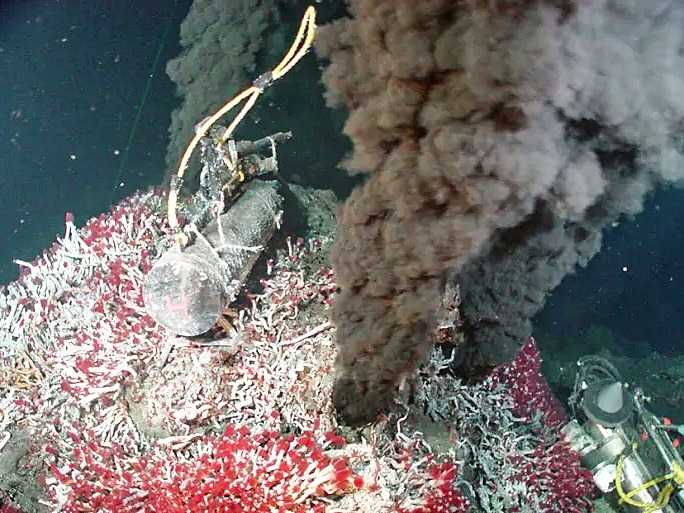
A research team from the Pacific Coastal and Marine Science Center of the US Geological Survey discovered spontaneous rock ignition
Translated by Qiyas from القبس — Original source
A recent study published in the journal Scientific Reports revealed that certain sulfur-rich rocks around hydrothermal vents on the seafloor can spontaneously ignite without an external flame source. Hydrothermal vents on the ocean floor discharge hot, mineral-rich water, which over time leads to the formation of mineral-rich deposits that can become valuable sources of copper, zinc, gold, and silver. However, these deposits also contain sulfur-bearing minerals that can generate heat when they react with oxygen in the air. If this heat accumulates, the material may spontaneously ignite. This phenomenon was discovered by chance by a research team from the Coastal and Marine Geology Program of the U.S. Geological Survey, while working on 57 rock samples collected from Axial Seamount in the northeastern Pacific Ocean, an area containing mineral deposits associated with hydrothermal vents. The samples were collected in 2022 and underwent freeze-drying to remove water, followed by preparation for laboratory analysis. During sample preparation, researchers noticed that two samples began producing heat and smoke, with their temperatures rising to over 100 degrees Celsius, and then ignited without an external flame. Heat generation even began before the rocks were crushed. The incident did not go unnoticed, as the researchers had to explain it. They compared the igniting rocks with non-igniting ones to identify differences, using microscopy, chemical analysis, and mineral identification. The comparison concluded that the two igniting samples were rich in marcassite, an iron sulfide mineral, whose structure features fine crystals, fractures, and voids that may increase its exposure to oxygen.
