UN Resident Coordinator in Kuwait: Kuwait's Experience in Humanitarian Diplomacy and Mediation Qualifies It to Build International Consensus
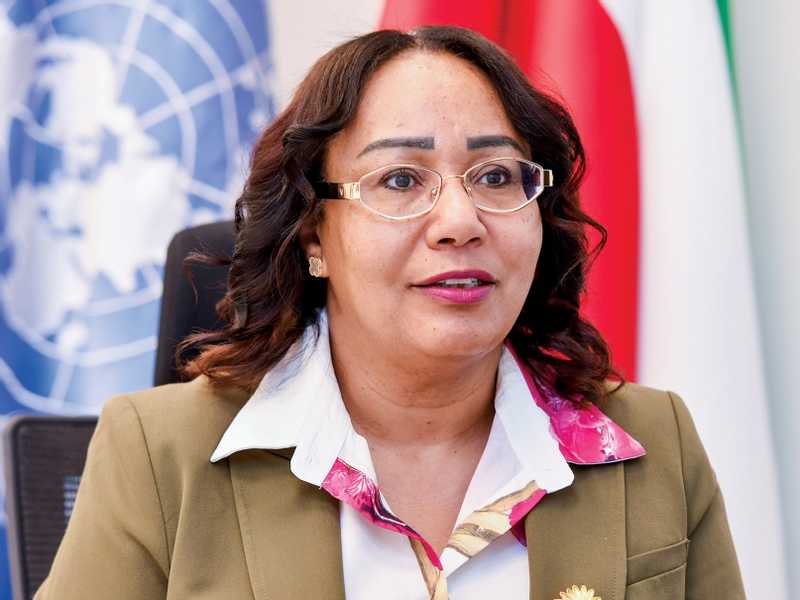
Ghada Fathi: Kuwait's experience in humanitarian diplomacy qualifies it to build international consensus.
Translated by Qiyas from القبس — Original source
The UN Resident Coordinator in Kuwait, Ghada Taher, affirmed that Kuwait’s re-election to the Human Rights Council for the 2027–2029 term represents a renewed responsibility and an important opportunity to continue its contribution to the multilateral work system, noting that Kuwait’s receipt of 173 votes reflects the significance of its role in international institutions.
In an interview with KUNA on Saturday, Taher stated that Kuwait previously served on the Human Rights Council during the 2011–2014 and 2024–2026 terms, and that the UN General Assembly has renewed its trust in Kuwait for a new term extending from 2027 to 2029.
She pointed out that Kuwait’s recent election to the Board of Governors of the International Atomic Energy Agency (IAEA) for the 2026–2028 term, along with its assumption of the Board’s presidency for the 2026–2027 period, reflect its growing presence in international institutions concerned with human rights, peace and security, nuclear safety and security, non-proliferation, and the peaceful uses of technology.
Taher emphasized that Kuwait’s expertise in humanitarian diplomacy and mediation can help build consensus on issues that have become highly polarized within the international system, thereby enhancing dialogue and cooperation and supporting efforts to protect human rights and uphold human dignity in the region and worldwide.
Regarding the UN’s assessment of Kuwait’s efforts to promote and protect human rights, Taher said that human rights represent a continuous journey for all countries, not a destination that a country reaches and then stops working toward. She stressed the importance of viewing Kuwait’s experience through the lens of achievements made, areas still requiring progress, and opportunities to build on existing reforms.
She added that the recent period has witnessed important legislative and institutional steps in Kuwait, particularly in the fields of protecting women and the family, enhancing children’s rights, raising the minimum age of marriage to 18, and repealing certain legal provisions that had been subject to human rights recommendations.
She highlighted efforts related to the rights, empowerment, and social and labor market integration of persons with disabilities, emphasizing the importance of continuing and strengthening these steps with additional measures that contribute to advancing human rights across all its dimensions.
On the key priorities the UN hopes Kuwait will focus on during its new membership in the Human Rights Council, Taher said there is a clear framework for member states’ obligations under international human rights law, including the outcomes of the Universal Periodic Review, recommendations from human rights treaty bodies, and special procedures of the Human Rights Council.
She added that the expectation is to build on existing momentum and more closely link international commitments with national implementation, making the next three years a period in which progress can be measured more clearly.
She pointed to the importance of continuing to strengthen fundamental rights and freedoms, expanding women’s participation as partners and leaders in decision-making rather than merely as beneficiaries of policies, and enhancing their role in peace, security, and humanitarian work.
She also stressed the need to continue developing protections for workers, expanding the effective inclusion of persons with disabilities, investing in children and youth, and promoting equality and access to justice.
She underscored the importance of developing effective national mechanisms to follow up on international recommendations and measure their implementation, clarifying that the goal is not the number of reports or recommendations, but the tangible change they bring to people’s lives.
Important tools and the role Kuwait can play in enhancing international dialogue and consensus on human rights issues were discussed. Al-Taher stated that the Human Rights Council, like many institutions of the multilateral system, operates in an international environment marked by sharp polarization. She added that Kuwait’s experience in mediation, preventive diplomacy, and humanitarian action provides it with important tools for building bridges and bridging differences, noting that this approach aligns with other international responsibilities undertaken by the country. Regarding ways to strengthen cooperation between the United Nations and Kuwait to support its human rights efforts in the coming period, Al-Taher emphasized that this cooperation already exists and is not something that will begin only after Kuwait’s re-election to the Human Rights Council. She added that the essence of the partnership between Kuwait and the United Nations, after 63 years, is no longer limited to Kuwait’s membership in an international organization, but has evolved into a broad network of cooperation spanning sustainable development, humanitarian action, human rights, peace and security, youth and women’s empowerment, and climate action.
