Emir of Qatar: Security of the region and the world is interconnected; destabilization cannot be isolated from the rest of the world
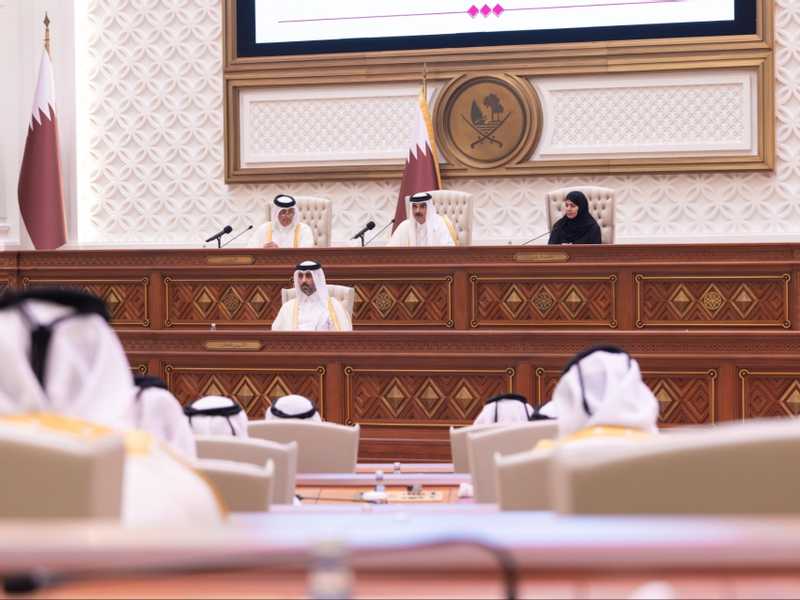
Sheikh Tamim bin Hamad Al Thani affirmed the interconnection of the region's and the world's security, stressing the necessity of Gulf cooperation, economic diversification, and protection of energy facilities, while emphasizing the peaceful resolution of crises.
Translated by Qiyas from القبس — Original source
Qatar’s Emir, Sheikh Tamim bin Hamad Al Thani, stated that the security of the region and the world is interconnected, and that instability in any place cannot be isolated from the rest of the world, emphasizing the necessity of continued cooperation and coordination among the member states of the Gulf Cooperation Council (GCC).
Speaking at the opening of the second regular session of the second legislative term of the 55th annual session of the Shura Council on Tuesday, the Emir of Qatar noted that Qatar and the region have faced exceptional events that once again demonstrated the strength of state institutions, social cohesion, and the ability to handle crises with competence and responsibility.
He added that “the security of the GCC states, the protection of their sovereignty, and their stability are matters that cannot be overlooked or treated with laxity, and they require us to double our efforts to ensure navigation in the Gulf and the Strait of Hormuz, and to protect energy facilities, water resources, and civil infrastructure.”
The Emir of Qatar recalled that his country has shouldered three responsibilities simultaneously during this crisis: protecting its sovereignty, fulfilling its role in global energy security and the economy, and keeping diplomatic channels open. He explained that Qatar’s strategy to bear these responsibilities consists of four core elements. These elements include: resolutely defending the homeland without being drawn into war; maintaining essential services, supply chains, and economic life; contributing to efforts to achieve a ceasefire and open maritime passages; and seeking opportunities to return to negotiations to reach peaceful solutions to the conflict.
He pointed out that Qatar supplies about one-fifth of the world’s liquefied natural gas (LNG) trade, and any disruption to it quickly impacts markets and consumers everywhere. He noted that the closure of the Strait of Hormuz and the direct damage sustained by some energy facilities in the industrial city of Ras Laffan led to the disruption of a significant portion of the country’s exports.
Sheikh Tamim emphasized the commitment to continuing the growth of non-hydrocarbon sectors, aiming for their contribution to reach approximately 80% of real GDP. He added that the state has placed the protection of human life, securing people’s needs, and enhancing economic activity at the top of its priorities.
He noted that the national economy faced this crisis from a strong foundation, as 2025 achieved real growth of 2.9%, with inflation stabilized at an average of half a percent annually, and a current account surplus was recorded.
The Emir of Qatar said it was natural for the crisis to negatively impact public finances, as total revenues fell by 42% during the first half of the year, while public expenditures decreased by 14%, without affecting basic services or developmental priorities.
He stressed that the goal is for recovery to serve as a springboard for accelerating economic diversification and strengthening national capabilities, pointing to a package of projects and investment opportunities valued at approximately 221 billion riyals (about $60 billion) over the next five years.
In the energy sector, Sheikh Tamim confirmed that the expansion of the North Field gas project is proceeding according to plans to increase the state’s LNG production capacity. He also noted significant progress in the “Golden Pass” project in the United States, while QatarEnergy’s investments and international partnerships are expanding in parallel with the development of petrochemical industries, solar energy projects, and enhanced water security.
He highlighted that Qatar ranks first regionally in the 2026 Food Systems Resilience Index, noting that Qatar faced an attack on its territory by Iran, which constitutes a blatant violation of its sovereignty, international law, and principles of good neighborliness.
The Emir of Qatar praised the armed forces and security agencies for fulfilling their duty to defend the homeland, and paid tribute to the martyrs who sacrificed their lives in defense of Qatar.
The Emir of Qatar stated that “insisting on dialogue and peaceful solutions does not mean being lax in defending our country, nor does our right to defend our sovereignty conflict with our commitment to preventing the war’s scope from widening.” He emphasized that Qatar has always preferred to resolve disputes through dialogue, negotiation, and diplomatic means. Regarding the Palestinian issue, he affirmed that it “remains at the forefront of our priorities,” noting that what has occurred in the Gaza Strip is, beyond doubt, genocide, and its perpetrators must not escape accountability. Sheikh Tamim warned against the dangers stemming from the ongoing aggressive practices of the Israeli occupation against the Palestinian people, including recent settler attacks on Palestinians in the West Bank, backed by occupation forces, as well as repeated incursions into Al-Aqsa Mosque and violations of international law, the UN Charter, and international humanitarian law. He reiterated Qatar’s steadfast position on finding solutions to crises in the region—specifically in Sudan, Libya, Yemen, and Somalia—through necessary political agreements that are comprehensive and fair, preserve the unity and territorial integrity of these countries, and safeguard the interests of their peoples in terms of security and stability.
