Eulogy by Dr. Mohammed Al-Abdulkader: The Final Farewell
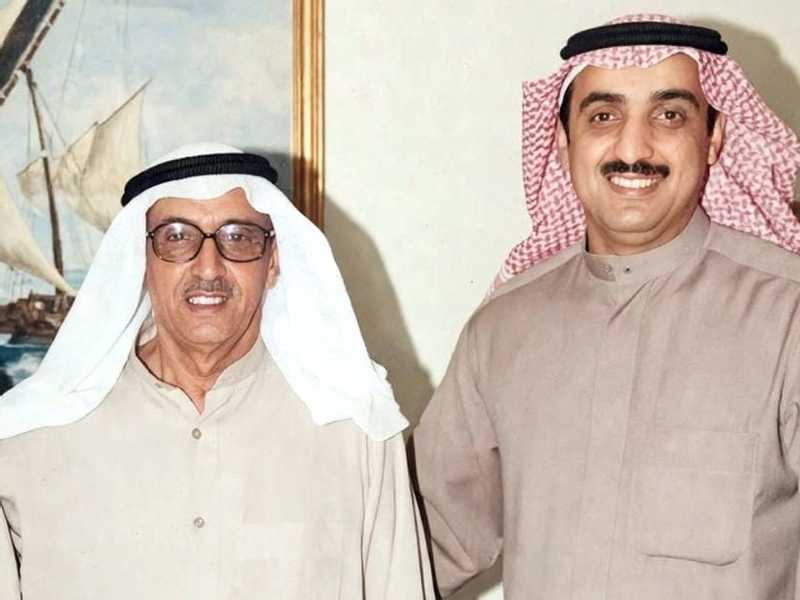
“Every breath tastes of death.” With the passing of my father, the last thread connecting us to the people of the sea was severed. He spoke to me of India, of Calicut, Karachi, Aden, and the coasts, of Mombasa. He told me about the roles of Kuwaiti merchants, their captains, and sailors, and about the honor of one’s word, the hardships of life, and the economic stagnation between the First and Second World Wars. The captain has departed, with whom I spent years of my life until I reached sixty, passing like clouds. He was my compass, my stern, and my sails, which he loved to talk about. He was a true captain who faced life in all its vicissitudes and navigated through a time when the world changed. He told us stories from the legends of the ancients. He lived in the age of the sea and its terrors, and in the age of the transition to oil, salaries, and their conditions. He moved through Kuwait’s urban landscape, from old Kuwait with its landmarks and markets, to the wooden house where he was born in the Central District, specifically in Al-Khosa neighborhood, at the beginning of Ghaneem neighborhood, at the site of the old Central Bank in Bahita, near the water pond where he saw his father, grandfathers, and Kuwaiti men saving Kuwait from thirst by leading wooden water ships and bringing them to a barren land. With the transformation of life and the country’s rise, he left the wooden house in the late 1940s, staying briefly with his family in Al-Murqab, next to the site of Al-Wazan Mosque, where he continued to pray Friday prayers until illness confined him.
He, along with the people of Kuwait, witnessed the transition from a life at sea to oil revenues in the 1950s. He worked in the Electricity Department, specifically in its finance section, which later became the Ministry of Electricity and Water. He worked as an accountant with complete honesty and simple Kuwaiti integrity, remaining there until his retirement in the 1980s. During that period, we moved from my grandfather’s house in Al-Fayhaa, where I was born with my siblings, to living in the Al-Nuzhah area. During the 1973 war, I listened to the radio with him about the glorious October victories, whose anniversary coincides with his passing these days. He took me to the offices of Members of Parliament Ahmed Al-Khatib, Jassem Al-Qutami, Sami Al-Munees, Abdullah Al-Nabari, and Ahmed Al-Nafisi, and later I worked with all of them. I subsequently participated in public service until my entry into the National Assembly in 2008 as a representative of the Second Constituency.
He instilled in his home a love for Kuwait, its rulers, and its people. I saw him standing tall and resilient in the face of the earthquake that struck us during the Iraqi invasion of Kuwait, which he predicted after Saddam Hussein’s threatening speech, based on his simple intuition. He stood by me at every stage, in my failures and successes, and supported me in every mistake. As a father and teacher, he always advised me to be kind to people throughout my public service. His advice was: “If you cannot benefit people, my son, do not strive to harm them.” This is an advice I heard from him, and which was echoed by the elderly men of Kuwait. I saw him patient and seeking reward, losing his family and loved ones one by one. He lost his sight and ability to walk, then we lost my mother, then my eldest brother. May God have mercy on them. He stumbled through various stages of illness and began to lose his health little by little, yet he continued to resist, like the patient and steadfast. He was the captain of a ship whose crew was his family and loved ones, directing and inquiring about everyone. He rose above trivialities, becoming great; he showed indifference to little, and much came to him. I lived with his illness until its final stages, marked by several “deafnesses,” but this was the “final deafness,” as the people of the sea call it, which I experienced since last Ramadan, accompanied by the sounds of war in our area, and sometimes by air raid sirens. He fought weakness silently, silently, and loudly at times. I gave the preliminaries for the end of the journey when he lost control and consciousness. It is the cycle of life and God’s law on earth; every term is written, and every “deafness” has a port.
In conclusion, if there is a word, it is gratitude and appreciation to the entire medical team at Al-Amiri Hospital, especially the Ninth Floor team, the Internal Medicine team led by Dr. Maryam Al-Rajhi, the Kidney team led by Dr. Anas Al-Yousef, and the senior management from the Director to my brother Dr. Oosan Al-Muhaini, and the wonderful nursing staff, who made a great effort in his care. Your departure is hard on me, oh dearest of those I have lost, and your separation, oh towering peak, is the will of God, which cannot be avoided. The captain departs, leaving behind his heavy cargo and sails that will not be furled. May God have mercy on you, oh my father. May He join you with your fathers and ancestors in the ranks of the righteous and the truthful. You are the pioneers, and we are the followers.
* The Final Deafness (The Final Journey)
Dr. Mohammed Al-Abdulkader
