Minister of Social Affairs: Protecting the Charitable Sector from 'Mercenaries and Interlopers'
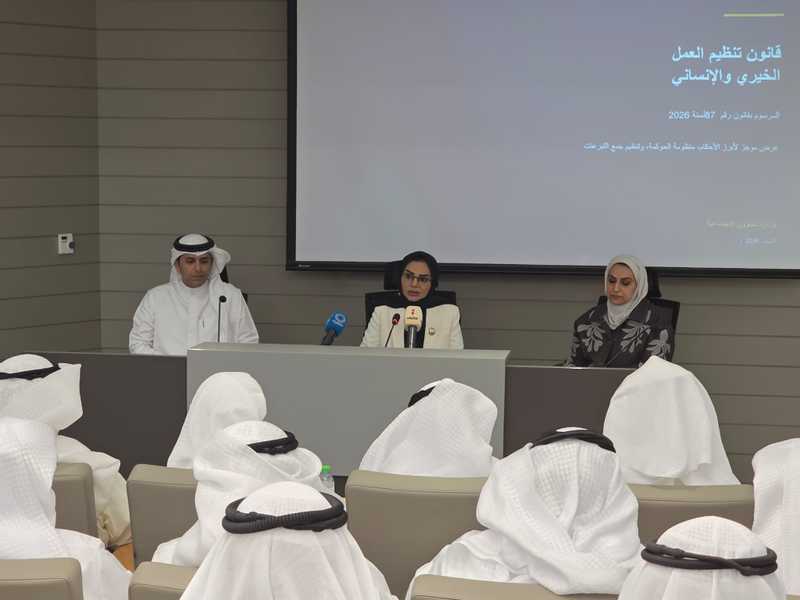
Faisal Matar: Minister of Social Affairs, Family, and Childhood Affairs, Dr. Amthal Al-Huwail, affirmed that the Law Regulating Charitable and Humanitarian Work is intended to support and regulate this sector, not to restrict associations. She stressed the importance of protecting it from “mercenaries and interlopers” and from any interventions that could harm or negatively impact it.
Speaking during her meeting with representatives of charitable associations to discuss the law, Al-Huwail expressed confidence in the associations and the charitable sector, despite any “impurities” that may appear within it. She emphasized that protecting the sector is an important mission and a great trust placed on those responsible for it. She noted that some individuals with weak resolve use association names and exploit them, and that some of these individuals, unfortunately, may be employees within the associations themselves. She called for immediate reporting to the competent authorities upon detecting any exploitation of an association or its name during events, forums, or fundraising campaigns.
She stressed the necessity of maintaining an open line and continuous communication with the charitable sector, enabling the ministry to fulfill its duty of protecting associations and their reputations. She clarified that those managing the associations are closer to identifying suspicious transactions and indicators, given their familiarity with the associations’ operations and staff. She affirmed that cooperation in this regard facilitates the adoption of necessary legal measures, noting that the ministry does not accuse anyone, delve into intentions, or place blame on anyone; rather, it is keen on protecting the sector and preserving its reputation, as exploitation attempts affect various sectors worldwide.
Al-Huwail stressed the importance of adhering to legal controls when selecting association employees and conducting security background checks, explaining that this procedure is also followed as a precaution in ministries and the public sector, and does not imply accusation or lack of trust. She called for selecting employees with appropriate expertise and qualifications for the nature of their roles, and placing the right people in the right positions, thereby enhancing competence, integrity, and governance within associations, which are increasingly under global scrutiny.
She emphasized the importance of localizing charitable work and directing donations and charitable projects toward Kuwait, stating, “Your goodness is for your people,” and clarifying that meeting the needs of Kuwaitis and those living in Kuwaiti society may be more deserving, without implying that assisting others abroad is prohibited, as the role of associations in this area is well-known and clear.
She explained that the law provides a clear framework to help sustain and develop charitable and humanitarian work, and to maintain trust among associations, donors, and beneficiaries. She affirmed that it is a supportive law for both associations and the state, and does not aim to restrict them. She added that the ministry acts in accordance with international conventions and Kuwait’s evaluations, and that the law regulates, distributes, and clarifies responsibilities, enhances transparency and governance, and safeguards an important sector that has a significant impact and clear footprint on Kuwait’s charitable landscape.
She pointed out that protecting this work is a shared responsibility between the ministry and the associations, requiring adherence to laws and regulations, oversight of associations’ operations and procedures, and monitoring of financial, administrative, and reporting aspects, as well as staff, each according to their respective responsibilities and jurisdictions.
Al-Huwail noted that the ministry is preparing the executive regulations for the law in preparation for their issuance, through a specialized committee that requested consultations with experts and specialists in the field. She invited association representatives to submit their observations and participate in drafting the regulations, stating, “This is your place and your area of expertise, and we need you to join us in preparing the executive regulations.”
