Digger: Tom Cruise in the Role of His Life, New Chances for an Oscar Win
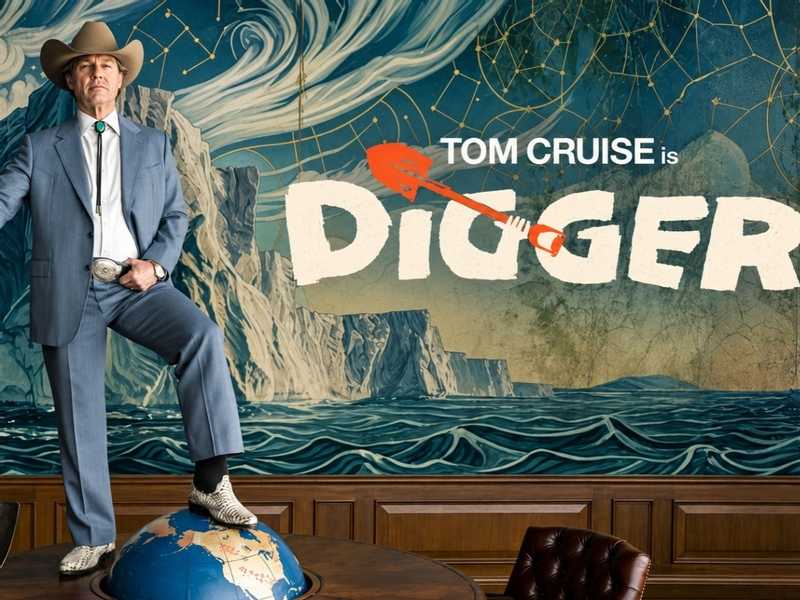
Amjad Jamal - From the very first promotional images released from the behind-the-scenes of the film *Digger*, the question was: What has Tom Cruise done to himself? A face we don’t recognize, strange makeup, swollen features, and a demeanor that seems as if time has punished him. Curiosity about the film intensified, especially since it comes from the pen of the Mexican Oscar-winning director Alejandro González Iñárritu, the filmmaker behind *Birdman* and *The Revenant*. He is a director who does not make films to pass quietly; his works invite debate and test the boundaries of the cinematic medium. The result lived up to this curiosity. Cruise and Iñárritu did not stray from the ambition expected of them, delivering a film full of artistic risks and completely outside the comfort zone they could have chosen for a project of this scale and budget, which exceeded $125 million. *Digger* is indeed one of the strangest films you can see in Hollywood today. It is a film worth watching, discussing, and talking about at length, not because it is a flawless or guaranteed-to-impress movie, but because it is a highly idiosyncratic and polarizing experience that you may love intensely or find utterly unbearable.
On its surface, the film tells an environmental disaster story about “Digger Raquel,” an extremely wealthy and influential oil exploration investor who finds himself embroiled in creating an environmental catastrophe that threatens humanity’s future. The world that made him rich through the exploitation of natural resources begins to pay the price for that exploitation, while those in power and wealth attempt to manage the disaster through their own interests and calculations. Notably, *Digger* approaches this idea from the start with a style leaning toward exaggeration. The characters are drawn with a high degree of caricature, the performances are louder than usual, and the visual details and sets sometimes operate in a space closer to farce than to realism. At first, this choice may seem strange, but as the film progresses, it becomes clear that it is an essential part of its language, justified later in the best possible way. Iñárritu does not want to present a realistic version of our world, but rather a world resembling ours, after its contradictions have been amplified to the extreme. Politicians behave absurdly, the wealthy continue to think in terms of self-interest, and international conflicts sometimes appear completely detached from the real danger facing everyone.
Around the first half-hour mark, a narrative surprise changes the shape of the film. A twist forces us to view the events in a completely different context. The film enters a metafictional narrative zone (where the text comments on itself, possessing a self-awareness that breaks the illusion and dissolves the barrier between reality and fiction), creating multiple layers of the story, each representing a distinct reality. This transition may cause a degree of frustration for the viewer at the moment of revelation, especially since breaking the illusion in this manner has acquired a bad reputation in modern cinema. Discovering suddenly that what you are watching might be a dream, a character’s imagination, a story being written by someone, or a play still in rehearsal has become a narrative device that can lose its impact if used merely for display or hollow complexity. Iñárritu had previously approached this territory in *Birdman*, the film that earned him the Oscar, but he used it there in a less radical way than in *Digger*. Here, the use of metafiction is more closely tied to the film’s structure and message, making it more appropriate and necessary. Importantly, this approach serves the actors, particularly Tom Cruise, by giving the performance more than one level and tone. The actor does not play the same character within a single reality but can move between different levels of performance, which justifies some exaggerations that might initially seem illogical. Furthermore, this style serves the film’s core idea concerning human survival and the protection of nature, but from another angle relating to the role and duty of the artist toward society. Here, the film reaches a highly pessimistic conclusion: it may already be too late for artists to play the role of preachers. This idea elevates the meta-narrative structure beyond mere exhibition, taking the film into a more intellectually stimulating space, making it visually more engaging, and allowing the film to critique itself: its pacing, its actors’ performances, its exaggerations, and even its preachy tone, which many films rely on when addressing climate and disaster issues.
**A Director Who Masters Layers**
The film’s success in handling these layers is largely due to the director. Iñárritu succeeds in tightly constructing a multi-layered world and extracting black comedy from the absurdity of the situations. He presents a film that is visually grand, but its pleasure does not rely on spectacle or effects, but rather on aesthetic ideas, visual compositions, and the details of constructing each scene. There is a fusion between cinematic mise-en-scène and theatrical mise-en-scène, such that transitions between scenes do not always rely on traditional cuts but merely on changing the camera angle. Iñárritu also blends multiple styles and tones: farce, absurdism, and deadpan comedy. These elements are not separate but flow from one to another within a single scene, making the film’s tone constantly shifting.
**A Calculated Display**
One of the film’s most brilliant scenes is the speech Digger delivers during his interrogation by the European Parliament. This scene took about ten minutes to shoot in a single continuous take without cuts. It is a marvel of acting, choreography, cinematography, and crowd direction, resembling a painting. The pale colors and sallow faces gave the scene a sense of human decay, reminding viewers of the frames of the renowned Swedish director Roy Andersson, who uses this technique in many of his films to express the human condition and man’s place in a world that has lost much of its vitality. Director of Photography Emmanuel Lubezki succeeds in moving the camera between the protagonist and the surrounding crowds with lightness, and the scene does not feel like it devolves into a technical display at times. Meanwhile, the protagonist’s monologue is filled with bold ideas and is not devoid of humor, particularly in his condemnation of all humanity for violating nature due to their selfishness and continuous desire for displays of luxury.
**Tom Cruise: Give Him the Oscar Now**
Tom Cruise is the element in the film about which it is difficult to disagree. He delivers a role of his life, both in the different appearance of the character and in the way he builds the performance from within. Digger is a strange, unpleasant, loud, selfish, ugly, and crude character. Cruise blends his enjoyable performance between classical theater with its exaggerated movements and intense emotions, and another side that is calmer and more balanced, seamlessly shifting to the other side of the character and moving between the two as the scene requires. Even the physical transformation was exhausting. The character’s makeup took about six hours to apply at the beginning, plus two hours to remove. This is one of the amusing details that reveal the extent of the commitment Cruise placed in embodying the character. Therefore, *Digger* represents an ideal opportunity for Tom Cruise to finally win an Oscar. He has demonstrated serious and complex acting abilities in his transformation that qualify him for the award. It would be a fully deserved prize and a culmination of a cinematic career that has been rich and influential in the film industry on multiple levels. Cruise has not only used his stardom for action films that helped revive Hollywood’s box offices but has also supported alternative cinematic experiments that would not have easily secured large funding without his name, including this film. Previously, he did so with Stanley Kubrick in *Eyes Wide Shut*, with Paul Thomas Anderson in *Magnolia*, and with Cameron Crowe, Sydney Pollack, and others. He is a man who loves his profession, loyal and dedicated. Therefore, his winning the award for *Digger* will not be an appreciation of this role alone, but an acknowledgment of a star’s career that has served the film industry from within and outside for many years, defending the big screen and its symbolism in viewing. The time has come for Tom Cruise to receive his literary due as an actor, not just as a star.
**Riz Ahmed**
On the other hand, the appearance of actor Riz Ahmed in the role of the scientist “Janesh” is the fruit of the film. The character tries to warn politicians that the situation is getting out of control, but his warnings are met with indifference, so his reactions gradually become humorous as events escalate. Ahmed plays the character with a degree of calmness that makes it seem as if it came from a film by a master of deadpan comedy like Wes Anderson. He did not need to exert much effort to be funny, because the comedy comes essentially from the contradiction between what he knows and what others refuse to acknowledge.
**Set Design as Hero and Music as Nature’s Voice**
The production design and set decoration are among the most important elements of *Digger*’s strength, as they create a highly distinctive visual container for the events. Iñárritu makes the location part of the narrative and comedy process simultaneously. Simple movements of some set elements can be responsible for part of the humor. A change in location, the movement of an element within it, or a light source can become the joke itself. This suits the theatrical nature of the work. For this reason, Iñárritu used the wide-frame VistaVision technique to shoot the film, allowing for a clearer image and greater ability to convey the details of the frame in its breadth. As for the score, composed by Cosmo Sheldrake, it was notable for using natural sounds of birds, frogs, and insects, mixed with fragmented phrases played by wooden and brass wind instruments, within an acceptable and melancholic harmony despite its brightness. He also uses rhythms of banging and collision sounds derived from daily life. The result is a captivating and exciting soundtrack, and importantly, it is directly linked to the film’s idea: nature speaks through the music.
**Critics’ Verdicts Are Not the End**
It is not surprising that critics are divided over *Digger*. It does not offer an easy experience, and negative reviews dominated its initial reception, where its rating on Rotten Tomatoes did not exceed 60%. Many reviewers saw it as a weaker version of Stanley Kubrick’s masterpiece *Dr. Strangelove*, particularly in its satire of power and political decisions that lead the world toward destruction. However, critic Josh Larsen pointed out an important point in his review: even *Dr. Strangelove* was not received with fanfare at its release! It did not reach the status of a classic masterpiece we know today but acquired its status over time. This point does not necessarily mean that *Digger* will become a future classic, but it reminds us that some films need time for us to know their true place, especially when they are highly different from the mainstream.
*Digger* also arrives at a notable time; it is the last major film produced by Warner Bros. studios before its acquisition by Paramount Skydance through the controversial deal. This reflects a certain poetry. We tell the story of a film that presents the end of the world, and it itself comes as the end of this prestigious production company.
In conclusion, *Digger* is not a film made to please everyone, and perhaps this is one of its most important strengths. It is a film that takes real risks in terms of form, structure, and performance, and places the issue of climate, politics, and the role of the artist within a complex meta-narrative experience. Most beautifully, it is a film that does not end with its events but begins to work inside your mind as you watch the end credits.
