Secretary General of the Council of Ministers confirms Kuwait's commitment to implementing 'GCC Supreme Council' decisions
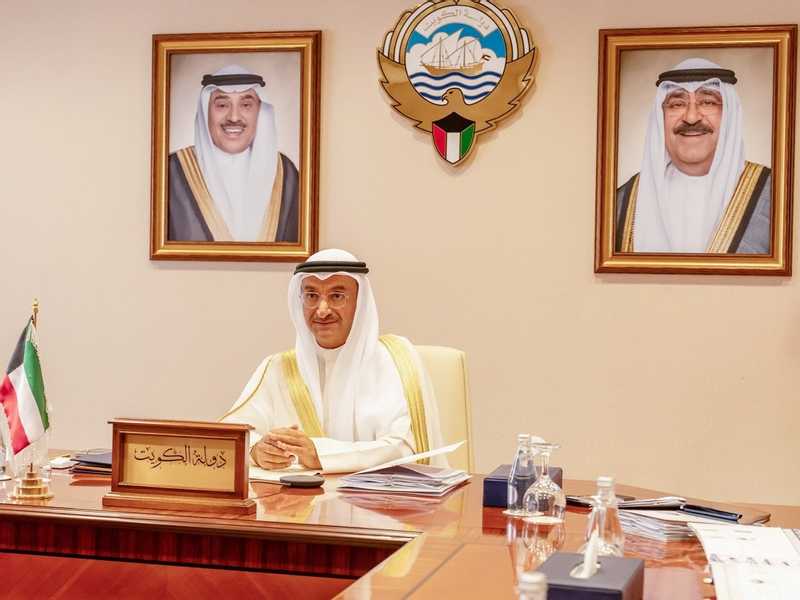
Saleh Al-Mulla confirms Kuwait's commitment to implementing decisions of the GCC Supreme Council during the ministerial committee meeting
Translated by Qiyas from القبس — Original source
Secretary-General of the Council of Ministers Saleh Sulaiman Al-Mulla affirmed the State of Kuwait’s full commitment to continuing efforts to complete the implementation of all decisions issued by the Supreme Council of the Cooperation Council for the Arab States of the Gulf, based on Kuwait’s conviction in the importance of comprehensive and integrated implementation of those decisions to achieve their intended objectives. This was stated in a speech delivered by Al-Mulla at the 27th meeting of the Ministerial Committee tasked with monitoring the implementation of decisions related to joint work within the Cooperation Council, held today, Sunday, via video conferencing technology, in the presence of Secretary-General of the Cooperation Council for the Arab States of the Gulf Jassem Al-Budaiwi.
Al-Mulla said that the rapid challenges and changes witnessed by the region and the world require the GCC member states to strengthen their unity and integration and to multiply efforts to accelerate the pace of joint GCC action. He added that “the full implementation of joint GCC decisions is no longer merely an administrative or procedural matter, but has become a strategic necessity to enhance the Cooperation Council’s capacity to respond to challenges, consolidate its security and stability, achieve sustainable development, and strengthen its regional and international standing.”
He emphasized that the regularity of this committee’s meetings and the constructive discussions and precise follow-up they feature reflect a shared commitment to implementing the Supreme Council’s decisions, not merely adopting them, thereby ensuring their tangible impact on the reality of joint GCC work and on the interests of the citizens of the member states.
He pointed out that the Cooperation Council’s success in fulfilling its mandate is measured by its ability to translate the directives and decisions of the leaders of the member states into practical outcomes that GCC citizens experience in their daily lives, whether through facilitating their movement, residence, and work, enhancing their access to economic, educational, health, and social opportunities, or providing a more integrated, secure, and prosperous Gulf environment.
Al-Mulla clarified that, thanks to the wise vision of the leaders of the GCC member states, the Council has been able to consolidate its position as a successful regional system and achieve numerous accomplishments and gains across various fields of joint work, including political, economic, security, social, developmental, and humanitarian areas.
He noted that it is everyone’s responsibility to preserve these gains, work to develop and highlight them in a manner that aligns with the aspirations of GCC citizens, strengthens their sense of Gulf citizenship, and enables them to fully benefit from the decisions, regulations, and programs adopted by the member states.
Al-Mulla reiterated that the State of Kuwait, in line with its steadfast approach and firm belief in the importance of the Cooperation Council as the unifying Gulf home, will continue to support all initiatives that enhance its progress, consolidate its unity and integration, and will keep working and coordinating with member states and the Secretariat-General to complete the implementation of joint decisions and overcome any challenges, thereby embodying the directives of the leaders and realizing the hopes and aspirations of their peoples.
The meeting was attended by Mariam Al-Hamadi, Minister of State and Secretary-General of the Council of Ministers of the United Arab Emirates; Ghanem Al-Buainain, Minister of Affairs for the Shura Council and National Assembly of the Kingdom of Bahrain; Khaled Al-Abdulkarim, Secretary-General of the Council of Ministers of the Kingdom of Saudi Arabia; Sheikh Al-Fadh Al-Harthi, Secretary-General of the Council of Ministers of the Sultanate of Oman; and Hamad Al-Muhaindi, Secretary-General of the Council of Ministers of the State of Qatar.
The Kuwaiti delegation to the meeting was chaired by Secretary-General of the Council of Ministers Saleh Sulaiman Al-Mulla and included Assistant Secretary-General for Administrative and Financial Affairs at the Secretariat-General of the Council of Ministers, Sheikh Sabah Ahmad Al-Sabah Al-Salem Al-Sabah; Faisal Mohammed Al-Awadi, Advisor for Gulf Cooperation Council Affairs at the Ministry of Foreign Affairs; Adel Al-Sayed Omar, Director of the Office of the Secretary-General of the Council of Ministers; Malak Rahim Al-Rashidi, Director of the Department for Monitoring the Awarding of Military Medals and Ribbons and International Agreements at the Secretariat-General of the Council of Ministers; and Rasha Abdullah Al-Asigha, Director of the Technical Office at the Secretariat-General of the Council of Ministers.
