Finance Minister: Importance of Development Banks in Facing Economic Changes
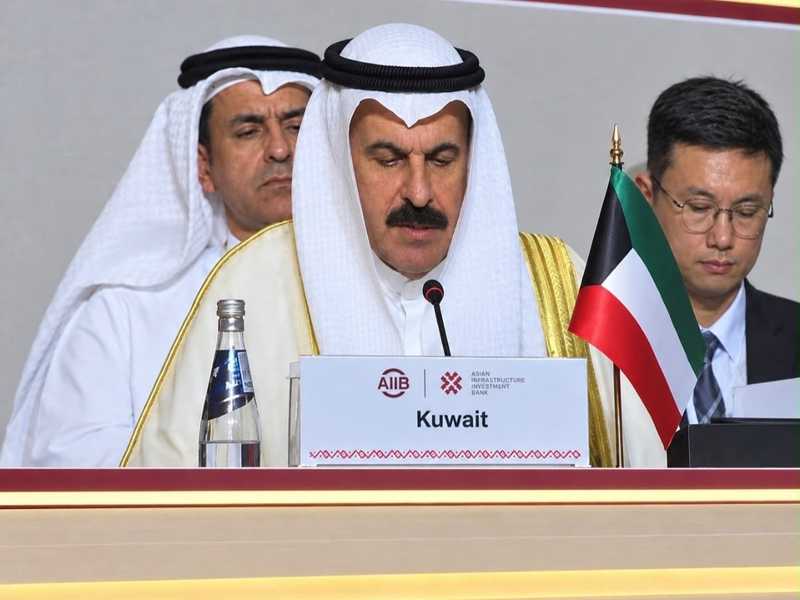
Kuwait's participation in the annual meeting of the Asian Infrastructure Investment Bank in Qatar.
Translated by Qiyas from القبس — Original source
Kuwait participated today, Monday, in the 11th Annual Meeting of the Board of Governors of the Asian Infrastructure Investment Bank (AIIB), led by a delegation headed by Minister of Finance Dr. Yaqoub Al-Rifaie. The two-day meeting was hosted and attended by Qatar’s Prime Minister and Minister of Foreign Affairs, Sheikh Mohammed bin Abdulrahman Al Thani, and AIIB President Zou Jiaji. It also included the participation of Kuwait’s Ambassador to Qatar, Ahmed Al-Sharrah, alongside finance ministers, governors, delegations from member countries, senior experts, private sector leaders, and civil society organizations.
Held under the theme “Infrastructure for Tomorrow: Impact and Innovation,” this year’s meetings hold particular significance as they mark a key milestone in the AIIB’s transition into its second decade. Amid rapid economic and financial changes, there is an imperative to strengthen the role of development finance institutions, enhance their tools and operational mechanisms, and enable them to respond to member countries’ needs, support sustainable and innovative infrastructure projects, and achieve greater developmental impact.
These meetings coincide with the 10th anniversary of the Bank’s operations, representing a moment to evaluate past achievements, outline priorities for the next phase, and chart the strategic direction for the Bank’s second decade. The meeting highlights the pivotal role of the Middle East region in enhancing interregional connectivity and cooperation.
Minister Al-Rifaie participated in a special session of the Board of Governors, during which decisions related to the Bank’s operations were adopted and its strategic initiatives for the coming years were reviewed. He also took part in a roundtable discussion alongside ministers and governors of the AIIB.
In his address, Minister Al-Rifaie reaffirmed Kuwait’s conviction regarding the importance of development banks in addressing economic changes that have adversely affected many countries, impacting development trajectories and economic growth rates. He emphasized the need to strengthen coordination and cooperation among international financial institutions to bridge financing gaps, unify efforts to support member countries, and enable them to implement their development projects. He also stressed the importance of providing technical assistance and expertise to prepare bankable and executable projects, thereby contributing to sustainable developmental impact.
The Kuwaiti delegation, led by the Minister of Finance, included Saad Al-Rashidi, Director General of Economic Affairs and Second Alternate Executive Director at the Board of Governors of the AIIB; Ibrahim Al-Filikaawi, Director of the International Economic Cooperation Department; and several officials from the Kuwait Fund for Arab Economic Development.
Kuwait’s participation in the meeting reflects its commitment to enhancing its role and contribution to the Bank’s work, as well as strengthening partnerships with international and regional financial institutions.
Qatar’s Minister of Finance and President of the AIIB Board of Governors for 2026, Ali Al-Kuwari, stated in his opening address that Qatar was among the founding members of the Bank in 2015, driven by its belief in Asia’s need for a new institution focused on infrastructure development, governed by the highest standards, and open to the entire world. He added that after 11 years, with the Bank’s membership reaching 111 members and approved financing totaling approximately $70 billion, this conviction has been proven correct.
For her part, AIIB President Zou Jiaji emphasized that the Bank aims to expand its developmental impact and nearly double its annual financing volume by 2030, reaching approximately $20 billion, with a focus on financing future infrastructure. She noted that the Bank’s objective for the next phase is to broaden its developmental impact through innovation and integrity, explaining that achieving this goal requires increasing the Bank’s operational scale and leveraging its comparative advantages.
