Kuwait and Baghdad: Formation of a Working Group to Address Outstanding Issues
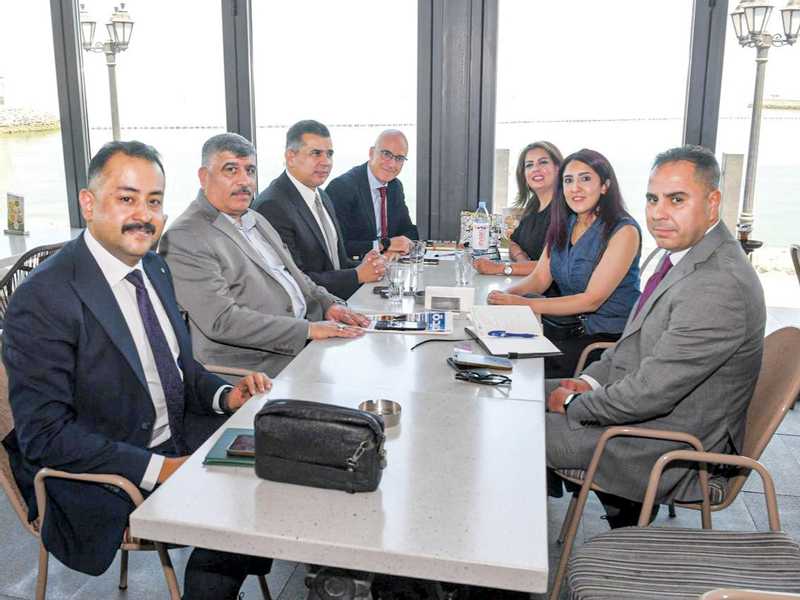
Mia Al-Sakri – Based on the outcomes of the meeting between His Highness Sheikh Sabah Al-Khalid, Prime Minister of Iraq, and Ali Al-Zaidi, Prime Minister of Iraq, held on the sidelines of the 81st session of the United Nations General Assembly in New York, and driven by the two fraternal countries’ commitment to strengthening bilateral relations and addressing outstanding issues in a spirit of brotherhood, good neighborliness, and shared interests, Kuwait and Iraq have agreed on the following:
1. The formation of a joint Kuwaiti-Iraqi working group tasked with reviewing outstanding issues, developing a roadmap for their resolution, and submitting joint recommendations to the leaderships of both countries within a period not exceeding thirty days.
2. The working group will hold its meetings alternately in Kuwait and Baghdad on a continuous basis until the completion of its mandate. Both sides reaffirm their full support for the group’s work and their commitment to ensuring the successful completion of its mission, which will contribute to resolving outstanding issues and opening a new phase of cooperation and partnership between the two fraternal countries, serving the interests of the Kuwaiti and Iraqi peoples.
In this context, Brigadier General Saad Maan, Head of the Security Media Cell in Iraq, praised the outcomes of the recent Iraqi delegation’s visit to Kuwait, noting that the meeting with representatives from the Ministries of Interior and Defense was “friendly and successful,” and included discussions on issues of mutual interest. He emphasized that the Iraqi delegation’s visit to Kuwait is a continuation of efforts to organize and strengthen the positive fraternal relationship between the two countries, in addition to ongoing coordination with the security media units of the Ministries of Interior and Defense. He stressed the importance of unifying security messages and enhancing direct communication channels to combat and stop rumors, prevent media disinformation, and avoid any misunderstandings that may arise from the circulation of inaccurate information.
In a meeting with journalists on the sidelines of the visit, which he undertook alongside Sabah Al-Nuaiman, spokesperson for the Commander-in-Chief of the Iraqi Armed Forces, and their accompanying delegation, Maan stated that Iraq’s security media is linked to the office of the Commander-in-Chief of the Iraqi Armed Forces and is responsible for coordinating and organizing security media across various security institutions, including the Ministries of Interior, Defense, and National Security, the Popular Mobilization Forces, and the Peshmerga, as well as engaging with external media.
He added: “If there are some minor issues, they can be overcome through direct communication.”
In response to a question from Al-Qabas newspaper regarding whether the discussions touched on whether Iraqi territory had been used to target neighboring countries, Maan said: “We are certain that there will be no launch or targeting of neighboring countries from Iraqi territory.”
He stated: “We are all confident that the days ahead hold many positive developments, and therefore there will be no strikes or targeting of neighboring countries.”
He added: “Some strikes, especially the recent ones against Saudi Arabia that were attributed to Iraq, were not carried out by Iraqi hands, but Iraqi geography may have been used.” He pointed out that the country’s vast size and the presence of more than one million non-Iraqis necessitate careful verification of information.
He clarified that Iraq “dealt with Saudi Arabia transparently and swiftly through joint committees, and they understand this,” adding: “Iraq will be a point of convergence for peace.”
Regarding cooperation in combating drugs and organized crime, Maan described the cooperation between Iraq and Kuwait as one of the most notable areas of success in recent times, noting the implementation of a joint operation to combat drugs and psychotropic substances in coordination between the two sides.
He explained that cooperation has become “proactive,” involving the exchange of information before operations occur, not only after the fact. He noted that the two-way flow of information has significantly contributed to reducing drug smuggling and trafficking between the two countries, in addition to the possibility of conducting joint field operations within legal frameworks.
In response to another question from Al-Qabas regarding land and maritime borders and the latest developments concerning “Khor Abdullah,” Maan affirmed that the land and maritime borders between the two countries are “very secure,” noting that security coordination between Iraq and Kuwait is “excellent” and not a result of the current visit, but has been in place for years, especially in the areas of drug control and border security.
He clarified that there is coordination between the leaderships of the Iraqi and Kuwaiti border forces in various fields, including information exchange and handling any incidents that may occur, noting that this coordination exists at both land and maritime levels.
He said that “human nature” may sometimes lead to issues related to fishermen’s movements or other matters, but the most important aspect is the speed of resolution and coordination.
He reaffirmed that “every issue is resolved and handled through understanding and law,” and that what is agreed upon is done within legal frameworks.
Regarding “Khor Abdullah,” Maan emphasized: “What is legally established regarding this file applies to everyone.”
For his part, Sabah Al-Nuaiman, spokesperson for the Commander-in-Chief of the Iraqi Armed Forces, affirmed that Iraqi security forces have now taken full control of the security file in the country, and that Iraq will not allow its territory to be a source of threat to any neighboring country, nor will it allow Iraq to be threatened or attacked by any neighboring state.
In response to a question from Al-Qabas regarding his assessment of the recent tripartite Kuwaiti-Iraqi-American security meeting and whether the file of the U.S. military presence in Iraq was discussed, Al-Nuaiman stated that the conclusion of the international coalition’s mission came at Iraq’s request and following an assessment of the readiness of Iraqi security forces and their human and equipment capabilities to take over the security file.
He indicated that the next phase will see the transition of security relations with countries that supported Iraq during the war against “Daesh” (ISIS) to a framework of bilateral cooperation, including the United States, the United Kingdom, France, Germany, and others.
He said that this cooperation will include “intelligence sharing, training, armament, and capacity development,” based on an equitable and equal relationship.
He affirmed that “the end of the international coalition’s mission on September 30 of this month, and after this date, there will be no foreign presence inside Iraq,” clarifying that the United States has American bases in the region, and that “this matter is left to the understandings and relations between the United States and these countries.”
He added: “This does not mean the end of cooperation with the countries that participated in supporting Iraq, but rather its transition to a new phase based on Iraqi sovereignty and equitable relations.”
“Daesh” has receded, and the remaining elements number in the tens
Sabah Al-Nuaiman, spokesperson for the Commander-in-Chief of the Iraqi Armed Forces, affirmed that the “Daesh” organization has significantly receded, and that the number of its remaining elements is now “in the tens only,” concentrated in mountainous and remote areas, especially in parts of Kirkuk, with no presence in cities.
Al-Nuaiman affirmed that Iraq will continue to develop its capabilities in the fields of armament, training, and information exchange, while maintaining its security relations with its international partners, noting that the next phase will be based on bilateral cooperation within the framework of Iraqi sovereignty.
Warning against “news washing” and disinformation
Brigadier General Saad Maan, Head of the Security Media Cell in Iraq, warned of what he called the “phenomenon of news washing,” where news from unknown sources is transferred to other sources and then treated as if it were information issued by official Iraqi authorities. He affirmed that Iraq is working to enhance its media and technical capabilities to counter disinformation and the tarnishing of the country’s image.
