Representative of His Highness the Amir, His Highness the Crown Prince, delivers Kuwait's speech at the 81st session of the United Nations General Assembly in New York
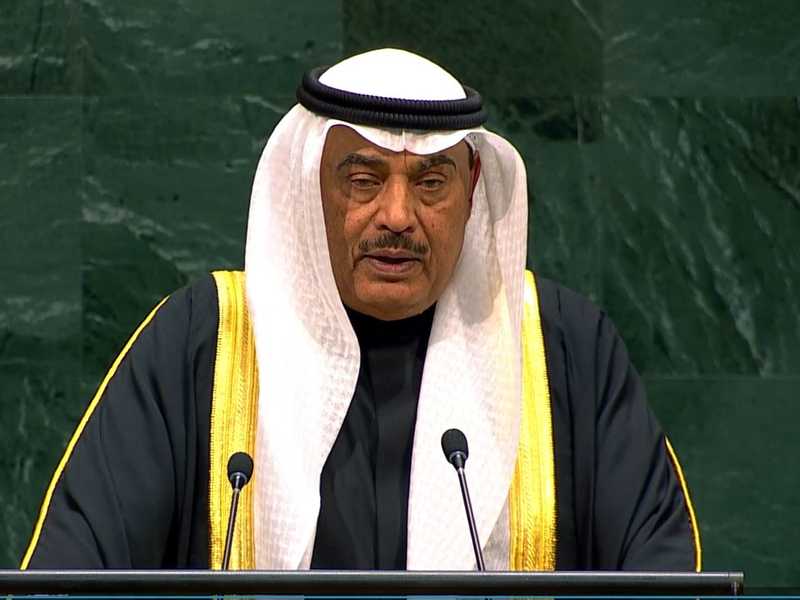
His Highness Sheikh Meshal Al-Ahmad Al-Jaber Al-Sabah, the Amir of Kuwait, represented the State of Kuwait and delivered Kuwait’s address at the 81st session of the United Nations General Assembly at the organization’s headquarters in New York City. His Highness the Crown Prince, Sheikh Sabah Al-Khaled Al-Hamad Al-Sabah, delivered the statement on behalf of the State of Kuwait.
He stated: “Since last February, the State of Kuwait, the countries of the Gulf Cooperation Council, and Jordan have been subjected to Iranian aggression, involving ballistic missiles, drones, and unmanned aerial vehicles, despite not being parties to the ongoing conflict in the region. This constitutes a blatant violation of international law, international humanitarian law, and the UN Charter.
These malicious attacks have systematically and repeatedly targeted civilian infrastructure and vital installations, including Kuwait International Airport, power and water stations, and oil facilities. This reveals an adversarial approach aimed at disrupting the foundations of life and vital infrastructure. These heinous attacks have claimed the lives of martyrs and innocent civilians, caused numerous injuries, and inflicted severe material and economic damage.
Furthermore, in an effort to harm the economies of regional and global states and to influence international trade and oil markets, Iran is obstructing maritime navigation and closing the Strait of Hormuz, using it as leverage in the war in violation of international law and relevant UN Security Council resolutions.
The State of Kuwait expresses its deep appreciation to the brotherly and friendly nations that stood by its side and showed solidarity with it, as well as to the countries that sponsored UN Security Council Resolution 2817 and other international resolutions issued by the Human Rights Council and the International Maritime Organization, which condemned the Iranian aggression as a threat to international peace and security, called for a ceasefire, and affirmed the natural right of states to self-defense in accordance with Article 51 of the UN Charter, as well as the importance of ensuring freedom of navigation without any conditions.
His Highness further stated: “The State of Kuwait reaffirms its support for all diplomatic efforts aimed at de-escalation and achieving a peaceful resolution to the ongoing conflict. It commends the efforts and mediation led by the State of Qatar and the Islamic Republic of Pakistan, emphasizing the necessity of reaching sustainable regional understandings based on a firm commitment to the principles of good-neighborliness, respect for state sovereignty, non-interference in internal affairs, refraining from the use or threat of force, halting support for proxies and militias, and addressing the security concerns of all countries in the region, including the Iranian nuclear file, ballistic missiles, and drones. It also stresses the importance of ensuring freedom and safety of navigation and the right of passage through the Straits of Hormuz and Bab al-Mandab.
His Highness affirmed that the State of Kuwait adheres to the principles of the UN Charter in its foreign policy, particularly respecting the principle of good-neighborliness, state sovereignty, and non-interference in internal affairs. From this perspective, the State of Kuwait regards the Republic of Iraq as a neighbor with whom it shares close relations, and as a partner in security and stability.
Since the fall of the previous regime in 2003, Kuwait has been keen to support Iraq and stand by its side in facing security, political, and economic challenges, in order to restore its regional and international role and status. This is based on the conviction that a stable, secure, and prosperous Iraq represents a shared interest for Kuwait and the entire region.
His Highness added: “We emphasize that reforming the UN Security Council, the body entrusted with maintaining international peace and security, has become a necessity to keep pace with the significant increase in the number of UN member states and the changes that have occurred in international relations since its establishment. There is an urgent need for the Council to be more representative, effective, and transparent.”
