Al-Sharaa: Syria Reborn After Sanctions Lifted
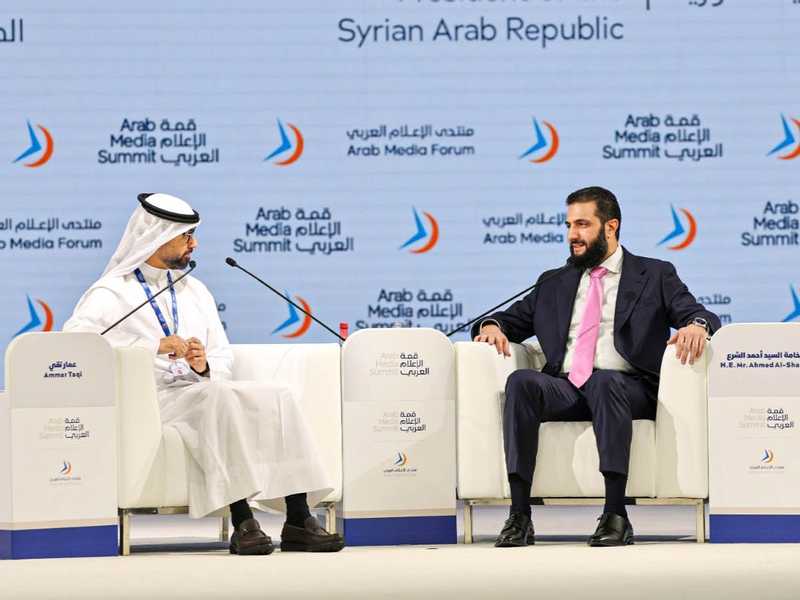
Syrian President Ahmad Al-Sharaa affirmed Syria's transformation from a conflict zone to a commercial corridor and hub of stability, praising the roles of the UAE, Saudi Arabia, and Turkey in lifting sanctions and attracting investments.
Translated by Alqyas from Al-Qabas — Original source
Syrian President Ahmad al-Sharaa confirmed that Syria has transformed from a conflict zone and source of Captagon into a region of stability, noting that the world now speaks of it as a secure commercial corridor for supply chains between the East and the West, in addition to its important role in energy supplies.
Al-Sharaa made these remarks while participating as a keynote speaker at the Arab Media Summit 2026 at the Dubai World Trade Centre on Tuesday. He stated that Syria, which the world and media once viewed as a major problem, has turned into a great opportunity benefiting everyone, having regained its regional and international role. He emphasized that Syria’s location serves the region and that its stability is a shared interest for all.
Speaking during a panel session moderated by journalist Ammar Taqi titled “Syria’s Future,” President al-Sharaa said, “Syria holds great opportunities for Gulf countries, neighboring states, and Europe,” pointing out that there are projects for massive investments. He added that the United Arab Emirates was among the first countries to seize opportunities in Syria, with DP World investing in the port of Tartous due to the importance of this corridor when linked to Jebel Ali Port, according to the Syrian Arab News Agency (SANA).
He said, “Syrians today feel a beautiful sense of eagerness for Arab and Muslim brotherhood, and joy at the victory and the liberation of Damascus. One of the most sincere expressions of these feelings was what Sheikh Mohammed bin Rashid said days after the liberation of Damascus: ‘The Syrian people have a place in the heart, and Damascus is loved before and after.’”
Rebuilding institutions
Al-Sharaa explained that Syria went through 60 years of administrative corruption and poor planning, and is now rebuilding itself and its institutions. The country is living through a transitional phase with its specific conditions, during which it seeks to benefit from various experiences. He noted that the country faced numerous challenges after liberation, including the threat of internal division and sectarian wars, as well as challenges related to the economy, infrastructure, services, energy, and sanctions. He stressed that these phases have been overcome at a rapid pace compared to the international reality and what Syria endures.
From a conflict zone to a strategic corridor
Al-Sharaa clarified that Syria has transformed from being a source of Captagon and human trafficking, and a foothold for spreading conflicts and problems in the region and neighborhood, into a zone of stability. He said, “The world has begun to speak of Syria as a secure commercial corridor for energy and food supply chains, and as a link between the East and the West, as well as in the field of energy supplies.” He pointed out that “Syria’s historical location has served the region through trade corridors, and Syria’s stability does not serve only itself, but the entire region.”
Lifting sanctions... a new birth
Al-Sharaa stated, “The sanctions imposed on Syria were very numerous, some dating back to 1979, and entire generations have not been familiar with financial trading mechanisms and banking guarantees, among other things.” He explained that “mediations carried out by Saudi Crown Prince Mohammed bin Salman and Turkish President Recep Tayyip Erdogan with US President Donald Trump contributed to a historic decision to lift sanctions on Syria.” He emphasized that his country was reborn after the lifting of sanctions and that the path is opening up before it, noting that the next phase requires adopting correct and sound policies, procedures, and options so that the Syrian vessel can reach safe shores.
Supporting the private sector
Al-Sharaa clarified that Syria is undergoing a transition from a system resembling socialism, characterized by bureaucracy and corruption, to a liberalized system that supports the private sector and a free economy. He indicated that the country is currently in a transitional phase that may experience shocks, and there is a need to make important decisions that might make some feel the previous economic situation was better, but that is natural. Over time, people will feel the change and its positive effects.
Economic growth
Al-Sharaa said, “The size of the Syrian economy reached approximately $60 billion in 2010, a modest figure despite Syria’s wealth. When Damascus was liberated in 2024, the economy’s size reached about $20 billion, and it grew to approximately $32 billion in 2025. It is expected to reach $50 billion this year, and Syria aims to return to the 2010 level of $60 billion by 2027. Economic programs aspire to reach an economy of approximately $200 billion within the next five to ten years, provided that global conditions stabilize.”
Wide investment opportunities for the Gulf
President al-Sharaa confirmed that Syria has great investment opportunities, and many countries have begun to seize them, particularly Gulf states, foremost among them the UAE, Saudi Arabia, and Kuwait, as well as neighboring countries and some European investors. He clarified that investments are gradually flowing into Syria, with some memorandums of understanding already being implemented, in addition to large projects led by some UAE investors, whether in real estate or tourism.
Syria as a pillar of food security
Al-Sharaa highlighted the importance of the Syrian agricultural sector, explaining that with modern technologies, Syria could contribute to achieving food security for the region, including Gulf countries. He noted that restoring reliance on the Syrian food basket to meet Gulf needs is part of investment targets.
No independence from the Arab neighborhood
Al-Sharaa stressed that Syria cannot do without its Arab and Islamic neighborhood, relying heavily on Arab brothers and working to benefit from successful experiences and expertise rather than starting from scratch. He affirmed that Syria’s decision-making is independent and that the country relies on itself to overcome many challenges, foremost among them the destruction caused by years of war. He also seeks to achieve stability in the region, noting that keeping Syria out of the conflict circle is not enough to maintain regional stability; rather, strategic and regional security must be preserved.
