American Pilot "Bravo" Recounts How He Survived After His Fighter Jet Crashed in Iran
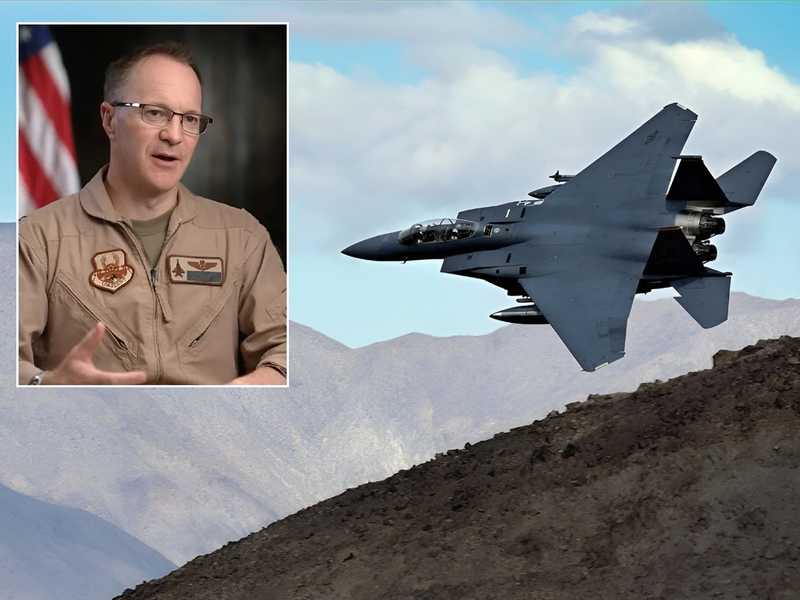
For the first time, the American colonel known by his callsign “Bravo,” a crew member of an American fighter jet shot down over Iran last April, recounted the details of nearly 50 hours spent alone, injured, and pursued behind Iranian lines, before his ordeal ended with a complex rescue operation described as one of the most complex in American military history.
In an interview with CBS News’ “60 Minutes,” Bravo said his mission began on the night of April 2, when he was seated in the rear cockpit of an F-15E fighter as the weapons systems officer, during a strike against industrial facilities linked to Iran’s drone and missile programs near a mountainous area south of Isfahan.
He explained that a shoulder-fired Iranian missile struck the aircraft, prompting him and his colleague, callsign “Alpha,” to use their ejection seats after realizing the plane could not be saved. Bravo recounted that the jump did not mark the end of the danger, as his parachute was damaged and failed to open fully, causing him to fall at speeds ranging between 113 and 161 kilometers per hour.
He said he experienced “the most terrifying scene” of his life when he looked up and saw no parachute, before praying for salvation and help. He added that he crashed into the ground with great force, sustaining fractures in his back, arm, and shoulder, but managed, despite his injuries, to move away from his crash site toward a rugged mountainous region, eventually finding shelter in a rock crevice in the Zagros Mountains.
Bravo said he remained hidden for approximately 50 hours, injured and with limited food and water, as Iranian forces closed in on his location. He noted that armed groups came within hundreds of meters of him, while he feared capture. He indicated that, as night fell, he was able to send a message to U.S. forces, informing them that he was injured but still mobile.
Meanwhile, his colleague Alpha landed about five miles away and was rescued by U.S. forces after approximately six hours, according to the American account.
The rescue operation for Bravo involved more than 90 U.S. military personnel on the ground, hundreds in the air, and thousands providing support, along with aircraft, bombers, drones, and Little Bird helicopters. The U.S. intelligence agency also contributed to locating him through classified technologies and deception operations against Iranian forces, according to the American account.
Bravo described the moment rescuers arrived as “one of the greatest moments of his life,” but noted that the evacuation faced difficulties when rescue helicopters became stuck in the sand.
After nearly 50 hours since his jet was shot down, Bravo was able to leave Iran and contact his wife, describing his survival of the fall, injuries, and pursuit as a “miracle of the modern era.”
