Decree-Law Issued to Increase Kuwaiti Teachers' Bonuses and Allowances
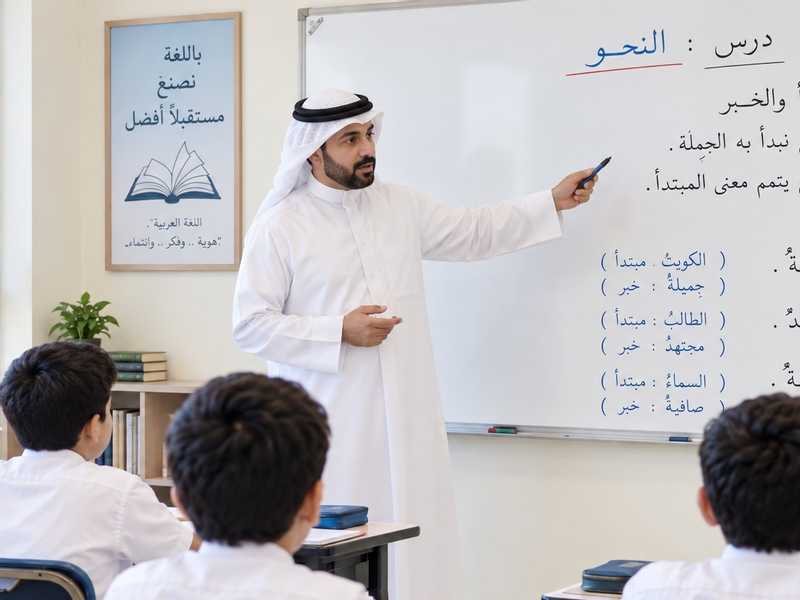
A new decree-law reorganizes the titles and conditions for educational positions and the financial benefits for members of the teaching staff at the Ministry of Education and the Ministry of Islamic Affairs.
Translated by Qiyas from القبس — Original source
A new decree-law has reorganized the titles and conditions for holding educational positions, as well as the financial benefits stipulated for Kuwaiti members of the teaching staff at the Ministry of Education and the Ministry of Islamic Affairs. It specifies allowances and bonuses totaling up to 1,400 Kuwaiti dinars for the highest job level, and introduces a new appointment pathway for Kuwaiti teachers, beginning with a full year in the title of “Trainee Teacher” before advancing to the functional levels of the teaching staff.
The Kuwaiti Official Gazette published today the decree-law No. 86 of 2026, which replaces Table No. (1) attached to Law No. 28 of 2011 concerning the granting of allowances and bonuses to Kuwaiti members of the teaching staff at the Ministry of Education and the Ministry of Islamic Affairs.
Article One stipulates that, without prejudice to acquired rights, Table No. (1) attached to Law No. 28 of 2011 is replaced by the table attached to the decree-law. Article Two cancels all provisions that conflict with the provisions of the new table, and Article Three states that the decree-law shall take effect from the date of its publication in the Official Gazette.
The new table defines the titles of educational positions and the conditions for holding them, along with the value of the job-level bonus, the incentive bonus, the teaching allowance, and the rare-specialization allowance for each functional level.
The level of “Specialist Teacher (A)” tops the levels listed in the table, with a job-level bonus of 600 dinars, an incentive bonus of 400 dinars, a teaching allowance of 200 dinars, and a rare-specialization allowance of 200 dinars, bringing the total of the four benefits to 1,400 dinars.
For “Specialist Teacher (B),” the table sets a job-level bonus of 500 dinars, an incentive bonus of 350 dinars, a teaching allowance of 175 dinars, and a rare-specialization allowance of 200 dinars, totaling 1,225 dinars.
For “Teacher (A),” the table specifies a job-level bonus of 400 dinars, an incentive bonus of 300 dinars, a teaching allowance of 150 dinars, and a rare-specialization allowance of 200 dinars, totaling 1,050 dinars.
“Teacher (B)” receives a job-level bonus of 350 dinars, an incentive bonus of 250 dinars, a teaching allowance of 125 dinars, and a rare-specialization allowance of 200 dinars, totaling 925 dinars.
For “Teacher (C),” the table sets a job-level bonus of 300 dinars, an incentive bonus of 200 dinars, a teaching allowance of 100 dinars, and a rare-specialization allowance of 200 dinars, totaling 800 dinars.
For “Teacher (D),” the job-level bonus is 250 dinars, the incentive bonus is 150 dinars, the teaching allowance is 75 dinars, and the rare-specialization allowance is 200 dinars, totaling 675 dinars.
Conversely, the table stipulates that the “Trainee Teacher” is not entitled to any of the four benefits.
The new table links progression through the functional levels to academic qualifications and years of experience. To hold the position of “Specialist Teacher (A),” a university degree with 17 years of experience, or a teaching diploma or equivalent with 19 years of experience, is required.
To hold the position of “Specialist Teacher (B),” a university degree with 13 years of experience, or a teaching diploma or equivalent with 15 years of experience, is required.
For “Teacher (A),” the table specifies a university degree with 9 years of experience, or a teaching diploma or equivalent with 11 years of experience.
A candidate for the “Teacher (B)” level needs a university degree with 5 years of experience, or a teaching diploma or equivalent with 7 years of experience. Meanwhile, the “Teacher (C)” level requires a university degree with 2 years of experience, or a teaching diploma or equivalent with 4 years of experience.
Recent graduates’ appointment. One of the most prominent changes in the decree concerns the entry of the new Kuwaiti teacher into the profession. The explanatory memorandum clarified that the Education, Health, and Youth Committee of the Council of Ministers and the Civil Service Board agreed to reorganize the appointment conditions for the teaching position for Kuwaitis. Under the new regulations, appointment begins with a one-year term in the job title “trainee teacher,” during which the teacher performs teaching duties and undergoes a one-year training program that includes theoretical study and practical training to familiarize him with the job’s tasks and the skills he must acquire. During this period, the trainee teacher receives his salary according to the financial grade assigned at the time of appointment, but he is not entitled to any allowances or bonuses granted to members of the teaching staff.
If the trainee teacher successfully completes the training program, he advances to the next functional level among the functional levels for members of the teaching staff, taking into account the conditions set out in Table (1) attached to the law, as well as the conditions and controls determined by the competent authorities. In the event that the trainee teacher fails to complete the training program, the regulations distinguish between two cases: if the teacher holds a university teaching qualification from the College of Education at Kuwait University or from the Basic Education College of the Public Authority for Applied Education and Training, he is transferred to an administrative position in the Ministry of Education. However, if he does not hold the aforementioned university qualification and fails to complete the training program, his file is referred to the Civil Service Diwan for assignment to another government entity in a job title appropriate to his obtained qualification.
Why were the appointment conditions amended? The explanatory memorandum detailed the reasons that prompted the reorganization of teacher appointment and career progression, noting that the Ministry of Education seeks to support teachers and provide all means to enable them to fulfill their noble mission, recognizing their role in advancing academic and cultural standards. The memorandum stated that education is undergoing rapid changes that have imposed new roles on teachers beyond the traditional framework of classroom instruction, and that the contemporary educational reality demands the development of tools and methods aligned with modern technologies. It further highlighted the Ministry of Education’s commitment to investing in the development of teachers’ skills by providing advanced training programs and workshops that keep pace with recent developments, aiming to enhance the educational process and stay abreast of new developments, with the goal of building a modern educational system based on the latest international standards.
A position of a special nature. The memorandum emphasized that the teaching profession enjoys a special nature due to its importance and impact on shaping and forming learners’ thinking, as well as being a comprehensive educational and pedagogical mission rather than mere rote instruction. It clarified that the profession requires a combination of academic and pedagogical skills, the ability to handle and modify behavioral problems, and the performance of diverse tasks such as planning and delivering course materials and evaluating student performance. The memorandum also noted that the teacher must possess the ability to develop professionally to keep pace with developments, in addition to serving as a role model for students in behavior and values, given the teacher’s direct influence on shaping the student’s personality. From this perspective, the memorandum concluded that the nature of these tasks necessarily requires additional conditions for candidates for the teaching position, ensuring the optimal performance of assigned duties and achieving the intended objectives.
Selection of the best candidates and clarification of the memorandum: The memorandum stated that developments affecting the education sector and the need to update appointment procedures for teaching staff positions require ensuring that only individuals with high competence are appointed to these roles. It emphasized that the objective is to select the best candidates for the positions and determine their eligibility based on objective criteria rooted in the nature of the job, thereby ensuring equality of opportunity and equal treatment under the law, and guaranteeing that only those who meet the general conditions, along with the specific attributes and capabilities necessary to perform the duties optimally, are appointed, thus ensuring the smooth functioning of the education sector. A degree alone is not enough. The explanatory memorandum detailed problems revealed by the practical application of the appointment conditions for recent graduates, noting that reality showed the existing initial conditions for appointing recent graduates as teachers were insufficient to ensure proper performance of the duties assigned to the position. It pointed out that some graduates, particularly those with the skills required to assume the teaching role, may have varying levels of competence despite holding the same academic qualification. It stressed that merely graduating and obtaining an academic degree does not indicate the highest level of competence, nor does having prior years of experience in the profession necessarily mean possessing genuine, effective experience that benefits the education sector.
Review of the 1996 system: The memorandum addressed the legislative background of the amendment, referring to Civil Service Council Decision No. 2 of 1996 concerning the positions, allowances, and bonuses of teaching staff members. This decision specified the teaching staff members covered by it and defined the job levels for teaching staff. It clarified that the levels started from Teacher (D) and ended at Specialist Teacher (A). The table attached to the decision specified the conditions for filling each job level, including the required academic qualification and years of experience. It added that Law No. 28 of 2011 concerning the granting of allowances and bonuses to Kuwaiti teaching staff members included Table No. (1) regarding the covered job titles, which ranged from Teacher (D) up to Specialist Teacher (A), specifying the conditions for filling each level.
2017 Amendment: The memorandum noted that in 2017, Law No. 86 of 2017 was issued, replacing the aforementioned table and amending the conditions for filling the Teacher (D) level. Under the amendment, a holder of a university teaching qualification or its equivalent would be considered to have met the years-of-experience requirement, or a holder of a teaching diploma or its equivalent would meet the requirement based on the specified number of years of experience. It highlighted that the initial appointment conditions for the teaching position differed from the general conditions prescribed for filling any other position, given the nature of the teaching role and the capability required to perform teaching duties.
University degree for “Teacher (C)”: The notes attached to the new table clarified that appointments for holders of a university degree would be at the “Teacher (C)” level, while appointments for diploma holders would be at the “Teacher (D)” level. The notes also authorized the Ministry of Education to add other conditions to those listed in the table, such as passing training courses or examinations, in coordination with the Civil Service Bureau.
The explanatory memorandum concluded that redefining the appointment conditions aims not only to regulate job benefits but is also directly linked to enhancing the competence of human resources within schools and improving the quality of the educational process.
She emphasized that selecting the most qualified candidates for teaching positions within the Authority, based on academic credentials, eligibility criteria, training, and required examinations, will enhance the efficiency of the education system and the educational infrastructure as a whole, and ensure that teachers possess, alongside their academic qualifications, the practical and pedagogical skills necessary to fulfill their educational mission.
