From Under the Rubble to the 'Memory of the World': Gaza Manuscripts Win UNESCO Award
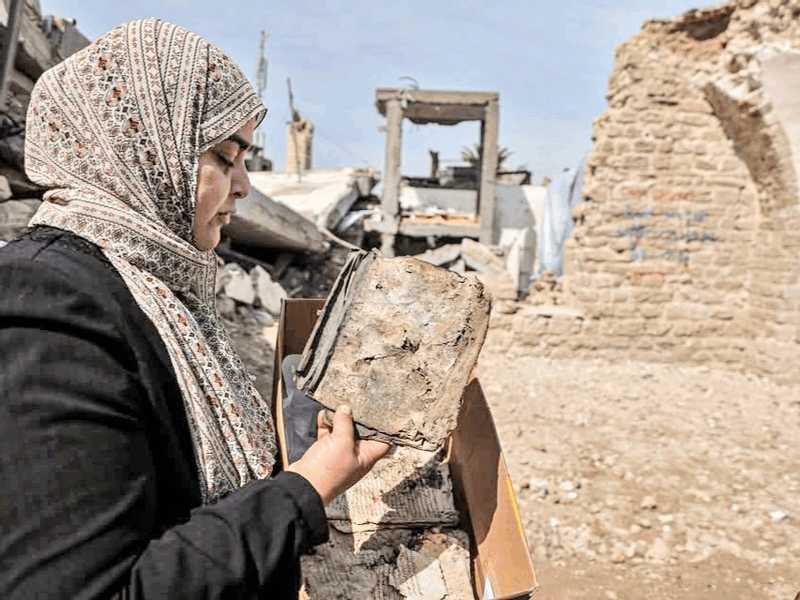
When war destroys a home, it can be rebuilt day by day. When a library is damaged, its books can be returned. But when a single manuscript is lost, the unique text it contains may vanish forever, along with a testimony that no one can recover. From this perspective, we can understand the honor bestowed by UNESCO on Palestinian manuscript researcher Abdul Latif Abu Hashem and conservator Hanin Al-Amassi, who were selected to receive the UNESCO/Jikji Memory of the World Prize for 2026, in recognition of their work to save endangered documentary heritage in the Gaza Strip. The winners were chosen from 58 nominations submitted by UNESCO Member States. The award did not stem from a project operating under normal conditions, but rather from an experience that took on an emergency character as the threat to libraries, documentary collections, and manuscripts in the Strip widened. Abu Hashem and Al-Amassi worked to rescue historical materials from sites that had been destroyed, most notably the collections of the Great Omari Mosque library in Gaza. The materials rescued included rare manuscripts, handwritten documents, copies of the Holy Quran, and historical works. After being removed from damaged sites, the materials were transferred to safer locations, where conservation, restoration, and digitization processes began. In some digitization efforts, scanning technologies that do not require close physical contact were used, thereby reducing the risk of further damage to fragile papers.
Twenty-five thousand pages facing oblivion reveal the scale of what was at risk: the two researchers managed to preserve and digitize more than 258 manuscripts, comprising approximately 25,000 pages. This number is not measured by page count alone. Each manuscript carries its own era, hands that wrote it, knowledge passed down through generations, and the memory of a city that left its traces on paper. Therefore, saving these materials means not only protecting old papers, but also preserving sources that researchers can rely on to read the history of Gaza and its scientific and cultural life. The importance of this task increases in the case of manuscripts that have no multiple copies; the single copy that survives war becomes a source that is difficult to replace. Hence, digitization is an essential part of the rescue process. The digital copy does not replace the original, but it gives the manuscript’s content another chance to survive and provides access and study opportunities even when the original document is at risk of deterioration.
The Great Omari Mosque: What remained of the library
The Great Omari Mosque was one of the sites linked to the mission after it sustained damage during the war. Among the surviving items were manuscript and documentary materials that were recovered and preserved. The library of the mosque holds significance beyond being a collection of books and manuscripts; historical libraries in Palestinian cities were part of the city’s cultural infrastructure, preserving the output of their scholars, copyists, and students, and revealing, through their contents, the nature of knowledge circulating in those societies. When such collections are destroyed, the loss is not limited to the building. What disappears may be part of the history of knowledge itself. Thus, the work of Abu Hashem and Al-Amassi takes place in a sensitive area bridging restoration, research, documentation, and rescue. They deal with materials whose scientific value cannot be separated from their human value, because the document here bears the imprint of the place and the people who lived in it.
Why “Jikji”?
UNESCO awards the prize under the Memory of the World Programme, established by the organization to protect global documentary heritage, with special attention to collections threatened by conflicts and disasters, and to enhance their availability to the public and researchers. The UNESCO/Jikji Memory of the World Prize was established in 2004 and is awarded to individuals, institutions, or non-governmental organizations that make significant contributions to the preservation and accessibility of documentary heritage. It is named after the book “Jikji,” the oldest known book printed using movable metal type, which was printed in Korea in 1377. Notably, the prize, named after a book that survived for centuries, this year goes to a project working to save books and manuscripts facing severe danger in a contemporary war. In both cases, there is a unifying idea: knowledge that reaches future generations is not that which has never been at risk, but that which found protectors when it was threatened with disappearance.
A record number of nominations
The 2026 cycle saw a record number of nominations, with 58 official nominations from UNESCO Member States, before the International Advisory Committee selected Abu Hashem and Al-Amassi as the winners. The monetary value of the prize also increased this year to $40,000, up from $30,000 in previous cycles. It will be presented during the opening of the Jikji Festival 2026 in the city of Cheongju, Korea, coinciding with Jikji Day on September 4. Their win fits within the history of the prize, which in previous cycles has honored institutions and projects from various countries, including the National Library of the Czech Republic, the National Archives of Malaysia, the National Archives of Australia, the American University in Cairo, and the National Library of Indonesia.
Saving the manuscript saves the city
The story of manuscripts in Gaza reveals an aspect of cultural loss that accompanies wars, a loss that does not always appear in the initial images of destruction. Rubble is visible. But the document lost within the rubble may go unnoticed, with no one knowing it ever existed. For this reason, the task of preserving manuscripts transcends professional duty. The researcher searching for a paper amidst the ruins does not recover the past for the past’s sake alone; he tries to leave behind for future generations evidence of a cultural life that once existed. What makes the experience of Abu Hashem and Al-Amassi worthy of honor is that their work did not stop at retrieving manuscripts, but extended to preserving, restoring, and digitizing them—transferring them from a state of danger to one of survival and accessibility. Ultimately, this is another battle that Gaza fights alongside its daily struggles: the battle to ensure that war does not completely erase its memory.
