New US Strategic Tanker Attacks to Punish Iran
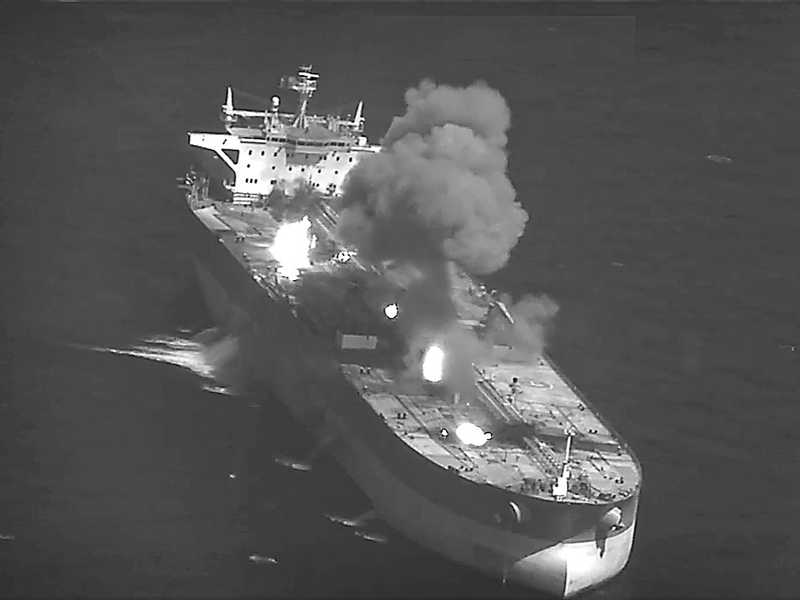
Time is no longer on Iran’s side in its battle over the Strait of Hormuz. The opening move in the world’s most critical 21-mile stretch now belongs to the United States, which is helping Gulf states transport large volumes of oil out of the region, while no shipments are leaving Iran. Tehran had previously claimed to hold a winning leverage card by threatening to close the Strait of Hormuz and mine the waterway, which is approximately 21 miles (34 kilometers) wide at its narrowest point, believing this would give it the upper hand over its American rival and that time would work in its favor. However, the tide appears to be turning against it.
The United States began targeting Iranian oil tankers earlier this week as part of a new strategy to punish Tehran and curb its ability to export oil, according to U.S. officials. In a notable development, U.S. Central Command (CENTCOM) launched an attack on three Iranian crude oil tankers on Saturday, following the Iranian Revolutionary Guard Corps’ (IRGC) launch of ballistic missiles at two U.S. Navy warships. According to a CENTCOM statement, an aircraft carrier and a guided-missile destroyer successfully evaded several unjustified Iranian attacks, and no U.S. personnel were injured.
Following the failed Iranian attacks, CENTCOM permanently disabled two IRGC-owned oil tankers: the “Dawni” off the coast of Kharg Island and the “Stark 1” near Jask. It also completely destroyed the empty tanker “Kailo” (also known as “Noksan”) in the Gulf of Oman, striking the vessel at multiple critical locations to disable it after ordering its crew to abandon ship. The three Iranian crude oil tankers are part of a secret, multi-billion-dollar network funding the IRGC and its regional proxies. According to CENTCOM, Iran has no means to defend them.
Admiral Brad Cooper stated: “Let the message be clear to the Revolutionary Guard: if you fire at two of our ships, we will impose a much higher economic cost on you by destroying three of yours. We will not hesitate to defend U.S. forces, and if necessary, we will destroy Iran’s limited and vulnerable oil fleet.”
Iranian media reported early Saturday that several explosions occurred near Kharg Island. The attacks on the oil tankers come after the United States announced the removal of sea mines from the main shipping lanes in the Strait of Hormuz. Meanwhile, the White House stated that the military is assisting more ships in transiting the oil-rich Arabian Gulf, preventing global oil prices from reaching critical levels. Through a quiet, complex military operation spanning months within an active combat environment, Washington has secured a safe navigation corridor in the Strait of Hormuz. This effectively erodes Tehran’s most significant leverage: its ability to directly control and influence maritime traffic through the strait. This decline was clearly evident in Iran’s shift in tactics toward attempting to plant mines remotely using missiles with a 75-kilometer range from Larak Island, rather than relying on the direct presence of IRGC naval boats, which former U.S. President Donald Trump repeatedly claimed had been eliminated.
The U.S. blockade on Iranian ports remains in effect, preventing Iran from shipping any oil since July. The Wall Street Journal quoted Samir Madani, co-founder of the maritime intelligence firm Tanker Tracker, stating: “Iran’s blockade of the strait has become more fragile; the Iranians are unable to close the shipping lane.” Tehran’s calculations six months ago, when it claimed to have closed the strait and withheld five percent of global crude oil supplies, were flawed. The crisis did not trigger a global economic downturn, nor did it force the U.S. President to end the conflict on Iran’s terms. Consequently, its influence over the Strait of Hormuz is slowly but steadily eroding due to the U.S. military campaign.
Meanwhile, political pressure within Iran is mounting due to the deteriorating economy, the rapid collapse of the rial’s value, rising inflation, and widespread fuel shortages. A senior Iranian source told Reuters that Iran has only enough gasoline for approximately two months, as the U.S. war and economic sanctions inflict heavy losses. According to Reuters, the ongoing U.S. military blockade of Iranian ports has cut off oil exports, which are the regime’s primary source of revenue. The source added that Iran is forced to import gasoline due to its limited refining capacity.
Last week, the U.S. Treasury launched the “Economic Pariah” operation against Iran to tighten the squeeze and prevent any potential revenue streams that fund the IRGC and the Iranian regime. In this context, three Iranian sources reported that these measures have left Iran with very few remaining channels to obtain currency and goods.
Analysts believe that although the U.S. blockade has not yet changed Iran’s behavior or triggered a popular uprising against the Islamic Republic, time is moving faster for Iranians due to their immense economic pressures. One option available to Iran is surrender. The other is significant escalation, attempting to break out of the impasse by force, betting on the U.S. political timeline, which is a key factor in Iranian thinking, aiming to influence the midterm congressional elections. This prospect was previously downplayed by President Trump.
According to a New York Times report, there are indications that Iran is determined to prolong the conflict at least until the midterms, betting on a war of attrition against the United States. U.S. intelligence reports suggest the hardline government may be considering major escalation in the coming weeks, similar to its actions last July when it attacked U.S. military bases, resulting in the deaths of three Americans in Jordan, and targeted shipping in the Strait of Hormuz.
In response, President Trump described the Iranian conflict as “trivial” for the United States, a day after Vice President J.D. Vance stated he would not describe the conflict as a war. Trump told reporters: “Many people don’t call it a war. I call it a military conflict because it doesn’t mean much to us. It’s not a big deal. We did it in Venezuela, and we did this too. We lost 18 people... In Vietnam, we lost 100,000 people.” He continued: “I say these are intermittent strikes. As you know, we are launching intermittent strikes.” He added that he is considering striking Mount Fasa (Peak X), an underground site in Iran believed to be part of the nuclear program, repeating a threat he has made for months. He told reporters: “Iran will not have a nuclear weapon. We have prevented them from having one. We may strike the Mount Fasa project very soon, because if there is any unauthorized activity there... we know everyone moving around Mount Fasa... and if anything goes wrong, we will strike them with force.”
