The people struggle with poverty... while the assets of the Islamic Revolutionary Guard Corps leaders abroad swell
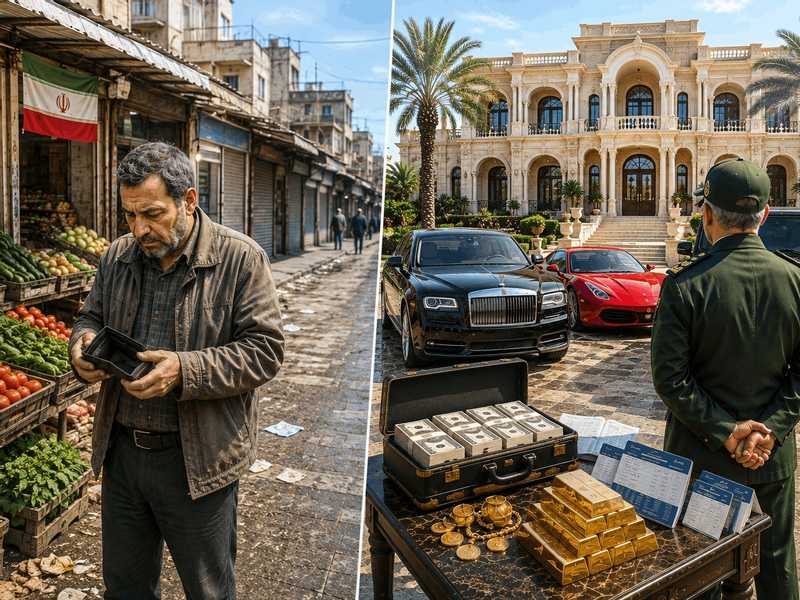
Iranians are facing one of the most severe living and economic crises in recent years, marked by a rapid deterioration in the currency’s value, a sharp rise in food prices, and a decline in purchasing power. This comes as the United States intensifies financial pressure on Tehran, accusing figures linked to the regime and the Islamic Revolutionary Guard Corps (IRGC) of transferring funds and assets abroad.
Recent economic data highlight the extent of the pressures bearing on Iranian households. Annual inflation exceeded 66% in July, while year-on-year food price increases reached approximately 128%, meaning the cost of many basic food items has more than doubled compared to a year ago. Meanwhile, the Iranian rial has plummeted to record lows, surpassing 2.2 million rials per dollar.
The crisis extends beyond soaring prices. U.S. sanctions, war, and trade restrictions have weakened economic activity and reduced oil revenues. The International Monetary Fund (IMF) projects that Iran’s real GDP will contract by about 5.4% in 2026, against an expected average inflation rate of 68.9%. These figures directly impact daily life. Iranian families are cutting back on basic necessities, seeking cheaper food alternatives, and some workers have been forced to take on additional jobs to compensate for the erosion of their incomes. The Associated Press quoted Iranians stating that rising prices, job losses, and currency devaluation have made securing daily necessities increasingly difficult.
Pressures are mounting as Iran’s ability to export oil and access foreign currencies diminishes. According to Reuters, Iran’s oil exports have dropped significantly amid a naval blockade and U.S. pressure, threatening to exacerbate inflation and shrink the state’s hard currency resources.
Conversely, Washington argues that part of the problem lies in financial networks linked to the Iranian regime and the IRGC. Officials and influential figures have transferred money abroad while citizens face a worsening cost-of-living crisis. U.S. Treasury Secretary Scott Bessent previously stated that U.S. authorities had detected transfers of millions of dollars out of Iran by regime leaders, affirming that the Treasury Department has the capacity to track these funds. In January, Bessent mentioned the detection of transfers amounting to “tens of millions of dollars” out of Iran. In his latest remarks, Bessent escalated his rhetoric toward Iranian leaders, stating that the United States knows the locations of some accounts and assets linked to the IRGC abroad. According to reports on his recent comments, he pointed to accounts in the British Virgin Islands and luxury properties, some valued at around $100 million, vowing to freeze these assets as part of the economic pressure campaign on Tehran.
These statements come within the context of a broader U.S. campaign targeting Iranian financial networks abroad. In July, the U.S. Treasury Department sanctioned Iranian businessman and banker Ali Ansari, accusing him of managing a global network of assets, real estate, and commercial interests that benefited regime officials and the IRGC. The department stated that the network facilitated the transfer of public wealth into properties and investments outside Iran. Over recent months, the U.S. Treasury has also targeted banking networks, shell companies, and exchange institutions it claims are used to transfer billions of dollars linked to the Iranian regime, fund the IRGC and arms programs, and circumvent sanctions. Washington asserts that these funds were intended to support the Iranian economy but are instead used to finance security apparatuses, military programs, and Tehran’s regional networks. In May, Bessent accused the IRGC of using shell companies to sell oil and transfer revenues, rather than directing them toward the needs of the Iranian people.
The economic crisis reveals a striking paradox: while the purchasing power of Iranians is sharply declining, successive U.S. sanctions have exposed financial networks, assets, and real estate linked to individuals close to power circles abroad. However, it is important to distinguish between assets frozen or targeted by sanctions and funds proven to be directly owned by IRGC leaders. Some claims regarding the size of these fortunes and their owners rely on intelligence investigations or media reports, whereas the U.S. Treasury officially confirms the existence of networks, companies, and assets linked to sanctioned Iranian individuals and entities.
On the other hand, Tehran rejects the U.S. narrative regarding its economic collapse. Iranian Central Bank Governor Abdolnaser Hemmati stated that the country still possesses sufficient foreign currency reserves and that the central bank is prepared to inject up to $2 billion into the exchange market, while acknowledging that sanctions and the naval blockade have caused significant economic difficulties.
While the Iranian government attempts to reassure markets and the public, the average citizen faces a different reality: a currency losing value, food prices rising by more than 100%, and incomes eroding rapidly. Meanwhile, Washington continues to pursue financial networks and assets linked to the regime abroad, in an effort to choke off its funding sources and compel it to make political concessions.
