The Mecca Agreement for Joint Defense: Establishing a New Security Architecture in the Region
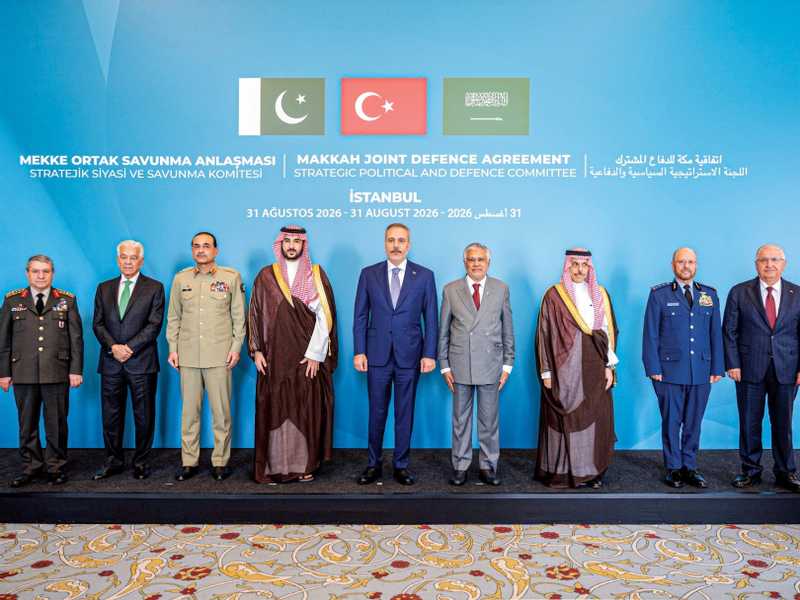
Saudi Defense Minister Prince Khalid bin Salman bin Abdulaziz chaired the Kingdom’s delegation at the first meeting of the Strategic, Political, and Defense Committee of the Mecca Agreement for Joint Defense, held in Istanbul, Turkey. The meeting was attended by defense and foreign ministers, heads of armed forces, chiefs of general staff, and senior officials from the Kingdom of Saudi Arabia, Pakistan, and Turkey.
Saudi Arabia, Turkey, and Pakistan agreed on practical steps to establish a regional security architecture under the Mecca Agreement for Joint Defense, alongside increased investments and development projects in a stable environment characterized by reduced uncertainty.
According to the Saudi Press Agency (SPA), the meeting discussed ways to enhance existing strategic partnerships in light of the Mecca Agreement, serving shared interests and fulfilling the aspirations of the leaderships of the brotherly nations. It also reviewed several topics and issues of common interest and adopted a number of decisions and recommendations included on the meeting’s agenda.
The discussions covered international security issues, the development of defense capabilities, enhancing operational integration among the armed forces of the three countries, deepening cooperation in the defense industry—including joint production and research and development—and strengthening efforts to combat terrorism.
The meeting defined the framework for the General Secretariat, which was agreed to be headquartered in Riyadh, along with other relevant mechanisms to guide work in areas of joint activity specified by the Strategic, Political, and Defense Committee.
In his speech, the Saudi Defense Minister expressed the depth of strategic relations among the three countries, highlighting the interdependence of their security and noting that confronting challenges and threats requires political coordination, defense integration, and collective military readiness.
For his part, Turkish Foreign Minister Hakan Fidan stated that with the Mecca Agreement for Joint Defense, the process of establishing a new security and cooperation architecture in the region has begun. He affirmed that the agreement would gradually enhance regional stability and reduce uncertainty. Fidan emphasized that coordinated action by regional countries for security, stability, prosperity, and lasting peace, as well as institutionalizing the steps taken in this direction, has become an urgent necessity.
He added that the Mecca Agreement for Joint Defense was built on the basis of keeping the door to expansion open, and that they are working on developing a roadmap for accession procedures to the alliance. “The alliance was formed primarily for expansion. However, in the initial phase, foundations must be firmly established, and mastery must be achieved effectively. Both Saudi Arabia and Pakistan are very keen on this matter, just as we are,” he said.
Fidan stressed that any potential ally joining the alliance should do so into a structure with a solid, existing, and efficient infrastructure. “We are currently trying, together, to complete the foundational phase, which is the most difficult part,” he added.
The Saudi delegation, in addition to Prince Khalid bin Salman, included Foreign Minister Prince Faisal bin Farhan, Chief of the General Staff Lieutenant General Faiyadh bin Hamed Al-Ruwaili, and Defense Minister’s Advisor for Intelligence Affairs Hisham bin Abdulaziz bin Saif.
The Turkish delegation, alongside Fidan, included Defense Minister Yasar Guler and Chief of the General Staff Salih Cevikoglu. The Pakistani delegation comprised Foreign Minister Muhammad Ishaq Dar, Defense Minister Khawaja Muhammad Asif, and Chief of the Army Staff General Asim Munir.
On the sidelines of the meeting, Prince Khalid bin Salman met with the Commander of the Pakistani Army, General Asim Munir, to review prospects for military and defense cooperation between the two countries and discuss developments in the regional situation and efforts to address them.
