An Analytical Reading of the US Oil Deal with Venezuela: 65 Billion Barrels Reshaping the Global Oil Market Balance
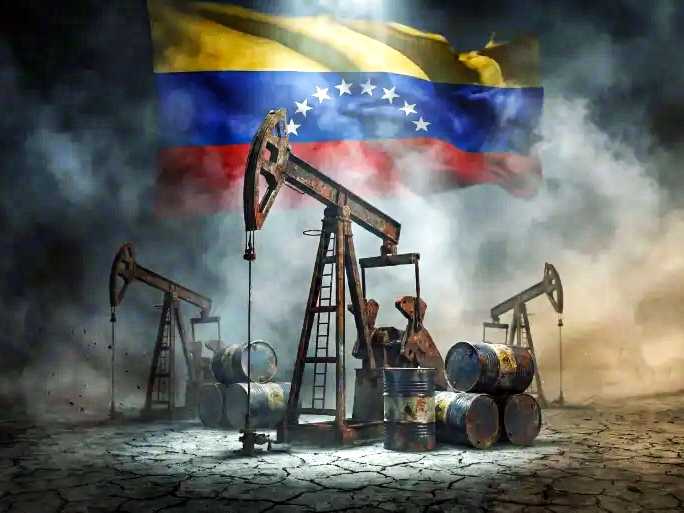
The oil agreement announced by US President Donald Trump with Venezuela opens a new chapter in the global energy market, following Washington’s announcement of obtaining majority control over more than 65 billion barrels
Translated by Qiyas from القبس — Original source
The oil agreement announced by US President Donald Trump with Venezuela opens a new chapter in the global energy market, following Washington’s announcement of obtaining majority control over more than 65 billion barrels of Venezuela’s proven oil reserves, as part of a plan to rehabilitate the sector, boost production, and attract investments in the country. Despite the magnitude of the figure, investment and energy firms believe the impact on markets will not be immediate, as converting reserves into actual production requires billions of dollars to rehabilitate fields, facilities, and transport networks, particularly since the bulk of Venezuela’s oil is heavy crude. Estimates from JPMorgan suggest that Venezuelan production could be gradually increased, but reaching higher levels requires investments, infrastructure, and a stable legal environment. The key equation for markets is that Venezuela’s return to full production capacity would add a significant source of global supply, potentially limiting oil price increases in the medium to long term.
The significance of this development lies in the fact that Venezuela possesses one of the world’s largest oil reserves, yet continues to produce limited quantities compared to its reserve size. Consequently, any broad influx of American investment would convert part of this “stranded oil wealth” into actual production. However, energy companies and investors do not expect large volumes to flood the market in the coming months, as estimates indicate that restarting damaged fields and infrastructure will take years. Moreover, US oil companies themselves are approaching investment with caution, given legal risks, a long history of asset nationalization, and an unstable investment environment.
US companies are the primary beneficiaries. American energy firms, led by Chevron, are among the biggest potential beneficiaries of this shift, as the company already has operations in Venezuela. Other US firms are moving toward investing in the development of new fields and providing oil equipment and services. This could create an investment cycle spanning drilling, production, oil services, pipelines, transport, and refining, making the deal more than just an agreement to secure oil for the United States.
Venezuela’s strong return to the global oil market may place major producers, OPEC+, in a more complex equation. Increased Venezuelan production means that, if global demand does not grow at the same pace, the available supply outside OPEC’s current production levels will rise. This could force the OPEC+ alliance to choose between absorbing the increase or implementing additional cuts among other members to maintain market balance. Furthermore, any departure of Venezuela from the Organization of the Petroleum Exporting Countries (OPEC) would be a development with future implications for global energy markets, as it reduces the organization’s ability to manage a portion of global supply.
China loses a strategic resource. The repercussions of the deal extend beyond prices and production to the map of global oil trade. Increased linkage between Venezuelan oil and the United States effectively reduces China’s sphere of influence in one of the world’s largest oil reserves, redirecting part of oil flows toward the US market. Washington is thus seeking to build an energy security system in the Western Hemisphere, combining Venezuelan reserves, US companies, and US refineries, thereby enhancing the United States’ ability to secure supplies and reducing its dependence on distant or geopolitically riskier sources.
For Gulf states, Venezuelan oil does not pose an immediate threat, but it may become a pressure factor in the medium term. Increased production from Venezuela, alongside growing output from the United States, Brazil, and Guyana, means a widening base of producers outside OPEC, making it more challenging to maintain market share.
Economic dimensions. Economically, the importance of the agreement lies not only in the value of the reserves but also in the possibility of it evolving into a massive investment project that reintegrates Venezuela into the Western oil system. The reserves exceeding 65 billion barrels do not mean this quantity will immediately flood the markets; rather, they represent a resource base that can be developed over decades. Conversely, injecting approximately $100 billion in private investment, as announced by the US administration, could significantly raise Venezuela’s production capacity if Washington succeeds in addressing infrastructure, legal, and investment stability challenges. Therefore, the oil impact of the agreement will unfold gradually over the coming years; by then, Venezuela will become a key factor in the price equation, quotas, and competitiveness of producers.
A new energy axis. The agreement can be viewed as more than a traditional oil deal; according to Reuters, it represents an American attempt to build a new energy axis in the Western Hemisphere, linking Venezuelan reserves with US companies and refineries to serve US energy security. The greatest impact will not be in the amount of oil entering markets in the short term, but in the redistribution of investments, markets, and oil shares over the coming years. However, the main obstacle is that 65–66 billion barrels of reserves are not 65–66 billion barrels of immediately exportable production; damaged infrastructure, the nature of heavy crude, and the need for tens of billions in investments make the process of converting reserves into actual production take years.
Key figures from the deal:
- 20% of Venezuela’s oil reserves will go to the US
- $100 billion in expected investments to revive Venezuelan oil
- Development of 17 strategic fields to support increased oil production in Caracas
- $209 billion in tax revenues the Venezuelan government is betting on
- Venezuela’s current oil production stands at approximately 1.25 million barrels
