News Report: Kuwait Reshapes Development and Aid in 5 Countries
In the heart of the world’s most complex humanitarian crises, aid initiatives led by Kuwait under high directives have become a vital lifeline, flowing like a gentle rain to wipe away the tears of the bereaved, heal the wounds of the afflicted, and touch upon human dignity in highly perilous environments. Kuwait’s humanitarian role has emerged as a living embodiment of a vigilant human conscience, forming a global human safety valve through a series of relief campaigns that have recently focused on diverse geographical axes in Africa and Asia, thereby cementing its status as a reliable compass of generosity and a safe haven during crises. This stands in stark contrast to a world exhausted by conflicts and battered by disasters, demonstrating Kuwait’s capacity to overcome logistical obstacles and secure vital supply lines that safeguard human dignity in highly complex settings.
In Uganda, Sudan, Benin, Thailand, and India, the humanitarian projects implemented over the past week reveal the breadth of Kuwaiti humanitarian work and the diversity of its tools, proving that Kuwait’s aid has never been merely an emergency response to a disaster, but rather a consistent strategic approach and a cornerstone of its diplomatic philosophy. These intensive campaigns reflect an evolved model of humanitarian engagement, particularly as they combine support for crisis-affected individuals with family empowerment, educational services, water provision, and support for community institutions. This reflects a shift in generosity from meeting immediate needs to contributing to the restoration of stability and the building of the future.
In Uganda, Kuwaiti support took on a human dimension linked to the return of Sudanese refugees to their homeland, as new batches prepare to depart under a voluntary repatriation program that funds the journey and supports families wishing to start a new chapter after years of war and displacement. Nour Al-Huda Al-Ajeb, Director of the Kuwait Direct Relief Association office in Uganda, announced the completion of preparations for the departure of 220 Sudanese refugees from Ugandan territory under the association-funded voluntary repatriation program for Sudanese refugees. He clarified that the program is part of an initiative funded by the association to support the return of approximately 1,200 Sudanese refugees from Uganda to their country, at a cost of 300,000 Kuwaiti dinars, thereby assisting families wishing to return and participate in the recovery and reconstruction phase.
In Sudan, Kuwaiti support took a path linked to the recovery and reconstruction of religious and Quranic institutions damaged during the war, through the provision of Qurans and support for mosques and Quranic schools to restore their educational and community roles, coinciding with the return of residents to Khartoum State. The International Islamic Charitable Organization launched the “Noor Al-Quran” project in Khartoum State to distribute 12,000 copies of the Holy Quran, funded by 9,620 Kuwaiti dinars, in support of programs for teaching and memorizing the Quran and rehabilitating places of worship damaged by the war. In Benin, another model of multi-service Kuwaiti projects was completed through a center that combines a mosque, a school, and a water source in one location, providing religious, educational, and developmental services to thousands of beneficiaries and enhancing the local community’s ability to access basic needs in its vicinity.
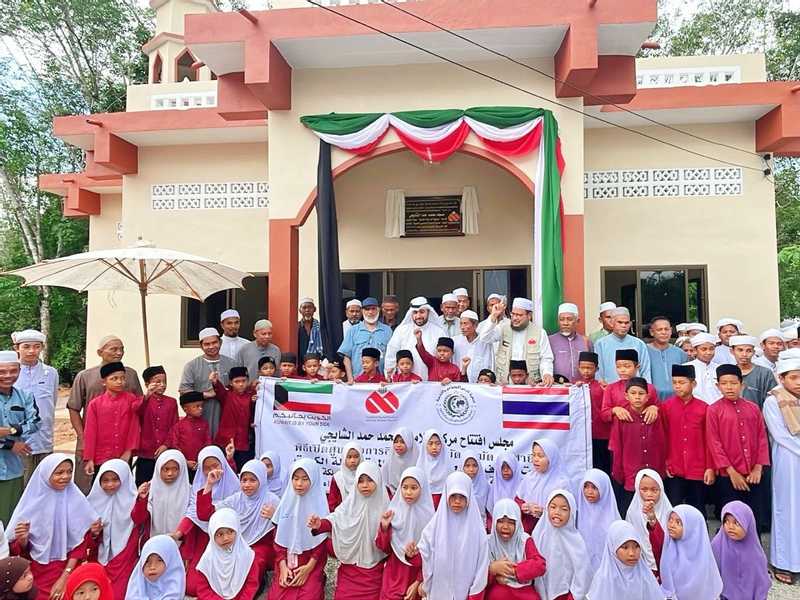
In Thailand, Kuwaiti generosity extended to projects combining education, community service, places of worship, and Quranic memorization, within a vision seeking to make charitable facilities sustainable centers serving their surrounding communities. Mohammed Al-Qassar, Director of the Asia, Africa, and Europe Regional Department at the World Mercy Association, affirmed that the charitable projects implemented by the association in the Kingdom embody the extension of Kuwaiti generosity and its commitment to creating a sustainable impact in needy communities through projects that combine education, worship, and community service. He noted that the association pays special attention to Quranic memorization projects, as its office in Thailand has established more than 95 memorization centers so far, alongside linking several mosque projects with educational programs and involving children from surrounding areas in memorizing parts of the Holy Quran.
In India, relief, empowerment, health, water, and orphan care converged in a single humanitarian journey targeting the immediate needs of families while simultaneously providing tools to help them work, produce, and achieve a greater degree of independence and living stability. On its part, Namaa Charity, affiliated with the Social Reform Association, in cooperation with the Hope Cloud volunteer team, carried out a relief and humanitarian journey in India. This included projects for food relief, water supply, healthcare, orphan care, and assistance to self-reliant families, alongside economic empowerment projects.
Thus, the “Kuwait is by Your Side” campaigns continue, under high directives, to chart new paths for generosity, placing human needs at the core of its projects and initiatives, and moving between relief, education, water, health, empowerment, and support for return and stability. This reflects an approach that does not merely respond to needs but seeks to build the foundations for a safer and more dignified life. Across vast geographical spaces, Kuwaiti presence has taken many forms, yet the goal remains one: from a Sudanese refugee preparing to return to his homeland, to a student finding a classroom and a family obtaining a means of livelihood, to a patient receiving care, and to a community regaining its religious and educational institutions, charitable initiatives have transformed into daily details capable of making a difference that transcends the project’s time and place.
Kuwaiti relief efforts, with their geographical and sectoral diversity, reveal a renewed image of generosity, whose scope is not measured by the number of projects alone, but by the impact and transformation they leave in the details of daily life. Thus, under the umbrella of “Kuwait is by Your Side,” the humanitarian journey continues, making the name of Kuwait a companion to the needy in many places, and solidifying the meaning of the institutionalization of humanitarian work, transforming it from temporary reactions to sustainable strategies. (KUNA)
