Europe draws inspiration from Gulf countries' experience in tackling heat
Waleed Mansour: A recent report published by the Financial Times confirmed that record-breaking heatwaves in Europe have boosted interest in advanced solutions developed by Gulf states to cope with extreme temperatures. The report noted that oil-rich countries have been years ahead of other regions in investing in technologies for cooling homes, offices, public facilities, and infrastructure.
It explained that Gulf states have developed solutions ranging from outdoor cooled and air-conditioned walkways and evaporative cooling technologies to building materials and roofs capable of reflecting solar energy, while European cities seek more effective ways to adapt to increasing heatwaves.
Project Development
The report stated that Gulf countries invested in homes, offices, and infrastructure to help residents cope with extreme seasonal temperatures long before scorching European summers prompted demands for more air conditioning in public and private spaces.
It quoted Oscar Brooks, a lecturer in urban climate and health at University College London, saying that solutions implemented in the Middle East and the Mediterranean region should be considered by Europe when developing new projects.
Cooling Costs
The report pointed out constraints on such projects, noting that large quantities of water and energy required for cooling must be considered, along with potential impacts on the natural environment. It highlighted that Europe’s summer, which recorded record heat levels this year, has sparked growing complaints about the scarcity of air conditioning, while scientists emphasized that such heat would have been nearly impossible without climate change.
It noted that Dubai has invested over the past decade in cooled walkways that facilitate pedestrian movement without direct exposure to heat, and launched the “Malathon” in 2025, an indoor race passing through shopping malls.
Gulf Solutions
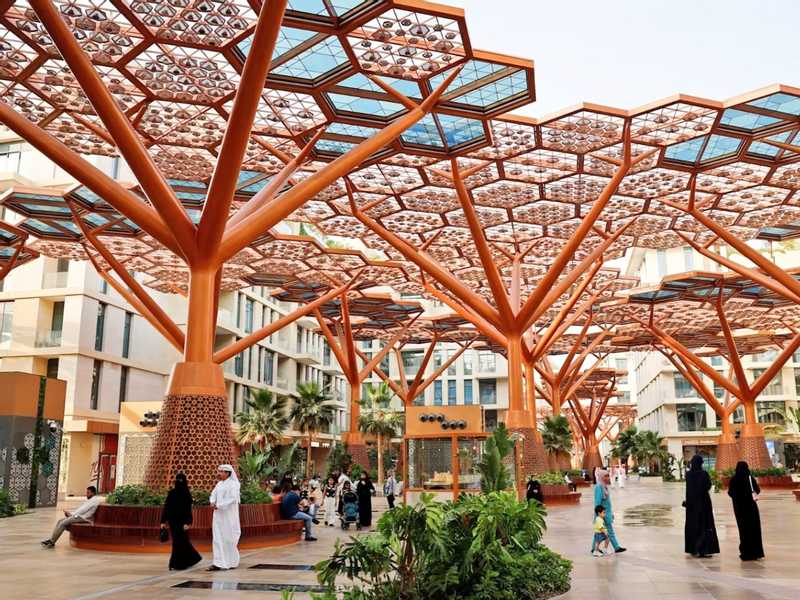
The report mentioned that Abu Dhabi opened a 660-meter covered and air-conditioned walkway in Al Khatem Park this year, while King Hamad bin Isa Al Khalifa Park in Bahrain features drought-resistant Ghaf trees and an open walkway equipped with cooling. In Qatar, the 450-meter “Crystal Walk” was opened in Doha, where cold air is pumped through floor vents, while artificial metal “trees” help trap cold air and provide shade.
The report quoted Mathaios Santamouris, a professor at the University of New South Wales, stating that evaporative cooling works more efficiently in extremely arid regions, limiting its applicability in parts of Europe.
Economic Diversification
Santamouris emphasized that cooling outdoor spaces requires significant energy and is not suitable for large-scale urban projects, warning against relying on it if the goal is transitioning to a carbon-neutral society.
Conversely, the report stressed that providing comfortable environments for visitors year-round has become increasingly important for Gulf countries, which are using tourism as part of plans to diversify their economies away from oil and gas. It noted that Qatar employed various cooling technologies during its hosting of the 2022 FIFA World Cup to demonstrate the country’s capacity to accommodate mass tourism despite its climate.
Innovative Technologies
The report affirmed that the ultimate goal is to develop technologies that use the minimum amount of resources while minimizing risks such as disease spread from stagnant water left by some cooling systems.
Sami Allah Khan, Chief Sustainability Officer at the UAE’s National Development Consortium, pointed to genuine technological advancements in this field, explaining that he participated in a project to cool 6,000 cows shipped from Europe to Sharjah.
The report detailed a system developed by the American company Airmocooling, which releases fine water droplets that evaporate to reduce air temperature by up to 9 degrees Celsius, whereas typical reductions range between 3 and 5 degrees. The system is being tested in the Abu Dhabi desert to lower air temperatures to levels more suitable for crops, relying on water evaporation to cool outdoor air instead of traditional air conditioning systems.
Reflective Materials
The report emphasized that the new generation of building materials capable of reflecting solar energy into space represents one of the promising solutions. It explained that coatings known as “super-cool materials” have proven their ability to reduce temperatures when applied to building roofs in Riyadh.
Santamouris noted that, depending on local climatic conditions, these materials can reduce urban surface temperatures by up to 15 degrees Celsius and can also be used in Europe. He added that European cities have traditionally relied on nature-based solutions to combat heat, but these solutions become insufficient when temperatures exceed approximately 35 degrees Celsius.
Growing Market
The report noted that outdoor cooling projects in the Middle East remain limited compared to the expansion of indoor building cooling systems, pointing out that district cooling has seen significant growth in the UAE over the past 15 years. The system relies on networks of chilled water pipes to cool buildings and benefit from economies of scale, similar to central heating systems used in Eastern Europe during winter.
The report confirmed that district cooling is becoming a major commercial sector, attracting operators with its long-term advantages and predictable revenue streams, with demand expected to rise as Gulf cities continue to expand. However, implementing such systems in Europe may be limited, as the number of days requiring building cooling may not justify the high cost of establishing infrastructure.
