16 million barrels of oil passed through Hormuz.. Friday night
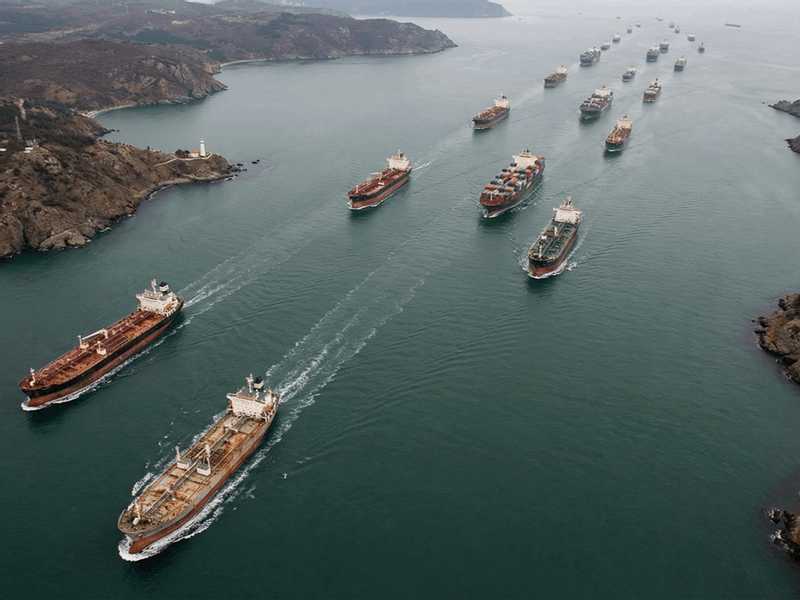
In a new sign of Iran’s waning ability to impose control over the Strait of Hormuz and disrupt navigation through it, oil flows through the vital waterway have continued to approach pre-war levels. Axios, citing three U.
Translated by Qiyas from القبس — Original source
In a new sign of Iran’s waning ability to impose control over the Strait of Hormuz and disrupt navigation through it, oil flows through the vital waterway have continued to approach pre-war levels. Axios, citing three U.S. officials, reported that approximately 16 million barrels of oil passed through the strait via the southern channel on Friday night, compared to a flow rate of around 20 million barrels per day before the war. Axios noted that about 40 oil tankers traversed the Strait of Hormuz in both directions—entering and exiting—during Friday night, indicating that navigation continues and oil flows are recovering a significant portion of their normal levels.
These developments coincide with Washington’s shift to a new phase in its conflict with Iran, one that places economic pressure at the forefront of its tools. U.S. Treasury Secretary Scott Bessent is scheduled to announce details of a new package of sanctions tomorrow (Monday), which he described as “the most severe in history” against Tehran.
The following are the details:
Friday night saw exceptional activity through the deep southern channel of the Strait of Hormuz, with approximately 16 million barrels of oil exiting and nearly 40 tankers passing in both directions. This surge marks the second time such levels have been observed, following U.S. Energy Secretary Chris Wright’s earlier remark that oil and product flows from the Gulf had exceeded 20 million barrels on Tuesday, after accounting for quantities transported via pipelines. Wright noted that the U.S. military facilitated the passage of more than 15 million barrels of oil through the strait on Tuesday, writing, “Do not be mistaken: thanks to the U.S. Navy, oil is flowing through the Strait of Hormuz.”
Sources in the U.S. Navy and Central Command stated that the United States is leveraging its military and naval blockade of Iranian ports in an effort to ensure the safe passage of ships through the strait, having intercepted drones and missiles attempting to target those vessels. According to a CNN investigation, “dark transit” operations under U.S. military protection represent the latest example of a shift in the balance of power vis-à-vis Iran.
On the afternoon of July 25, the massive oil tanker “Kiko,” owned by a Greek company, docked at the oil export terminal in the port of Mesaieed, Qatar. Four days later, “Kiko” sailed with crude oil through the Strait of Hormuz. The supertanker, the largest among oil tankers and measuring over 1,000 feet in length, maintained a steady speed of 13 knots while crossing the Gulf—a speed close to its maximum. Then, on July 31, “Kiko” disappeared off the coast of Dubai after turning off its Automatic Identification System (AIS), which broadcasts the vessel’s identity, speed, route, and location. Suddenly, at 10 a.m. on August 1, the “Kiko” signal reappeared, but on the other side of the Strait of Hormuz.
The vessel was part of the oil sector’s latest tactic, known as “dark transit” or “stealth transit,” involving nighttime passage through the strait under U.S. military protection to avoid Iranian drone attacks. With the assistance of the U.S. Navy, Gulf oil companies have hired tankers to disable their AIS transponders, transporting oil from the Gulf through the Strait of Hormuz to the Gulf of Oman, where the crude cargo is offloaded into waiting tankers owned by purchasing companies. The hired tankers then return through the strait.
Conversely, the Iranian News Agency (IRNA) reported on Saturday that Iran had allowed a number of Iraqi oil tankers to pass through the strait. However, the exact number of vessels permitted passage remains unclear. One of Baghdad’s key demands during the recent visit of Iranian Parliament Speaker Mohammad-Bagher Qalibaf to Iraq was obtaining special permits for Iraqi tankers.
