"Diwan of Verses of Blood and Jasmine," the latest work by Helmi Al-Zuwaiti
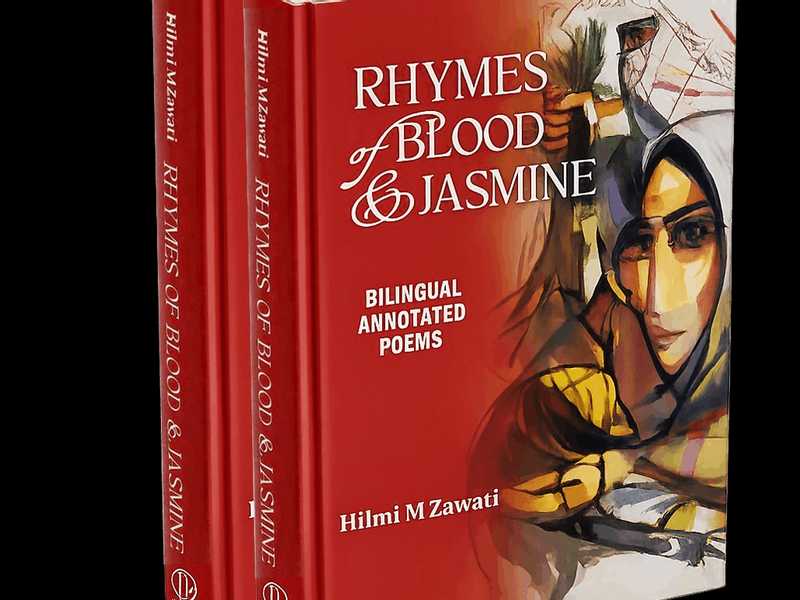
Darajaa Publishing in Quebec, Canada, has recently released “Rhymes of Blood and Jasmine,” a bilingual poetry collection by Dr. Hulmi al-Zuwati. Spanning fifty years of poetic output, the work is presented not merely as a selection of poems but as a “cognitive effort” and a “critical statement.” It stands out as a rare project of “self-translation,” in which the poet himself rendered his poems from Arabic into English to preserve the cultural, philosophical, and emotional nuances of the Palestinian experience.
Al-Zuwati’s rejection of “rigid literalism” led him to adopt a methodology grounded in “symbolic precision” and “emotional impact.” This approach highlights his dual role as author and translator, granting him a unique “hermeneutic authority” that bridges Arabic poetic traditions and English-speaking audiences without falling into the trap of “orientalist simplification.” This act of self-translation is classified as “narrative justice” and “ethical diplomacy,” as it resists the “foreignization” of Arabic texts and challenges dominant representation policies that often marginalize diverse Palestinian voices.
The duality of woman and homeland is the dominant theme of the collection, describable as a “dialectic of identification.” The poems illustrate how al-Zuwati weaves woman, love, and Palestine into a single, indivisible “poetic fabric.” Drawing on Professor Shakir Mustafa’s introduction to al-Zuwati’s complete poetic works (1986), the reader encounters a “Sufi harmony” in his literature, where woman appears not merely as a romantic symbol but as a living embodiment of the homeland—as mother, beloved, and companion. In this context, love transforms from a personal feeling into an “existential act of belonging” and a call for liberation.
Al-Zuwati employs “resistant nostalgia,” treating memory not as a passive sense of loss but as a living identity. By evoking symbols such as jasmine, orange, and fig, the poet summons meanings of “authenticity and renewal.” Artistically, the poems blend classical Arabic poetic traditions with modernist structures, creating a “free-spirited” composition rich in internal music. This allows the collection to function as a tool for “memory retrieval,” ensuring that historical trauma is transformed into a globally resonant aesthetic experience.
Thus, it is fair to situate al-Zuwati’s work within a broader academic and global context. Professor Meriye Rabezz has described it as a “weapon of ink” against historical erasure, while George Elliott Clark views it as a significant contribution to “war poetry” and “post-colonial discourse.” By presenting a bilingual edition that includes historical footnotes and annotations, the volume becomes a vital resource for universities and researchers in Middle Eastern studies and translation theory.
In conclusion, “Rhymes of Blood and Jasmine” emerges as a “poetic declaration” that transcends linguistic and geographical boundaries. It restores plurality to the Palestinian poetic landscape by resisting the monopoly of singular narratives, demonstrating that Arabic poetry can live with “dignity and beauty” in multiple languages, and standing as a testament to creativity’s capacity to shape ethical consciousness and foster global human solidarity.
