Cabinet Holds Meeting Chaired by PM
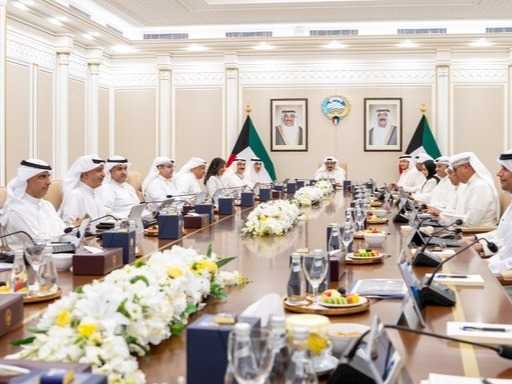
The Cabinet held a meeting chaired by the Prime Minister to discuss relations with Britain, attacks on ADNOC vessels, Kuwait's stance on Trump's Gaza plan, and amendments to the Nationality Law.
Translated by Alqyas from Al-Qabas — Original source
The Cabinet held its meeting today, Tuesday, August 18, 2026, presided over by His Highness Sheikh Ahmad Abdullah Al-Ahmad Al-Sabah, Prime Minister. Following the meeting, Sheikh Sharida Abdullah Al-Muwasharji, Deputy Prime Minister and Minister of State for Cabinet Affairs, issued the following statement:
“At the outset of its meeting, the Cabinet was informed of His Highness the Amir’s approval, Sheikh Meshal Al-Ahmad Al-Jaber Al-Sabah, may God protect and safeguard him, to preside over the inauguration of a number of new health projects in the country, and to entrust His Highness Sheikh Ahmad Abdullah Al-Ahmad Al-Sabah, Prime Minister, may God protect and safeguard him, to attend on his behalf, may God protect and safeguard him.
On another note, the Cabinet was informed of the content of the written letter received today, Tuesday, by His Highness the Amir, Sheikh Meshal Al-Ahmad Al-Jaber Al-Sabah, may God protect and safeguard him, from the Right Honourable Andy Burnham, Prime Minister of the United Kingdom of Great Britain and Northern Ireland, a friendly country. The letter pertains to the deep-rooted historical relations between the two countries and their friendly peoples, and ways to develop them across various fields. It also addressed a number of issues of mutual interest and the latest developments on the regional and international scenes. The letter was delivered to His Excellency Sheikh Hamad Jaber Al-Ali Al-Sabah, Minister of Diwan Amiri Affairs, by His Excellency Qudsi Rashid, Ambassador of the United Kingdom of Great Britain and Northern Ireland to the State of Kuwait, in the presence of His Excellency Sheikh Thamer Jaber Al-Ahmad Al-Sabah, Head of the Crown Prince’s Diwan.
On another note, the Cabinet expressed its strong condemnation and rejection of the unjust Iranian attacks that targeted two tankers and a vessel belonging to the UAE’s ADNOC company while they were transiting the Strait of Hormuz. It emphasized that targeting commercial ships and international maritime routes constitutes a blatant violation of international law and UN Security Council Resolution 2817, and poses a threat to the security and safety of maritime navigation, global energy supplies, and international trade. It stressed the necessity of halting all actions that could escalate tensions in the region, respecting freedom of navigation and safe passage through international routes, and fully and unconditionally reopening the Strait of Hormuz. The Cabinet reiterated the State of Kuwait’s full solidarity with the sisterly State of the United Arab Emirates and its support for it in all measures it takes to safeguard its sovereignty, protect its security, and defend its interests.”
On another note, the Cabinet expressed the State of Kuwait’s condemnation of the Israeli occupation authorities’ explicit rejection of the Road Map aimed at completing the implementation of the comprehensive plan of His Excellency President Donald Trump, President of the United States of America, for ending the conflict in Gaza, which was endorsed by United Nations Security Council Resolution (2803). It also condemned the Israeli occupation authorities’ rejection of the establishment of a Palestinian state, affirming that these stances constitute an outright refusal to move forward with the implementation of the comprehensive plan and fundamentally undermine collective efforts to achieve a just and lasting peace, including those undertaken by the State of Qatar, the Arab Republic of Egypt, the Republic of Turkey, the United States of America, the Peace Council, and all concerned parties. The Cabinet stressed the necessity for the international community to assume its responsibilities and compel the Israeli occupation authorities to fully comply with the obligations and arrangements stipulated in the comprehensive plan and its associated Road Map, and to prevent any further obstacles to its implementation. It reiterated the urgent need for the full and immediate implementation of the comprehensive plan, which would contribute to addressing the dire humanitarian situation and ensuring security and stability for all in Gaza, paving the way for reconstruction, recovery, and progress toward a just and lasting peace based on the Palestinian people’s right to self-determination and the establishment of their independent state on the borders of June 4, 1967, with East Jerusalem as its capital, in accordance with international law and relevant United Nations resolutions.
On another front, the Cabinet heard a briefing from His Excellency Minister of Foreign Affairs Sheikh Jaraah Jaber Al-Ahmad Al-Sabah regarding the political and diplomatic efforts undertaken by the Ministry of Foreign Affairs and its diplomatic missions abroad to keep pace with the latest developments in the regional and international arenas. His Excellency also informed the Cabinet about the substance of the telephone calls he conducted and received in recent days with several foreign ministers of brotherly and friendly countries, during which the latest regional developments and diplomatic efforts aimed at de-escalating tensions, enhancing security and stability in the region, and ensuring the safety and freedom of maritime navigation were reviewed.
On another note, the Cabinet approved a draft decree-law amending certain provisions of Emir Decree-Law No. 15 of 1959 on Kuwaiti Nationality. Article One of the aforementioned draft decree-law stipulated the following:
Article 14, Paragraph 4: If a person intentionally adds to his nationality file, or to the nationality file of another person, any individual who is not his son or descendant, and this is established through an investigation conducted by the Supreme Committee for Kuwaiti Nationality or through a final judicial ruling, the nationality of any of his sons or descendants may be revoked once his knowledge of this act is established.
Article 19: The Minister of Interior shall issue a certificate of Kuwaiti nationality to every Kuwaiti after verifying its establishment in accordance with the provisions of this Law. This certificate shall be issued in electronic form. The Minister shall issue a decision specifying the technical and procedural controls and requirements for issuing, preserving, and using the electronic certificate, as well as the procedures for verifying its authenticity, revoking it, or suspending its validity.
Article Two also stipulated the following:
A new paragraph shall be added to the text of Article 7 of the aforementioned Emir Decree-Law No. 15 of 1959, with the following text:
Article 7, New Paragraph: A person who has acquired Kuwaiti nationality through naturalization shall not have the right to vote, stand for election, or be appointed to any legislative body.
Article 3 stipulates the following: “The electronic certificate referred to in this Emirate Decree-Law shall have the same legal validity and effects as the nationality certificate, and shall replace the paper certificate in the application of the laws, decrees, and regulations in force.” The Council of Ministers submitted a draft Emirate Decree-Law amending certain provisions of Emirate Decree No. 15 of 1959 on Kuwaiti Nationality to His Highness the Amir of the State, Sheikh Meshal Al-Ahmad Al-Jaber Al-Sabah, may God protect and support him.
The Council of Ministers also approved a draft Emirate Decree-Law on the organization of the judiciary, which comes within the framework of efforts to develop the judicial system, enhance the efficiency of judicial work, and consolidate guarantees of the independence and integrity of the judiciary. This is achieved by updating the rules governing the affairs of the judicial authority and the Public Prosecution, and establishing a more integrated framework for justice institutions through several interrelated main axes.
The first axis consists of the aforementioned draft Emirate Decree-Law to develop the organization of the judicial authority by updating the rules governing the selection, appointment, and promotion of its members, as well as enhancing the jurisdiction of the Supreme Council of Justice and the rules governing its work.
The second axis focuses on strengthening the oversight and accountability system and litigation guarantees by developing rules for judicial inspection, accountability, and discipline, enhancing the rights of litigants, and updating the regulations governing the work and jurisdiction of the Public Prosecution, while reinforcing its role in overseeing detention facilities.
The third axis aims to develop judicial work and enhance the stability of legal principles by establishing a comprehensive mechanism to unify judicial precedents of the Court of Cassation, thereby ensuring the stability of legal principles and consistency of judicial rulings. It also involves regulating trials and judicial procedures conducted using electronic means, in a manner that responds to legislative and technological developments and elevates the efficiency of the justice system. The Council of Ministers submitted this draft Emirate Decree-Law on the organization of the judiciary to His Highness the Amir of the State, Sheikh Meshal Al-Ahmad Al-Jaber Al-Sabah, may God protect and support him.
The Council of Ministers also approved a draft Emirate Decree replacing the schedule attached to Decree No. 126 of 2018 concerning the minimum periods required for judges and members of the Public Prosecution to remain in their respective ranks, and submitted it to His Highness the Amir of the State, Sheikh Meshal Al-Ahmad Al-Jaber Al-Sabah, may God protect and support him.
Furthermore, the Council of Ministers approved a draft Emirate Decree-Law issuing a law establishing Economic Courts, in order to keep pace with recent international and regional legislation and to harness advanced technological systems in the service of justice. This necessitates the issuance of a law establishing Economic Courts, which is an implementing law aimed at achieving the required balance between the right to defense and the expeditious resolution of cases brought before the courts. This is pursued through three interrelated objectives the law seeks to achieve:
1. Establishing an Economic Court and assigning a judge to preside over it. This assignment extends to the expert appointed to conduct expertise proceedings in disputes heard by the court, down to the execution judge responsible for enforcing its rulings.
2. Simplifying litigation procedures by reducing certain procedural deadlines, working on case preparation and notifying parties of the statement of claim, and enabling mutual access to memoranda and documents before referral to the competent court. Additionally, it activates remote litigation systems while ensuring the principle of confrontation between parties and safeguarding the right to defense.
3. Legislative flexibility, by carefully avoiding the rigidity of legislative texts, which is considered one of the major flaws of legislation.
The Council of Ministers submitted a draft decree-law on the issuance of the law establishing the Economic Courts to His Highness the Amir of the State, Sheikh Meshal Al-Ahmad Al-Jaber Al-Sabah, may God protect and guard him. The Council of Ministers also approved the draft decree-law on the issuance of the law establishing the Economic Courts, with the aim of keeping pace with modern international and regional legislation and harnessing advanced technological systems to serve justice. This necessitates the issuance of a law establishing the Economic Courts, which is an procedural law aimed at achieving the required balance between the right to defense on one hand and the swift resolution of cases brought before the courts on the other, through three interlinked objectives the law seeks to achieve:
1. Establishing an Economic Court, a judge assigned to preside over it, and extending this specialization to the expert appointed to conduct expertise in disputes heard before it, down to the execution judge who implements its rulings.
2. Simplifying litigation procedures by reducing certain procedural deadlines, working on preparing the case and notifying the parties with its pleadings, and facilitating mutual access to memoranda and documents before referring the case to the competent court, while also activating the remote litigation system while ensuring the principle of confrontation between the parties and without undermining the right to defense.
3. Legislative flexibility, by striving to avoid the rigidity of legislative texts, which is considered one of the greatest flaws of legislation.
The Council of Ministers submitted a draft decree-law on the issuance of the law establishing the Economic Courts to His Highness the Amir of the State, Sheikh Meshal Al-Ahmad Al-Jaber Al-Sabah, may God protect and guard him.
On another note, the Council of Ministers reviewed the visual presentation submitted by the Deputy of the Amir’s Diwan, Sheikh Abdulaziz Meshal Mubarak Abdullah Al-Ahmad Al-Sabah, and the committee responsible for administration and supervision of the third phase of the Martyr’s Park project, regarding the final stages of the project’s operation and opening. The project is scheduled to be opened to visitors on Thursday, October 1, 2026. It was clarified that on this occasion, a carnival will be held featuring entertainment activities for visitors, including musical bands, light shows, and entertainment segments for families and children. The vision for the park is to be a model and integrated park that includes various sports and recreational facilities. The total area of the project land is 243.605 square meters, while the total built-up area is 203.162 square meters. The green area amounts to 190.661 square meters, and the investment area is 16.232 square meters. The project components include:
- The Sur Theater Building, which houses the Roman theater, an outdoor cinema, a multi-purpose hall, a women’s health club, cafes, and commercial shops.
- The Sports Building, which includes the upper park, an indoor skating hall museum, the skating hall, an ice sports hall, an electric car racing track, and a flying ride.
- External facilities, consisting of a mosque, an open-air theater, outdoor playgrounds, a running track, and fountains.
- Parking areas, accommodating 2,388 vehicles.
For his part, the Council of Ministers commended the efforts undertaken by the leaders, officials, and staff of the Amir’s Diwan and the committee responsible for administration and supervision of the third phase of the Martyr’s Park project to open this cultural and recreational project, which will serve as a tourist landmark attracting visitors from within and outside the State of Kuwait.
The Cabinet reviewed a number of items on the agenda, as well as reports and minutes of ministerial committees, and approved them. It also decided to refer several of these items to the relevant ministerial committees for study and to submit appropriate recommendations regarding them to complete the procedures for their implementation.
