Walking for Weight Loss: Consistency Is More Important Than Step Count
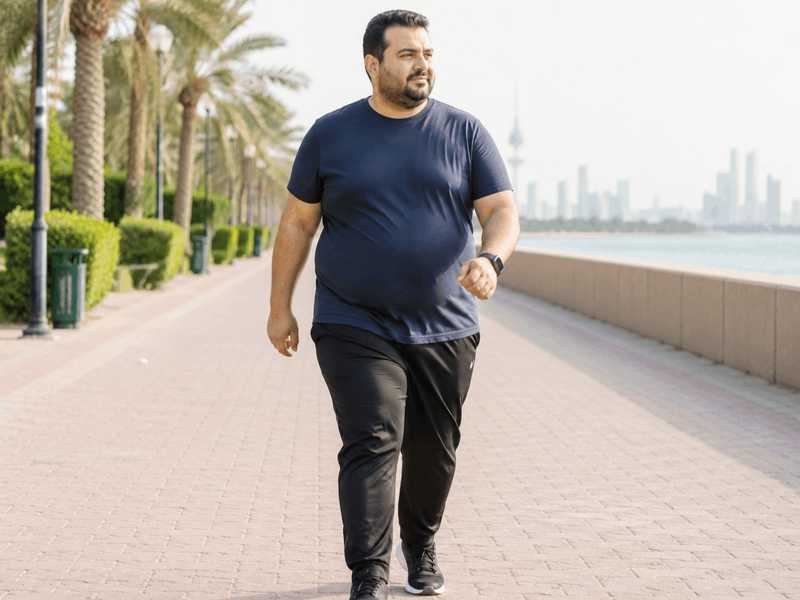
Reem Qasim - More than one in ten people worldwide want to lose weight, but they face difficulties in achieving this. Alongside diet, physical activity is a fundamental pillar of weight loss, yet choosing the right activity can be challenging for beginners, those who are overweight, or individuals who fear injuries. Walking stands out as an easy, low-impact option that helps burn calories and supports weight loss, while being easily integrated into daily life. So, what are the appropriate duration and intensity to achieve the best results? Below are answers from sports nutritionist Laura Martinez, according to a report published in the magazine “Sante.”
Walking is a suitable activity for everyone, including non-athletes and overweight individuals, as it helps burn calories and supports weight loss when practiced regularly. According to the expert, there is no specific duration or step count that guarantees weight loss; rather, the most important factor is setting a gradual goal that aligns with one’s fitness level and daily habits, and sticking to it. The specialist clarifies that walking alone does not guarantee weight loss, as compensating for burned calories by eating more food can negate its effects. Therefore, walking remains a supportive tool for weight loss, but it should not be considered the sole factor.
One of the key advantages of walking for weight loss is its ease of practice, especially for obese individuals or those with musculoskeletal issues, making it an activity that can be sustained over long periods. Sports nutritionists emphasize that the best activity for weight loss is not necessarily the one that burns the most calories, but rather the one that can be adhered to for months or years, making consistency a crucial factor in achieving results.
◄ No Magic Equation
Martinez points out that there is no specific walking duration that guarantees weight loss, as this depends on weight, diet, age, gender, walking intensity, and overall physical activity level. However, increasing walking duration raises energy expenditure, which may support weight loss. There is also no ideal step count, but reaching 8,000 to 10,000 steps daily is considered a good level of activity for a non-athlete and may aid weight loss if maintained consistently.
◄ Gradual Progression in Walking
Sports nutritionists advise sedentary individuals to gradually increase their walking, noting that raising the daily step count from 3,000 to 6,000 steps can increase energy expenditure, improve health, and support weight loss. Once accustomed to this level, walking duration can be gradually increased. She notes that the impact of walking depends not only on the number of steps or distance, but speed and intensity also play important roles. Brisk walking, which slightly increases breathing rate and heart rate, burns more calories and may be more effective in supporting weight loss.
◄ When Are Results Visible?
There is no single answer, as weight loss depends on several factors, most notably walking intensity, physical characteristics, metabolic rate, and diet. Laura Martinez clarifies that weight loss fundamentally depends on maintaining a calorie deficit, noting that brisk walking for one hour daily may burn approximately 250 to 350 calories, depending on body weight and walking speed, which may support gradual weight loss when combined with a balanced diet. The expert explains that these estimates are approximate, as the body’s response to weight loss varies from person to person. Additionally, weight loss may not be linear in the early weeks, as weight can fluctuate rapidly or stabilize temporarily due to changes in fluid levels, glycogen stores, or increased muscle mass.
