Why did NASA chase the solar eclipse with jet aircraft?
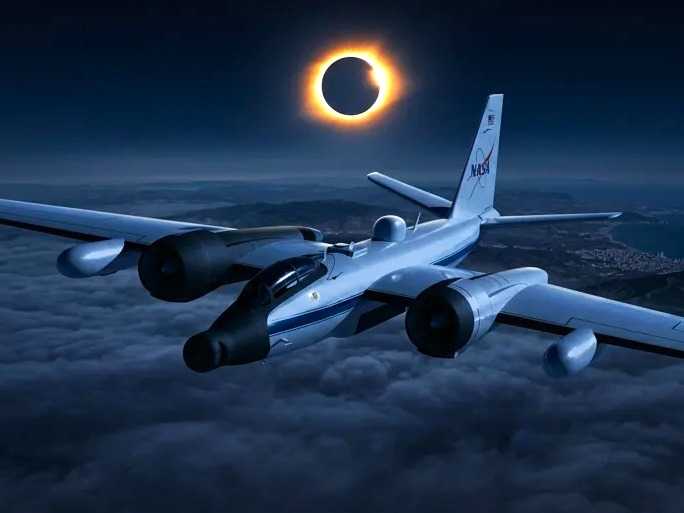
NASA has taken a new exceptional step in the history of solar eclipse chasing, continuing a scientific journey that began decades ago in an effort to understand the star that gives life to our planet. The roots of these historical efforts date back to 1923, when the U.S. Navy sent a fleet of aircraft to observe the eclipse, culminating in a notable achievement in 1973, when scientists used a supersonic Concorde aircraft to track the Moon’s shadow for more than 74 minutes over the Sahara Desert. Building on this rich legacy, NASA will fly powerful WP-57 jet aircraft to altitudes of approximately 15.2 kilometers to pursue the total solar eclipse, soaring above clouds and dense atmospheric layers that hinder precise observation from the Earth’s surface. According to Al Jazeera, this mission extends a pioneering experiment conducted by NASA in 2017, although the 2026 journey represents a qualitative leap in the technology, imaging equipment, and measurement instruments used. In this context, Dr. Amir Kaspi, the mission’s principal investigator from the Southwest Research Institute, highlighted the extent of technological advancement, stating, “In the 2017 experiment, we flew with only two cameras measuring two different wavelength ranges. In this experiment, we used four cameras capable of measuring across seven different wavelength ranges, providing us with more detailed information about the solar structures we observed.” The flight focused primarily on studying the solar corona, the Sun’s mysterious outer atmosphere, whose temperature rises to become millions of degrees hotter than the Sun’s surface itself. In an interview, Dr. Kelly Korreck, NASA’s eclipse program manager, emphasized the unique value of this aerial observation, saying, “From our unique vantage point on Earth during a total solar eclipse, scientists can study the Sun’s corona in a way that we cannot do from anywhere else in the solar system.”
