Yemeni Ambassador to Al-Qabas: 180 individuals had their Kuwaiti nationality revoked and regained their Yemeni nationality
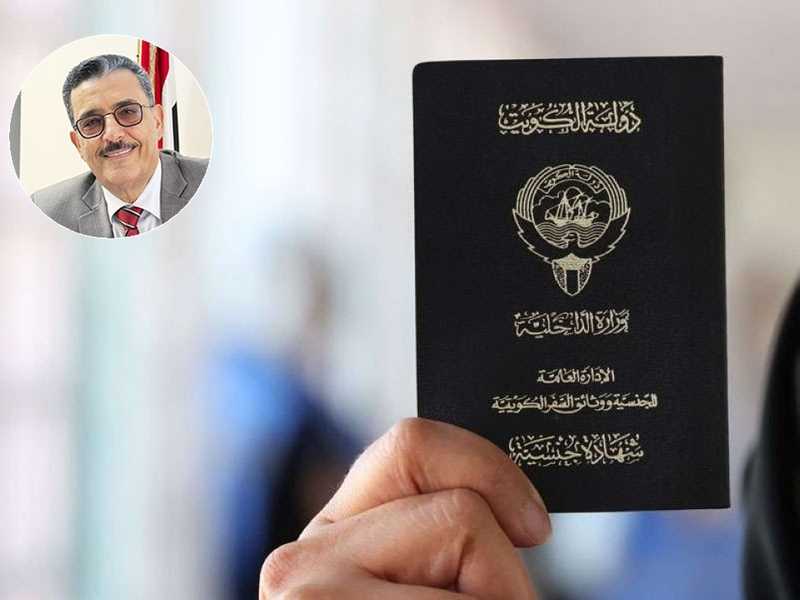
While emphasizing the strength of relations between Kuwait and his country, Yemeni Ambassador to Kuwait Dr. Ali Mansour bin Safaaf pointed to continued joint coordination and cooperation in all fields. In an interview with Al-Qabas, the Yemeni Ambassador announced that more than 180 individuals, described as “Yemenis whose Kuwaiti nationality had been revoked,” had managed to reclaim their Yemeni citizenship. He noted that the embassy had received their files and forwarded them to the relevant authorities in Yemen to complete the procedures. He stated, “A committee from the Yemeni Civil Affairs and Passports Department received these individuals, examined all the files, and issued them Yemeni documents and passports confirming their Yemeni nationality.”
He clarified that “there is no special committee within the embassy for this file,” adding that some cases continue to emerge from time to time, and the embassy fulfills its role by forwarding them to the relevant authorities and providing them with all necessary information and data, stressing that “matters are proceeding smoothly and without complications.”
On the developments in the regional situation, the Yemeni Ambassador warned against the danger of continuing Iranian threats and their proxies in the region. He affirmed that Yemen’s security is directly linked to the security of the Gulf states and the region, and that any failure or instability in Yemen would inevitably have repercussions on the security of the Arab region. He revealed plans to activate the existing security agreement between Kuwait and Yemen soon, stressing that the security of the Red Sea and the Bab al-Mandab Strait represents a priority in security cooperation between the two countries, given the aggressive Iranian behavior and threats targeting international navigation.
He affirmed that Kuwait has handled recent developments with political wisdom, exceptional security capability, and self-restraint, considering that its experience in managing these events should be studied in the fields of security academia and political science. He praised his meeting with the Deputy Minister of Interior, Major General Abdulwahab Al-Wahayb, describing the meeting as “pleasant, productive, and fraternal.” During the meeting, a number of issues and topics related to Yemeni-Kuwaiti relations in the security, humanitarian, and various other fields were reviewed. He stressed that “Kuwait has distinctive footprints in Yemen in all aspects of life.”
When asked if there are new security arrangements or understandings between Kuwait and Yemen amid the security challenges facing the region, bin Safaaf said that “security arrangements between Kuwait and Yemen are in place and functioning well, with coordination between the security authorities in both countries.” He added that “the recent developments in the region require us to pay special attention to the security aspect, especially since issues that were not anticipated have emerged, whether in Yemen, Kuwait, or the Gulf Cooperation Council (GCC) countries, due to the aggressive Iranian behavior. It is essential to coordinate in this regard.”
When asked if the Yemeni government has requested any new security support or cooperation from Kuwait in the coming period, bin Safaaf said that “the Yemeni government has always been in this situation, and from an early stage, since the establishment of the Yemen Arab Republic in North Yemen and the Republic of Yemen, Kuwait has extended its hand with great generosity.” He added that “Kuwait, by nature, has no political reservations, orientations, or economic interests in its relationship with Yemen; its relations are natural, based on mutual respect, and extending assistance and cooperation in various fields.”
He revealed the existence of “a security agreement between the security agencies of the Republic of Yemen and Kuwait,” noting that “during our meeting with the Deputy Minister, this agreement was discussed, and we are in the process of activating it in all its stages soon.” He stated, “We are the Arab country that has suffered most from Iran’s fire for the past 13 years, and we are also experiencing the consequences of this rogue regime through its proxies present in Yemen, namely the Houthi proxy, and those present in the region.”
The Yemeni Ambassador stressed that “the security of the Red Sea and Bab al-Mandab is a priority in security cooperation between Kuwait and Yemen.” He said, “Any harm in Yemen, or any failures or problems, will inevitably extend its impact to the entire Arab region and the Gulf states. Anyone who believes they are immune to the aggressive Iranian behavior is mistaken.” He added that “this aggressive Iranian wave does not aim to harm Yemen alone; rather, it wants Yemen to be the pathway to reach the entire Arab region.”
He pointed out that “their threats regarding the Red Sea and the Gulf of Aden are among the tools used by the Iranian regime, and their situation has become exhausting, especially as they have begun to act arbitrarily, with no connection to either the ethics of war or established conventions.” He said that “Houthi attacks on international waterways employ all methods, and they believe that the storm they are creating can affect or hinder international navigation, which is impossible, especially since they do not possess and have no direct control over Bab al-Mandab or the Red Sea.”
He explained that “the Houthis typically use residential areas and strike waterways from a distance to avoid detection, but the cohesion present among the ranks of the armed forces, security agencies, tribal leaders, and all well-wishers” represents an important factor in confronting these threats.
Regarding a solution to the Yemeni crisis, the Yemeni Ambassador said, “Without a doubt, we in Yemen have tried on multiple occasions, from Switzerland to Kuwait, to seek a peaceful solution to remove Yemen from this dilemma, in order to preserve Yemeni society.” He added, “But they, acting as a militia, care only about achieving propaganda to deceive many people regarding their claim of defending the Palestinian cause and opposing America and Israel, which unfortunately serves all those agendas.” He continued, “Therefore, they are a rogue gang and a tool, lacking decision-making authority. Consequently, we cannot rely on political solutions for the Yemeni issue, whether with the Houthis or with Iran. Thus, the optimal solution to address this problem is a military one to eliminate this faction.”
When asked if there is concern about Yemeni territory being exploited by any regional parties to implement military agendas threatening the security of Gulf states, bin Safaaf said, “Of course, we fear the exploitation of Yemeni territory, especially since the Houthi militia controls a large part of the northern governorates and the capital, Sana’a. Therefore, we expect this without a doubt.” He pointed out that “what the Kingdom of Saudi Arabia has undertaken, in cooperation with some countries and coordination among them, such as Pakistan and Turkey, has also given us Arab strength in the region, in the Peninsula and the Gulf, and reassures us of the existence of a defensive force that there is someone to confront this aggressive Iranian wave.”
