"The Mecca Defense Agreement" – A Wall of Strategic Deterrence
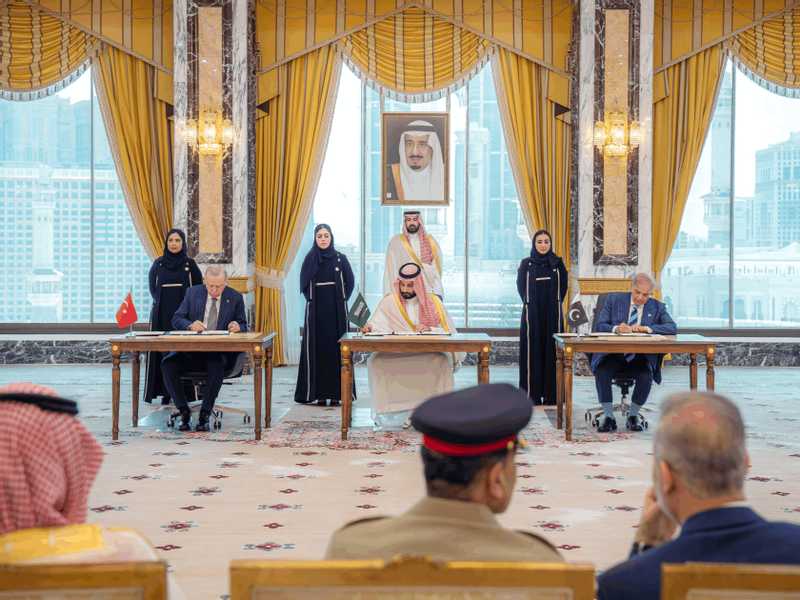
In a moment of complex regional dynamics and as a strategic advance, the Kingdom of Saudi Arabia, Turkey, and Pakistan signed the “Mecca Agreement for Joint Defense” on Friday at the Royal Diwan in Makkah Al-Mukarramah.
Translated by Qiyas from القبس — Original source
In a moment of complex regional dynamics and as a strategic advance, the Kingdom of Saudi Arabia, Turkey, and Pakistan signed the “Mecca Agreement for Joint Defense” on Friday at the Royal Diwan in Makkah Al-Mukarramah. The agreement was signed by Saudi Crown Prince Mohammed bin Salman, Turkish President Recep Tayyip Erdogan, and Pakistani Prime Minister Muhammad Shehbaz Sharif. The agreement aims to build an integrated regional deterrence system that ensures the protection of the three countries from any aggression and supports regional stability amid current geopolitical changes and challenges, through enhanced military cooperation, defense industries, and comprehensive field coordination.
Saudi Defense Minister Prince Khalid bin Salman wrote that the agreement “solidifies a framework for a long-term defense partnership and enhances deterrence, coordination, and integration among our brotherly countries, contributing to supporting the security and stability of the region and the world.”
The “Mecca Defense Agreement” cannot be read in isolation from the massive transformations the region is undergoing; it comes at the peak of escalating regional tensions that arose following the US-Iran war and the accompanying Iranian aggression that targeted several countries in the region. It can also be viewed as a pivotal step in reshaping the geopolitical landscape and shaping the region’s future, as the defense alliance between Riyadh, Ankara, and Islamabad represents an unprecedented Islamic depth and geopolitical weight, given the vast military and economic capabilities possessed by the three countries, which can restore balance to the Middle East and curb any attempts to monopolize the region.
In its regional dimension, the agreement constitutes a strategic blow to Iran’s expansionist projects. After decades of Tehran’s attempts to undermine regional security and proliferate militias to weaken central states, the agreement imposes a decisive deterrence equation against Tehran and its proxies, especially following its recent transgression in aggression against Gulf Arab states. It also represents a setback for Tel Aviv and a buffer against the occupation entity’s regional encroachments following the events of October 7, 2023. Notably, the agreement was drafted with flexibility allowing for the accession of other interested countries, which will open the door to developing it into a comprehensive security umbrella to consolidate stability in the region and the world, far from attempts at domination, imposing facts on the ground by force, or spreading chaos.
Below are the full details:
Saudi Arabia, Turkey, and Pakistan signed the “Mecca Agreement for Joint Defense” on Friday during a summit at Al-Safa Palace in Makkah Al-Mukarramah, in response to a gracious invitation from Custodian of the Two Holy Mosques King Salman bin Abdulaziz. Saudi Crown Prince Mohammed bin Salman received Turkish President Recep Tayyip Erdogan and Pakistani Prime Minister Shehbaz Sharif. The Mecca Summit for Joint Defense was held, during which the distinguished relations between the Kingdom of Saudi Arabia, the Islamic Republic of Pakistan, and the Republic of Turkey, along with a number of issues of common interest, were reviewed.
The summit’s final statement indicated that the agreement aims to enhance joint collective deterrence and develop all aspects of defense cooperation among the three countries. It stipulates that any armed attack on one of the signatory states constitutes an attack on all parties. The statement added that the agreement is based on “historical ties” and shared strategic interests among the three countries, aiming to enhance security and stability in the region and the world.
**Sharing Burdens and a Shared Understanding of Security**
The “Mecca Agreement for Joint Defense” is a strategic collective defense treaty between three major military and political powers in the Islamic world. It reflects the three countries’ commitment to coordination and enhancing their shared security, thereby raising readiness levels and strengthening their capacity to confront common security challenges, achieve security, peace, and stability in the region and the world, and strive for a secure and prosperous future. It is a cooperation focused on defense, not targeting any specific country, and aims to enhance commitments to maintaining regional and global peace and stability based on burden-sharing and a shared understanding of security. Additionally, it is an arrangement focused on defense, aiming to improve cooperation in defense industries, military interoperability, and the development of defense industrial capabilities.
The “Mecca Agreement” does not imply withdrawal from any existing alliance or agreement; rather, it enhances regional security by complementing existing alliance relations and provides a foundation for open cooperation for the accession of regional countries. It is viewed as an “element supporting peace and security.”
Turkish news agency Anadolu reported that sources familiar with the matter stated that this agreement is not an offensive military front, nor an attempt at encirclement or a plan to launch an attack, but rather a step that will also contribute to achieving the goal of a “terror-free region,” aimed at ensuring regional stability and not targeting any country, without closing existing dialogue channels. Officials viewed the “Mecca Agreement” as historic by all standards for the region and the Islamic world, considering that “the regional security architecture has been redesigned through the Mecca Agreement.” They added that Turkey’s membership in the North Atlantic Treaty Organization (NATO) and its regional partnerships are not substitutes for one another, but rather structures that complement each other.
**Right to Self-Defense and Supporting Peace Opportunities**
Turkish President Erdogan stated in a post on the X platform that the agreement is based on the principle of collective deterrence, including enhancing security and defense cooperation among the three countries, developing joint projects in defense industries, and cooperating in counter-terrorism, thereby enhancing the security and stability of the region. He added that the agreement affirms the right of states to defend themselves in accordance with Article 51 of the UN Charter, as one of the fundamental principles of international law, noting that it does not target any country and is open to the accession of other countries seeking peace and stability in the region.
Erdogan pointed out that Turkey will continue, based on its vision of enhancing regional ownership, to support peaceful solutions to conflicts and crises through respect for international law, dialogue, and diplomacy. He expressed hope that the visit, discussions, and signed agreement would contribute to achieving goodness and stability for the region, emphasizing that cooperation between Saudi Arabia, Turkey, and Pakistan reflects a shared will to enhance regional security and support opportunities for peace and development.
The Turkish Presidency also announced that the “Mecca Agreement” is a historic step within a more robust strategic framework that safeguards peace and stability in our region, pushes cooperation forward in the field of defense industries, and enhances common security and collective deterrence. According to Burhan Duran, Director of Communications at the Turkish Presidency, “this strong will demonstrated by Turkey, Saudi Arabia, and Pakistan represents a tangible embodiment of the steadfastness of brotherly peoples standing shoulder to shoulder in difficult times in their shared values, and their determination to build a future security system with a spirit of solidarity.”
**A Pivotal Station and Unity of Destiny**
For his part, the Prime Minister of Pakistan emphasized that the agreement represents a “pivotal station” in the path of cooperation between brotherly countries bound by mutual trust and unity of destiny. He noted that signing it in the precincts of Makkah Al-Mukarramah and next to the Two Holy Mosques adds a historical and symbolic dimension to it, reflecting the depth of shared responsibility toward the security of the three countries and serving the interests of their peoples.
In the same context, Pakistani President Asif Ali Zardari welcomed the signing of the agreement, noting that it represents an important step toward enhancing strategic partnership among the three countries, describing it as a significant development capable of enhancing peace, security, and stability in the region and the world, and strengthening the joint defense capabilities of the three countries, embodying their commitment to building a secure, stable, and prosperous future for their peoples.
**Political Will to Protect Stability**
For his part, Saudi Defense Minister Prince Khalid bin Salman said the agreement solidifies a framework for a long-term defense partnership that enhances deterrence, coordination, and integration among our countries, and supports the security and stability of the region and the world.
For his part, Saudi Foreign Minister Faisal bin Farhan described the Mecca Agreement for Joint Defense with Turkey and Pakistan as an “important station” in defense cooperation among the three countries. In a post on the X platform, he stated that the agreement affirms the depth of fraternal and strategic relations between the three countries and represents the culmination of a shared desire to unite efforts to confront challenges and threats affecting the security and stability of the region. It embodies the shared political will of Saudi Arabia, Turkey, and Pakistan to protect security and stability and support a safer regional environment.
**Integration of Defense Capabilities, Not an Arms Race or Military Axis**
Dr. Raed Qarmali, Undersecretary of the Saudi Ministry of Foreign Affairs for Public Diplomacy, stated that the agreement “comes as an embodiment of the deep historical strategic relations between the three countries, spanning decades, and the culmination of detailed negotiations that lasted for years.” He added that it “allows the three founding countries to develop joint defense capabilities, strategic deterrence, and readiness, and to work on developing and integrating their defense capabilities to jointly confront any threat to the security and safety of their territories.”
Under the agreement, “any external armed attack on any of the three countries is considered an attack on all,” he stressed, while emphasizing that it “does not represent any trend toward building a military axis or a sectarian/religious bloc, nor is it linked to nuclear pursuits or an arms race, but rather to building sustainable indigenous capabilities.”
Qarmali pointed out that “the agreement does not come at the expense of Saudi Arabia’s strategic and strong relations regionally, Arably, and internationally, nor is it a threat to the security of any country in the region, nor an escalation of tensions between any two countries.” He clarified that it “does not cancel or replace any bilateral or multilateral agreements between these countries or with other parties, countries, or organizations.”
**4 Geopolitical Reasons Leading to the Agreement**
Professor Dr. Murat Yesiltas, a faculty member at Ankara University of Social Sciences and Director of Foreign Policy at the SETA Foundation, wrote an article for the state-owned Turkish Anadolu Agency, analyzing the Mecca Agreement for Joint Defense, its regional repercussions, and the potential stances of other regional countries. He viewed it as solidifying a new strategic framework that could have significant repercussions on the regional security architecture, as the agreement goes beyond existing bilateral defense relations and is based on the concept of collective deterrence. He believed that viewing the agreement merely as an enhancement of military cooperation among three countries is insufficient.
The Mecca Agreement is the product of a period of increasing uncertainty in the international system, growing selectivity in security commitments by major powers, especially the United States, and the interconnection of regional conflicts. The agreement also reveals how medium-sized powers seek to adapt to the changing international system, how they unite their diverse elements of power, and how they expand the scope of their strategic maneuvers.
Dr. Yesiltas enumerated four geopolitical reasons that led to the agreement:
* The worsening of uncertainty in the international security system and the expansion of great power competition to include the Asia-Pacific region make US security policy more selective, forcing regional actors in the Middle East to bear greater responsibility for their own security.
* The increasing regional nature of conflicts in the Middle East: The war that started in Gaza has, over time, created a broader conflict zone encompassing Lebanon, Syria, Iraq, Yemen, Iran, and Gulf security.
* The use of military force in the region has become less constrained. The conflict between the occupation entity and Iran is no longer merely a two-party competition but has taken on a character that directly affects regional security, especially with the use of missiles and drones, increasing the likelihood that any crisis will quickly turn into a cross-border war.
* Technological transformation in warfare: The proliferation of missile and drone technologies makes critical infrastructure, energy facilities, and cities more vulnerable. Possessing a strong army is no longer sufficient in itself; it requires an intelligence network capable of proactive threat detection, a multi-layered air defense system, cyber warfare capabilities, continuous logistical support, and a sustainable defense industry.
**The Three Leaders Performed Friday Prayer in the Grand Mosque**
Saudi Crown Prince Mohammed bin Salman, Turkish President Recep Tayyip Erdogan, and Pakistani Prime Minister Muhammad Shehbaz Sharif performed Friday prayer at the Grand Mosque in Makkah Al-Mukarramah on the sidelines of the Mecca Summit for Joint Defense.
The performance of Friday prayer followed the convening of the trilateral summit and the signing of the Mecca Agreement for Joint Defense. The performance of Friday prayer at the Grand Mosque, coinciding with the trilateral summit, reflected the symbolic dimension that Makkah Al-Mukarramah carries as the Qibla of Muslims and a center that unites the religious dimension with Saudi Arabia’s role in enhancing dialogue and cooperation among Islamic countries, at a time when the region faces challenges requiring closer coordination and cooperation to achieve security and stability.
