Manifestations of Fragmented Consciousness in the Novel "Standing on the Fingers"
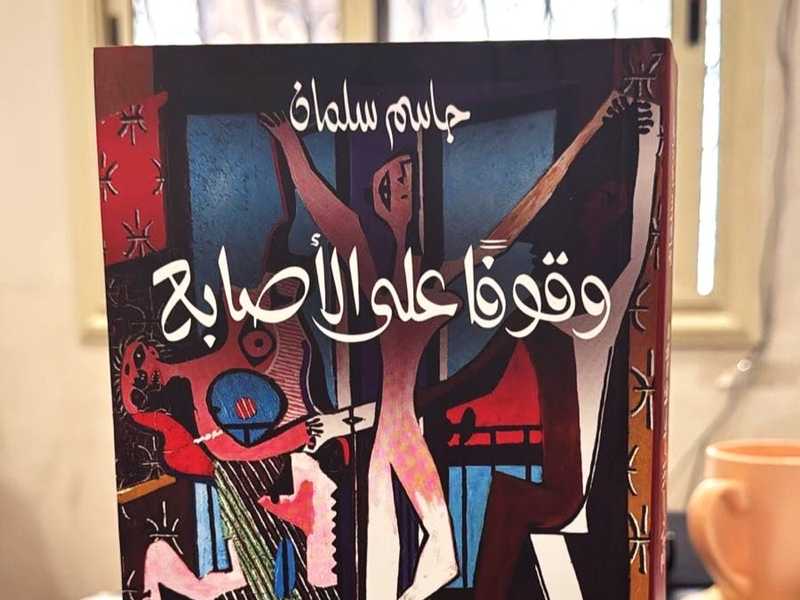
Dr. Salwa Al-Abbasi – Discussing experimentation in contemporary Arabic narrative may not seem to us a critical luxury or merely a formal description of the diverse methods employed by writers; rather, we consider it an indispensable epistemological entry point for comprehending the profound transformations that have affected the structure and epistemic function of the novel. Its multiple manifestations transcend the boundaries of formal adventure or technical deviation from traditional patterns, transforming—amid the collapse of major reference points and the erosion of grand narratives—into a literary space brimming with experiments and fractures simultaneously. This space reflects, in its trajectories and directions, the courage of writers who, through art and free speech, sought to confront a reality open to multiple possibilities.
It is precisely within this horizon, commonly referred to as the “stream of consciousness,” that the novel *Standing on Fingers*, recently published by the writer Jasim Salman, emerges as an experimental, adventurous text that mirrors this anxious consciousness. It works to deconstruct the worlds of the contemporary self and reconstruct them within a network of intellectual and existential tensions. The novel, with its substantial length (596 pages) and eleven chapters, narrates the story of Mikhail al-Rumi, an elderly Iraqi Christian intellectual who flees his country and family to the homeland of exile and protection, America, after being accused of treason by his warring adversaries. These adversaries used his profession of translating from English to Arabic during the Iraq War as a pretext for condemnation. Thus, he departs for the country occupying his homeland, accompanied by his wife, Mary, as a refugee seeking refuge from the fires of war in the embers of exile. Through a strange choice by the author, he bears the heaviest burden of the experience and the tragedies of the tragedy from the beginning to the end of the story (“Do you know what it means that you were chosen above all others to bear the weight of treason?”).
The narrative is fragmented, and the novel rises from its first hint upon a fragmented narrative structure in which memory intertwines with investigation, reality with delirium, and personal history with modern Iraqi history, through the trajectory of Mikhail’s character, following his accusation of treason and his gradual slide toward psychological collapse. The story begins with an ambiguous hint of his absence or death, and a notebook in which he leaves his confessions and reflections, evoking his childhood in Basra and the wars, loss, looting, and devastation that marked it, where his worldview was shaped through fear, language, and memory. Conversely, his wife Mary’s anxiety grows after his disappearance, and she, in turn, recalls the memory of Iraqi devastation, while his notebook becomes the focal point of investigation and truth-seeking. As they move to New York, the theme of intensifies treason in the form of a central question that has haunted Mikhail, whether in his relationship with his homeland, his language, or his self; especially given his past as a translator conscripted by the US military forces. His alienation deepens, and his relationship with Mary becomes tense. She remains torn between clinging to him and her desire to break free from the burden of the relationship and get lost in exile.
Then, throughout the novel’s events, the pace of investigations accelerates, becoming a symbolic trial of history, wars, and the values of loyalty and belonging to the entire human homeland, paralleling the deterioration of his psychological state and his entry into the space of hallucination and the anguish of consciousness, thereby raising an open question about his madness or, conversely, his hyper-awareness of the world’s madness. The circles of anxiety widen further through other characters he encounters on his path, of different ethnic and religious origins, who also fled to the New World from the wreckage of their worlds, seeking stability and answers to the questions of the self in all its dimensions. They all share, despite the differences in their narrative paths, the obsession with the journey, the transformations of the stage, and its concerns, undergoing arduous experiences of displacement and homelessness, or the desire to discover the human home in his fluctuating world with its paradoxes. Thus, the journey takes various divergent directions.
The experience of the exile is embodied by the novel’s characters, whose multiple narrative voices represent different models of the exile experience. These include the elderly Joseph the Egyptian of Greek origin, the office clerk who employs Mikhail in America, and his wife Lisa, the Latin American American; the elderly “Robin Hood,” the building’s doorman of African origin, and his wife Margaret; Harun, the Syrian refugee poet fleeing his war-torn homeland; Wanes, the Iraqi ney player; Timur, the Turkish aristocrat; and the nomadic Gypsies living in tents... Then, in the same context, we notice that the map of narration tends, conversely, to gradually contract as its external extensions shrink, burrowing into primarily psychological and mental spaces, resistant to direct sensory perception. This is clearly manifested when Mikhail retreats into his inner worlds, weighed down by sorrows and torments; where states of delirium and psychosis intertwine, and the narrative experience becomes closer to a dramatic representation of the self’s disorder and the fracture of its consciousness, paralyzed by anxiety. Often, “his memory is clouded by the sediments of years, filled with scars, the smells of fear, the tremors of death, and the gunpowder of tanks and rifles.”
Thus, this character arises within a unified narrative structure with an exploratory, symbolic function, surreally anticipatory, transcending its individual boundaries to become a symbolic equivalent for the tragedy of humanity in its multiple times and places, and in the complexity of the conditions of its existence and the fracture of its certainty. With the arrival of the catastrophic moment or the climax, Mikhail’s trial for treason transforms into a cosmic scene in which history intertwines with myth and delirium, and human balance becomes fragile in a turbulent world. The novel ends without a final resolution regarding the fate of the psychotic hero or his truth, leaving him suspended between the image of the traitor and the victim, as a deep contemplation on the collapse of man and questions of identity, belonging, and loyalty in a time of devastation and fragmentation. Accordingly, the author does not hesitate to carve out for the reader an image of an unconventional hero, embodying the traits of an intellectual passionate about books, historical manuscripts, and narratives of conquests and antiquities. Thus, he is a hero burdened with questions of existence and its ambiguities, contemplating the contradictions and fractures of reality. He bears the burdens of “a prophet’s warning in a society that does not see what he sees”; especially when “the sighted person’s vision is of no use among the blind.”
The game of narration, in this way, rises on a dualistic axis of vision and obscurity, meticulously shaping this strange fictional creature in the form of an ambiguous, mysterious entity; as if it were a hybrid being, half human and half made of paper, ink, and tangled memories. Nevertheless, he remains sensitive, listening to the creeping movements of the narrative around him, and defining his vision to capture what others fail to perceive. He transcends his environment in knowledge and awareness, and never ceases to ask persistently, with no one answering. What we have learned about him is that “they call him the Red, and his blood sees beneath his blond skin. He was transparent, and still is,” and that he wears “a face like a copper mask without eyes” when he becomes angry, his cheeks flushing with redness, in addition to being an insatiable eater who cannot resist Iraqi tea and traditional Iraqi dishes, as if he pours into them the fullness of his hunger for his homeland; especially when he “carries the Iraq of I will go with him.” Above this, we find him passionate about books, manuscripts, and history, knowledgeable and cultured, and skilled in translation, “interacting with texts and their authors’ styles with exceptional speed.” However, he simultaneously bears unstable psychological traits, which his wife Mary sometimes labels as “quick-tempered,” at other times as having the cold blood of reptiles, and as “useless.” Despite the conflicts and tensions in his relationship with his wife Mary, he loved her to the utmost extent, even though he remained unable to satisfy her. Together, they embodied a living model of a tense husband, their narrative and marital relationship also fractured, marked by presence and absence, coldness and silence, the ignition and extinguishing of emotions, which we see most of the time. Thus, the writer Jasim Salman’s tendency to crystallize a new narrative model for the experimental “Ripley” hero, stigmatized with shame, the “living dead,” the “crucified on himself,” suspended between contradictory dualities: life and death, presence and absence, negation and existence, certainty and uncertainty. This makes him a voice shrouded in questions, appearing in the image of a truth obscured, wrapped in mystery, absence, certainty, and “uncertainty,” so that his life and death remain a riddle and an enigma.
The riddle of the story is unveiled only when the novel reaches its climax, at which point we discover that the entire story is a deliberate artistic invention woven from the hero’s own imagination, a trick devised to deepen experimentation and obscurity; for he was neither a traitor, nor psychotic, nor hallucinating; rather, he carried in his narrative mind the strongest manifestations of consciousness and knowledge of what he writes; and he composed all this fabric consciously, as sane as possible, brilliantly embodying his psychosis, and depositing the reserve of his time, the essence of his emotions, and the extract of his memory into a game of cards.
Liquid Modernity – We conclude this critical glimpse of Jasim Salman’s novel *Standing on Fingers* by saying that it is a novel that moves within the horizon of what Zygmunt Bauman calls “Liquid Modernity.” In this liquid world, fixed identities disintegrate, and the boundaries between homeland and exile, and between treason and salvation, become more blurred. We sense in the title itself what may summarize its project in its search for an “impossible balance” among all dimensions of the human experience. Standing on fingers is not merely a physical posture; it encapsulates an entire existential state; a persistent attempt to see what is not visible and thereby avoid final collapse, and to reach the thresholds of a higher truth than merely acquiring the physical ability to endure and live uprightly, and in the grand hospital of the world.
* A critic from Tunisia
