"The Clown": A Monodrama of Gratitude to the Coalition Forces
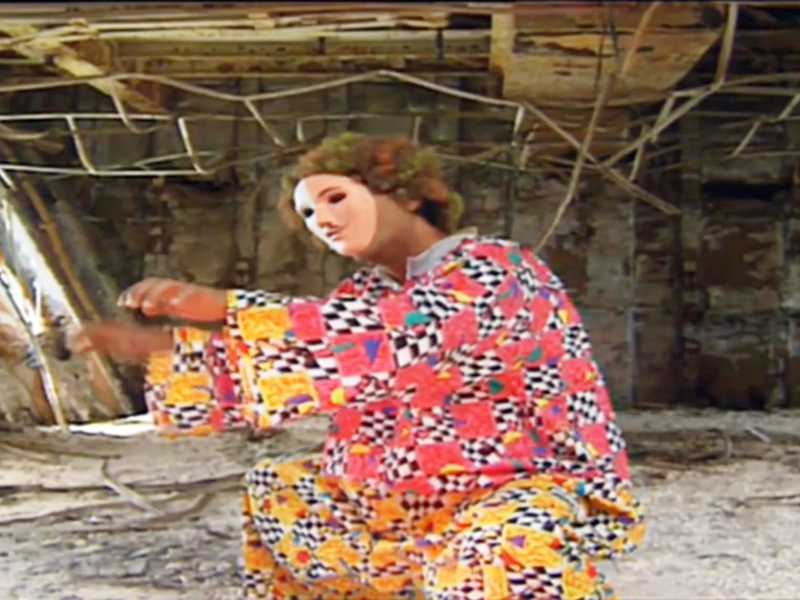
Nawaf Al-Rabie’ - In the devastated lobby of the Salam Hotel, Abdulaziz Al-Haddad, the director of the 1991 “Ramadan Contests” program, decided to be the guest of the final episode of his show, where he was interviewed by journalist Salwa Hussein. At the conclusion of the interview, Al-Haddad headed to his car, then returned wearing a clown costume, mask, and carrying a cassette player. The camera was still rolling, with Salwa Hussein standing in front of it, while Al-Haddad—without prior arrangement—began performing a segment of his silent show “The Clown”; the same performance he had presented five times to the coalition forces that participated in the liberation of Kuwait.
In 1991, immediately after the liberation of the State of Kuwait, journalist Salwa Hussein hosted several artists on her program “Ramadan Contests” at various sites damaged by the Iraqi invasion, with Al-Haddad, the program’s director, appearing as the guest of the final episode. He spoke about his observations during that period, as well as his ideas and projects he intended to implement after the catastrophe. During the conversation, he mentioned that he had performed silent theatrical acts for the coalition forces. The journalist, visibly astonished, asked him about the nature of this work.
The Birth of “The Clown”... A Performance Before Coalition Forces
Al-Haddad recounted that he wanted to offer something to the coalition forces as an expression of gratitude, so he conceived a short theatrical performance titled “The Clown”; a silent act committed to a universal human language—the language of the body and movement—without any other element that might hinder communication. There was no set, no stage lighting, not even a single word. All he needed to execute this performance was a cassette player broadcasting music, a clown costume, and a mask.
Al-Haddad’s choice of silence can be read as a decision that transcends the aesthetic dimension to reach a human and communicative one; the coalition forces that participated in the liberation of Kuwait included soldiers of various nationalities and languages. Faced with this linguistic diversity, words seemed limited in their impact, whereas the body, through its gestures and expressions, formed a shared human language that required no translation or intermediary. From this context, the performance emerged as an attempt to build a bridge of communication between a people who had just emerged from their ordeal and soldiers who had come from distant lands to share their moment of liberation.
Furthermore, the choice of the clown persona appears consistent with the symbolic weight associated with this character in theatrical tradition; that smiling face which hides profound pain, and which, in the context of occupation and liberation, acquires a denser meaning, as its smile carries fear, anguish, and fragility, just as it carries joy in the moment of victory.
Perhaps what gives this experience an additional dimension is that it does not appear disconnected from Al-Haddad’s own theatrical project. Observers of his career note that “The Clown” represents an extension of Al-Haddad’s first work in monodrama, specifically the performance “Strangeness of a Clown,” which he presented at the First Kuwaiti Theater Festival in 1989, one year before the catastrophe of the invasion. Here, a methodological question arises regarding the nature of the work: was “The Clown” a new performance, or a reworking of the monodrama “Strangeness of a Clown” in a different context? The answer to this question likely reveals how Al-Haddad worked on the clown persona as an expressive tool capable of reinterpretation, returning to it whenever he needed a language that transcended the boundaries of speech.
However, the answer confirms only that we are facing a distinctive artistic event, revealing a rare model of employing theater as a tool for gratitude and human communication at a pivotal historical moment, far from any commercial or ostentatious purpose. Al-Haddad did not later mention this experience among the prominent milestones of his career, nor did it receive the journalistic or critical attention it deserved. Moreover, I have not yet found any image documenting that moment; only Al-Haddad’s oral testimony in his television program remains.
Perhaps my writing about this event and its recollection is an attempt to rescue a small page from the history of Kuwaiti theater after liberation; a page from which only an oral testimony remains, yet one that reveals how theater— even in its harshest moments—could serve as a language of gratitude, a means of communication, and a memory for a nation that was writing a new victory.
