Ambassador Olivier Goffan to Al-Qabas: France will stand by Kuwait... and we are proud of our partnership
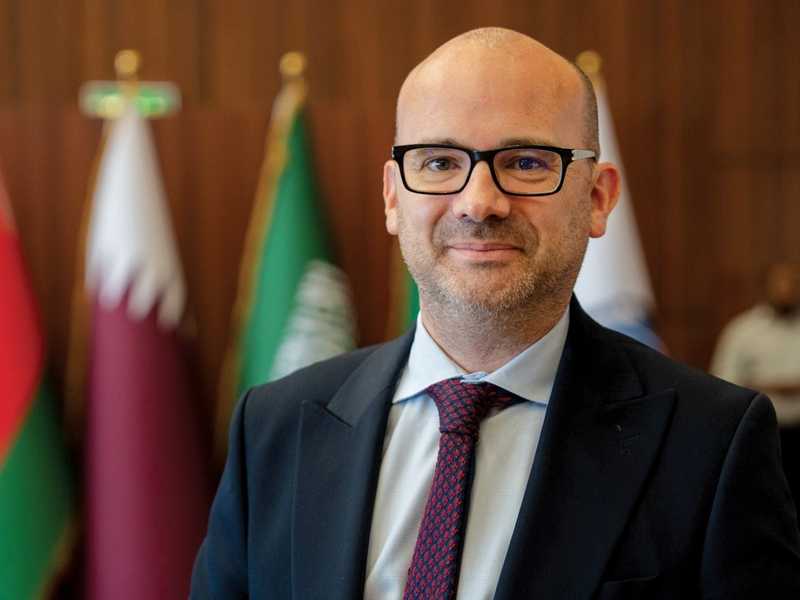
The French Ambassador to the country, Olivier Guévenoux, affirmed that the 36th anniversary of the Iraqi invasion of Kuwait serves as a reminder for France of the importance of the fundamental principles underpinning the international system, foremost among them being respect for the sovereignty, independence, and territorial integrity of states. He stressed that France will continue to take pride in its participation in the liberation of Kuwait, viewing it as a symbol of the strong friendship binding the two countries.
In a statement to Al-Qabas on the occasion of the 36th anniversary of the Iraqi invasion, Guévenoux praised the Kuwaiti people, who demonstrated “extraordinary courage, dignity, and resilience in the face of one of the most painful trials in their history.” He emphasized that France still holds vivid memories of that period and honors the memory of all victims.
He added that France was a key partner in the international coalition. From the outset of the crisis, it stood by Kuwait within the UN-mandated international coalition defending international legitimacy. Noting that France participated in “Operation Daguet” in 1991, he highlighted that more than 18,000 French soldiers contributed alongside Kuwaiti and coalition forces to liberate the State of Kuwait, a commitment that remains a source of pride for France and a symbol of the enduring friendship between the two nations.
Ambassador Guévenoux also commended Kuwait’s post-liberation trajectory, noting its remarkable progress in rebuilding national institutions, consolidating the rule of law, enhancing its defense capabilities, and maintaining security in a regional environment often marked by complexity. He pointed out that Kuwait has solidified its status as a respected nation on the international stage through its balanced diplomacy, humanitarian commitment, and active role in mediation. He affirmed that these achievements reflect the determination of Kuwaiti leadership and the Kuwaiti people’s confidence in their country’s future.
He viewed the invasion of Kuwait as a true turning point in the international system, illustrating starkly that any violation of a state’s sovereignty threatens international peace and security. It also demonstrated that, under the umbrella of the United Nations, the international community’s response proved that respect for international law is not merely a theoretical principle but a practical commitment, reinforcing the conviction that collective security rests on shared rules and state responsibilities to uphold and protect them.
The most important lesson Kuwait offered the world after the invasion, he said, was its ability to transform tragedy into an opportunity for reconstruction, modernization, and openness. Kuwait proved that national resilience, when grounded in popular unity, institutional legitimacy, and international support, can overcome even the most severe crises. It has become a model of dialogue, moderation, and humanitarian commitment—values that resonate today on the international stage.
Guévenoux emphasized Kuwait’s significant role in supporting and enhancing regional security. Drawing on its experience, Kuwait has become a recognized actor in pursuing regional stability, dialogue, and de-escalation. He noted that Kuwait prioritizes an approach based on consultation, mediation, and respect for international law, which is essential given the security challenges facing the region.
He affirmed that Franco-Kuwaiti relations are characterized by strength and depth, built on mutual trust consolidated over decades. The events of 1990 and 1991 contributed to strengthening ties between the two countries and affirmed their solidarity at critical moments. Today, bilateral cooperation spans numerous fields, including defense, security, economy, energy, culture, higher education, innovation, and scientific collaboration. Both countries look forward to further developing this relationship to serve the interests of their peoples.
Regarding security cooperation between Gulf states and their international partners, Guévenoux noted significant progress in recent decades, with more advanced cooperation mechanisms, whether military or in areas such as intelligence sharing, cybersecurity, counter-terrorism, and maritime security. However, he stressed that the nature of threats is evolving rapidly, making it imperative to continue enhancing coordination, improving interoperability among forces, and strengthening strategic dialogue between regional and international partners. He emphasized that security is a collective effort requiring continuous adaptation to changes.
He pointed out that the invasion of Kuwait brought about a radical shift in the security architecture of the Gulf region, highlighting the need to strengthen regional cooperation and build robust partnerships with active international stakeholders. Gulf states today possess more advanced defense capabilities and are increasingly investing in critical areas such as cybersecurity, protection of critical infrastructure, maritime security, and the capacity to confront hybrid threats.
