British Chargé d'Affaires Stuart Summers to Al-Qabas: Lessons of the Iraqi Invasion of Kuwait Still Shape Regional Security Equations
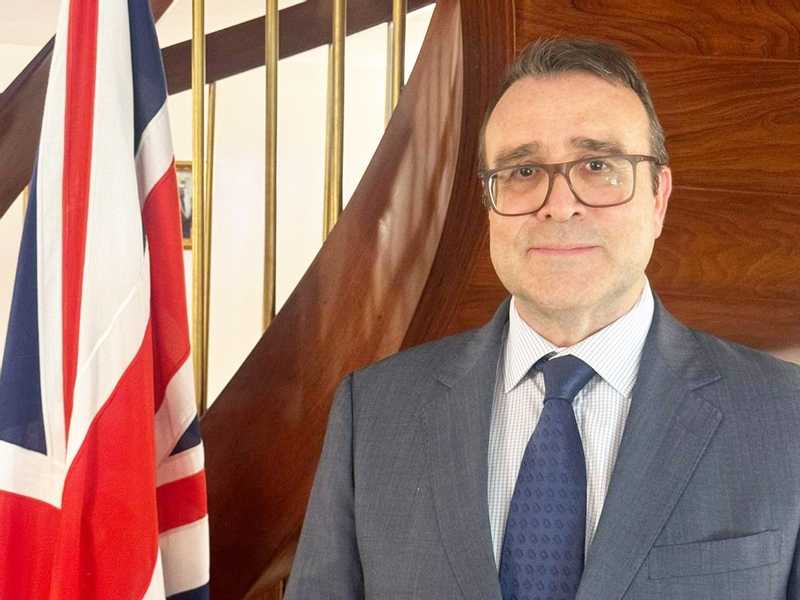
The British Chargé d’Affaires in Kuwait, Stuart Summers, affirmed that the United Kingdom stands by Kuwait’s side, just as it did during the Iraqi invasion in 1990. He emphasized that his country’s commitment to Kuwait’s
Translated by Qiyas from القبس — Original source
The British Chargé d’Affaires in Kuwait, Stuart Summers, affirmed that the United Kingdom stands by Kuwait’s side, just as it did during the Iraqi invasion in 1990. He emphasized that his country’s commitment to Kuwait’s security and stability is “firm and unshakable,” and that the defense partnership between the two nations continues to evolve to keep pace with changing security challenges in the region.
Speaking to Al-Qabas on the occasion of the 36th anniversary of the Iraqi invasion of Kuwait, Summers noted that the UK commemorates the suffering caused by the invasion and honors the courage, resilience, and unity of the Kuwaiti people. He stressed that the liberation of Kuwait remains a pivotal moment in the shared history of the two countries and a testament to international solidarity in defending state sovereignty and respecting international law.
Summers highlighted that the UK was proud to participate in the international coalition that supported the liberation of Kuwait and the restoration of its sovereignty and independence. He pointed out that more than 53,000 British military personnel took part in that mission, which stands as one of the largest British military deployments since the Second World War.
He added that, 36 years after liberation, the UK remains fully committed to supporting Kuwait’s security. He noted that amid regional tensions witnessed this year and attacks linked to the Iranian crisis, London has worked closely with Kuwait to enhance its security and defense capabilities. This cooperation includes the deployment of the Royal Air Force’s Rapid Sentry and ORCUS systems to counter drones, thereby strengthening Kuwait’s ability to detect and respond to emerging threats.
Summers reaffirmed that the UK stands by Kuwait today as a “trusted friend and partner,” just as it did in 1990 and 1991.
**Significant Achievements**
Summers noted that Kuwait has achieved significant milestones in state-building since liberation, successfully rebuilding and strengthening its institutions, developing its infrastructure, updating its defense capabilities, and consolidating its role as a state advocating for dialogue and stability in the region. He added that the experience of the invasion prompted Kuwait to invest in readiness, resilience, and collective security, contributing to the establishment of strong defense and security institutions that now work closely with international partners to address evolving threats and maintain regional stability.
He emphasized that the British-Kuwaiti defense partnership is a cornerstone of bilateral relations, noting that the British Military Mission has been present in Kuwait since 1992, continuing to support military training, enhance interoperability, and develop defense cooperation between the two countries. He explained that this partnership has evolved in recent years to align with the regional security environment, including the deployment of the Rapid Sentry and ORCUS systems, as well as specialized personnel to bolster Kuwait’s air defense and drone countermeasures capabilities during periods of tension.
Summers stated that the Iraqi invasion of Kuwait marked a turning point in the international system, as it proved that state sovereignty, territorial integrity, and respect for international law are not merely theoretical principles but the foundation upon which international peace and security rest. He said the international community demonstrated at the time that aggression is unacceptable and that states can unite to defend a rules-based international order, principles that remain highly relevant today.
He added that the world continues to face threats to state sovereignty, making the lessons from Kuwait’s liberation more important than ever: the necessity of resolving conflicts through diplomatic means, respecting state sovereignty, and adhering to international law.
In assessing Kuwait’s regional role, Summers said Kuwait has much to offer in supporting regional security. He noted that the events of 1990 reinforced the importance of diplomacy, international partnerships, and effective defense capabilities, establishing Kuwait as a widely respected state for its role in dialogue, de-escalation, and regional cooperation. He added that Kuwait has demonstrated a responsible and balanced approach during recent regional tensions linked to Iran, cooperating with regional and international partners to support stability while safeguarding its national interests.
**A Pioneering Role**
He praised Kuwait’s pioneering role in humanitarian action, emphasizing that its continuous commitment to mediation, humanitarian aid, and support for countries affected by conflicts has enhanced its status as a responsible and constructive regional actor. He added, “For the United Kingdom, Kuwait is a trusted and valuable security partner. Cooperation between our two countries covers defense, maritime security, air defense, military training, and support for regional stability. We commend the professionalism of the Kuwaiti Armed Forces, Kuwait’s commitment to humanitarian work, and its readiness to cooperate closely with international partners to enhance the security and stability of the Gulf region.”
Summers affirmed that UK-Kuwaiti relations are in excellent shape, describing them as one of the UK’s strongest partnerships in the region. He noted that these ties are built on more than 125 years of friendship, trust, and cooperation in defense, security, trade, investment, education, and culture, as well as close bonds between the two peoples. He explained that the experience of Kuwait’s liberation significantly strengthened these relations, and the trust forged during that period remains the cornerstone of the current partnership. He pointed out that, just as the UK stood by Kuwait during the invasion, it has also swiftly supported Kuwait’s security during the current regional crisis through defense cooperation and close coordination between the military and security institutions of both countries.
Summers emphasized that what distinguishes current relations is that they are not based solely on shared history but represent a modern partnership looking to the future, focused on supporting regional stability, enhancing security, and creating economic opportunities that benefit both countries.
**Security Coordination**
Regarding security coordination among Gulf states, Summers said security and defense cooperation between Gulf countries and their international partners has never been more critical, given the growing threats facing the region, including missiles, drones, cyberattacks, attacks on critical infrastructure, and maritime security threats. He added that recent tensions have highlighted the importance of close cooperation, noting that the UK’s response has included working with Gulf partners to enhance air and missile defense capabilities, support maritime security, and contribute to protecting freedom of navigation through the Strait of Hormuz. He stressed that these challenges transcend national borders and cannot be addressed by any single country alone, making regional and international cooperation an urgent necessity.
**Strong National Capabilities**
The British Chargé d’Affairs, Stuart Summers, affirmed that the Iraqi invasion of Kuwait underscored that security requires strong national capabilities, close regional cooperation, and sustainable international partnerships. He also emphasized that Gulf stability has global implications due to the region’s importance for international trade, energy supplies, and sea lanes. He noted that Gulf states have invested heavily since 1990 in updating their defense capabilities, becoming better prepared to face a wide range of threats, including missiles, drones, cyberattacks, and attacks on critical infrastructure.
**Developing Defense Capabilities**
Summers stated that the current crisis proves that developing defense capabilities is an ongoing process. He noted that the UK’s deployment of systems such as Rapid Sentry and ORCUS in Kuwait reflects the growing importance of integrated air defense and drone countermeasures in protecting national security and civilian infrastructure.
**Strong Partnerships**
Summers stressed that the lesson uniting the events of 1990 with the current reality is that strong partnerships, readiness, resilience, and respect for international law will remain the foundation of regional security. He reaffirmed the UK’s continued commitment to working alongside Kuwait and its Gulf partners to build a safer and more stable region.
